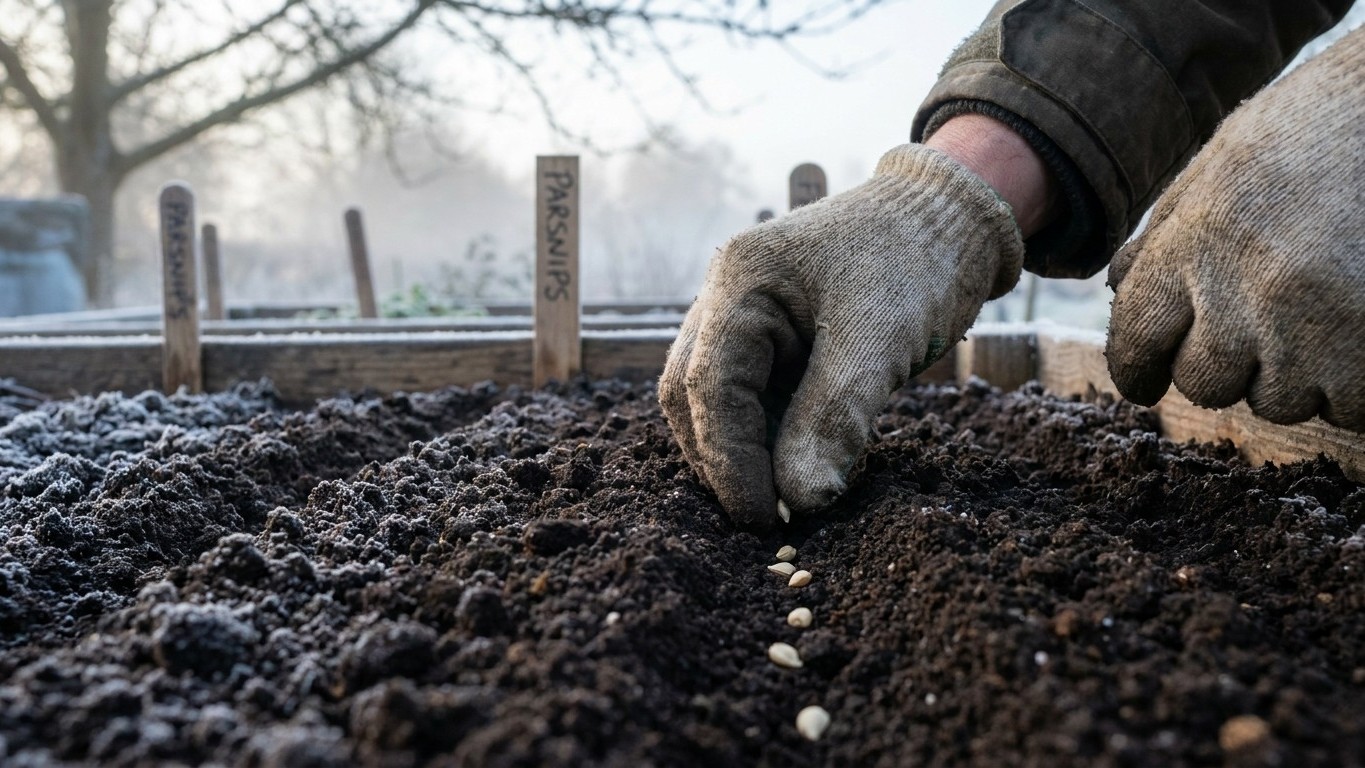

The short answer: not really. Nunavut’s growing season, bounded by an average last frost near June 19 and an average first frost around September 13, runs shorter than the 100 to 120 days parsnip roots need to reach harvest size. The cold itself isn’t the obstacle. Time is.
The short answer
Start with the number that matters most for flavor: the mean daily minimum in Rankin Inlet’s coldest month sits at -29.8°F, according to Environment and Climate Change Canada’s 1981-2010 climate normals. That’s a brutal figure, and it tells you this territory has no shortage of cold. Parsnips actually want a taste of that cold. Utah State University Extension notes that the roots convert stored starch to sugar only after several weeks of cool, frosty weather in the ground. So if a parsnip could survive to maturity here, the frost exposure to sweeten it would be more than sufficient.
The catch is getting there in the first place. Sweetening happens after the crop has already sized up, in the closing weeks before harvest, not during the depths of an Arctic winter. A root that’s still thin and immature when the ground locks up doesn’t get a second chance to sweeten next spring. It’s an annual root crop grown for a single season, not a plant that overwinters in the garden and finishes the job later. So the -29.8°F figure answers one question (yes, there’s real cold available for flavor development) while leaving the harder question open: does the growing season actually give a parsnip enough days to grow a root worth sweetening?
That’s where Nunavut runs into trouble. Between the average last spring frost and the average first fall frost, the window is short, even before accounting for the fact that these are averages, not guarantees. Environment and Climate Change Canada is explicit that these are mean dates: in one year out of two, frost arrives later in spring or earlier in fall than the average suggests. Treat June 19 and September 13 as the midpoint of a moving target, not a safe calendar entry.
Put plainly, a gardener in Nunavut is working with deep, reliable cold, more than enough to sweeten a mature parsnip, but a growing season that’s tight to nonexistent for getting a root to maturity in the first place. The soil-and-sun side of the equation, not the cold side, is what decides whether this crop succeeds here.
Does the season fit?
- Start with the crop’s requirement. Parsnips are sown directly in place, not transplanted, and need 100 to 120 days from seeding to reach harvestable size. Add to that a slow start: germination alone takes 14 to 21 days, meaning three weeks can pass before a single true leaf shows above the soil.
- Work out the recommended sowing date. The standard guidance is to sow 2 to 3 weeks before the average last spring frost. With that frost landing around June 19 in Rankin Inlet, sowing would fall somewhere around late May to the first days of June, assuming the ground has thawed and can be worked, which in itself is not guaranteed that early this far north.
- Count forward to the minimum harvest date. Add the minimum 100 days to an early-June sowing and the earliest possible harvest lands in mid-September, right around the average first fall frost of September 13. Add the full 120 days and harvest slides into early October, three weeks past that average frost date.
- Compare that to the actual frost-free window. From June 19 to September 13 is roughly 86 days, using Environment and Climate Change Canada’s averages for Rankin Inlet. That’s shorter than even the minimum 100-day requirement, before subtracting the 14 to 21 days the seed spends underground just germinating.
- Read the arithmetic honestly. The frost-free window falls short of the crop’s minimum need by roughly two to five weeks, depending on where in the 100-to-120-day range the roots land. This isn’t a tight fit that a careful gardener can nurse along with good timing. It’s a shortfall built into the climate.
None of this changes if a gardener pushes the sowing date earlier. Soil this far north often isn’t workable in mid-May, and forcing seed into cold, wet ground tends to rot it rather than speed it up. The math doesn’t bend much either way.
What goes wrong here
- Forked, stubby roots in heavy or stony ground. Parsnips send a single taproot straight down, and anything it meets, compacted clay, rocks, old root channels, splits it into two or three forked legs. Utah State University Extension recommends deep, sandy soil and says heavy ground needs to be double dug before sowing, loosened well past the depth the root is expected to reach.
- Forked roots from overwatering. This is a separate cause from soil texture, not the same problem in disguise. Consistently soggy soil encourages the root to branch rather than drive down cleanly, even in beds with decent structure. Even watering, not heavy or frequent watering, keeps the taproot growing straight.
- The season running out before the root sizes up. Given the arithmetic above, this is the most likely failure in Nunavut specifically. A root sown in early June may still be pencil-thin when the average first frost arrives in mid-September, and there’s no way to speed up a taproot’s growth by watering or feeding it harder. The only real lever is sowing as early as the soil allows and choosing the most sheltered, sun-exposed bed available.
- The ground freezing solid before harvest is possible. Unlike milder regions where a gardener can leave parsnips in the ground and dig as needed, deep cold here can lock the soil before roots finish sizing. A heavy mulch layer over the bed in early fall delays that freeze by insulating the soil, buying extra days to dig even if it doesn’t add growing time.
Common questions
Can parsnips be started indoors and transplanted to get around the short season?
No. Parsnips are sown directly in the garden because the taproot doesn’t tolerate transplanting well; disturbing it tends to produce the same forking and stunting that heavy soil causes. The 100 to 120 day count assumes seed sown in place, not seedlings moved outdoors.
Is the extreme cold in Nunavut a problem for parsnips themselves?
Not for the crop’s flavor. The mean minimum of -29.8°F in the coldest month, as recorded at Rankin Inlet, actually supplies more than enough frost exposure to sweeten a mature root. The problem is the growing season length, not the depth of winter cold.
What does it mean that the frost dates are averages?
Environment and Climate Change Canada’s June 19 and September 13 dates are mean dates drawn from the 1981-2010 normals, not guaranteed cutoffs. In roughly half of all years, the last spring frost falls later than June 19, or the first fall frost arrives earlier than September 13, shrinking the already tight window further.
Would sowing earlier than the recommended 2 to 3 weeks before last frost help?
It rarely does this far north. Parsnip seed germinates slowly, 14 to 21 days, and sitting in cold, still-thawing soil tends to rot seed rather than get a head start. The soil generally needs to be workable and warming before sowing makes practical sense.