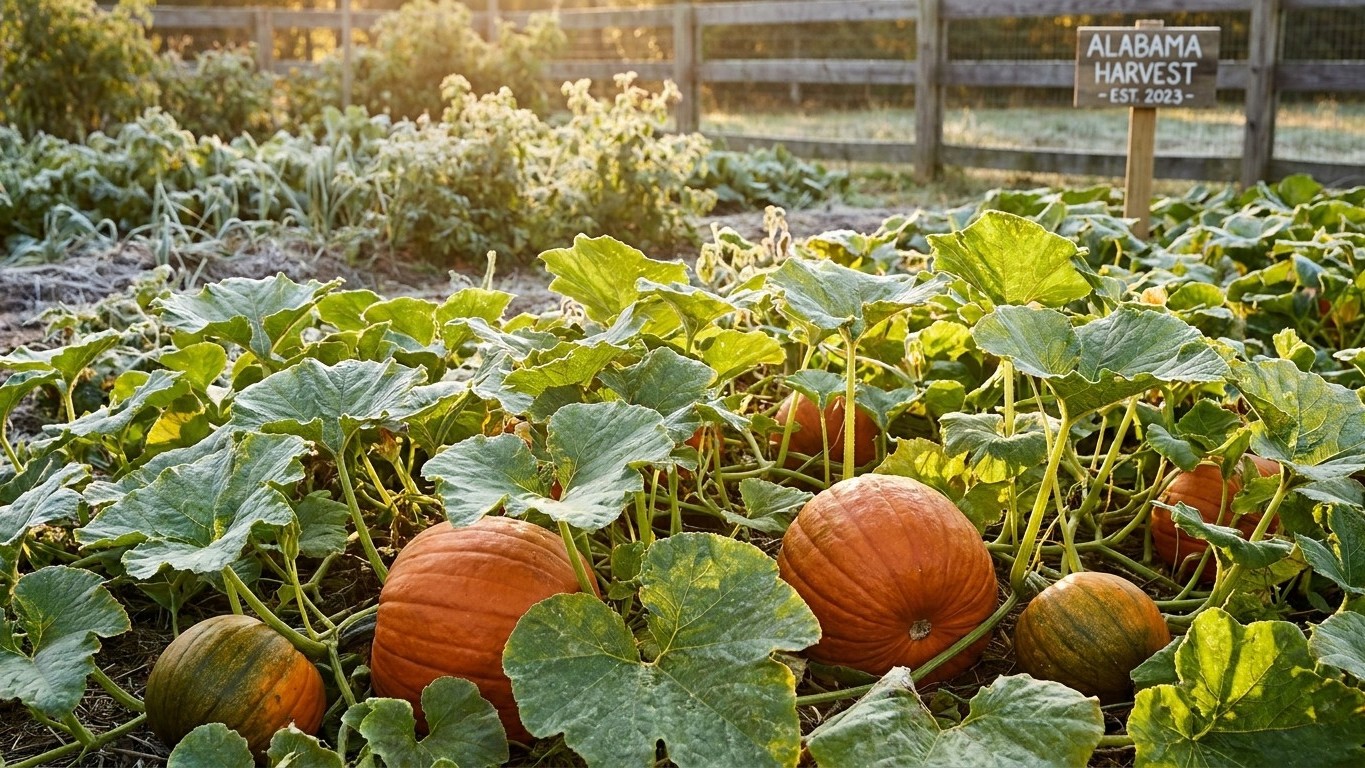

Nunavut’s frost-free stretch runs from a mean last spring frost on June 19 to a mean first fall frost on September 13, roughly 86 days if both dates land exactly on schedule. Pumpkins need 45 to 55 days after their flowers open, not from the seed going into the ground, to size up and harden off. Stack those two numbers against each other and the math gets tight fast, before you even account for how long it takes a seed to become a flowering vine.
The short answer
Start from the average first fall frost, September 13, and count backward. A flower needs 45 to 55 days after it opens to produce a pumpkin ready for harvest, so the latest a bloom can appear and still finish is somewhere between July 25 and July 30. That’s not a single deadline, it’s a window, because the 45-day and 55-day ends of the maturation range shift the cutoff by nearly a week on their own.
That window assumes the frost behaves like the average. It won’t always. The September 13 date is a mean pulled from Environment and Climate Change Canada’s 1981-2010 climate normals for the Rankin Inlet A station, which means in roughly half of all years frost arrives later than that, and in the other half it arrives earlier. Treat September 13 as the middle of a range, not a promise, and treat the July 25-30 flowering deadline the same way. A cold year could push the real cutoff into mid-July.
Here’s where the calculation gets harder rather than easier. The 45-to-55-day clock only starts once a flower opens, and nothing in the maturation figures published by Utah State University Extension says how many days a pumpkin vine needs to get from a planted seed to its first bloom. That earlier stage, seed to flower, isn’t covered by the source this page relies on, so no number for it appears here. What that means practically: even if a grower nails the July 25-30 flowering deadline on paper, the vine still has to reach flowering size well before that date, and Nunavut’s own soil-warming lag (covered next) eats into the time available to get there.
Put the two averages side by side and the honest picture is this: a grower working from mean dates has a frost-free season of about 86 days, needs a chunk of that just to get soil warm enough to plant, then needs the vine to flower with enough runway left for 45 to 55 more days before mid-September. There isn’t much slack built in, and in a below-average year there may be none at all.
When to sow here
The last spring frost date, June 19 on average, tells a grower when the air stops freezing. It does not tell them when the soil is warm enough to plant pumpkin seed. Pumpkins need soil at 65 F, and soil lags behind air temperature by weeks in a climate like Nunavut’s, where deep cold and short daylight keep ground temperatures low long after the air has cleared freezing. That lag is the single most misunderstood part of pumpkin timing here, because gardeners who plant on the frost date rather than the soil-temperature date routinely lose seed to cold, wet ground that never sprouts it.
- Mark the mean last spring frost, June 19, as the point when air stops freezing on average, not as a planting date.
- Track soil temperature separately rather than the calendar. Utah State University Extension sets the sowing threshold at 65 F soil, a number that has nothing to do with air temperature and typically arrives well after the frost has cleared.
- Consider row covers if soil is close to threshold but not quite there. Covers can buy about two weeks of warming time, which in a season this short can be the difference between a viable planting date and none at all.
- Recheck against the flowering deadline. Once a sowing date is set, compare it to the July 25-30 flowering cutoff calculated above. If the gap between sowing and that deadline looks too short for a vine to grow, root, and bloom, the planting date needs to move earlier, which usually means leaning harder on row covers or a cold frame rather than waiting on the open ground to warm naturally.
- Build in a buffer for the fact that soil-warming lag isn’t published as a fixed number of weeks for this territory. Treat any planting date as an estimate and watch the actual soil, not the calendar, before committing seed to the ground.
What goes wrong here
Nunavut’s compressed season produces a handful of predictable failures, each traceable back to the same gap between how long a pumpkin needs and how long the ground gives it.
- A late flower that never colors. If a bloom opens after the July 25-30 cutoff, the fruit behind it may still be small and pale-green when frost hits, because it never got its full 45 to 55 days. The remedy is to force earlier flowering by starting seed under cover or using row covers at planting to push the sowing date forward, buying the vine roughly two weeks it wouldn’t otherwise have.
- A fruit caught by frost before the stem hardens. Utah State University Extension is specific that harvest should happen with the stem attached, before frost reaches the fruit. In a season this tight, a single early cold snap ahead of the September 13 average can catch pumpkins that were on track to finish. Watching the forecast in early September, rather than trusting the mean date, and harvesting slightly early rather than risking a freeze, protects the crop even if the pumpkin isn’t fully colored.
- A vine that dies back before the skin hardens. Cold snaps kill foliage before they kill the fruit outright, and a vine stripped of leaves can’t finish hardening a pumpkin’s rind even if the fruit itself survives another week or two. Cold frames or cloches placed over individual fruits once the vine shows stress can extend ripening time without needing the whole plant to stay alive.
- Choosing a variety with no margin built in. Names like Small Sugar, Jack Be Little, Connecticut Field, Baby Pam, New England Pie, Casper, Cinderella, Autumn Gold, and Spirit turn up often in seed catalogs, but no maturity figures for them appear in the source this page relies on. Picking blind, without knowing a variety’s actual days-to-maturity from a seed packet or supplier, adds risk in a climate with almost no room for it.
Insect pressure adds another layer of risk once a vine is already running behind schedule. Squash bugs and cucumber beetles both slow plant growth at exactly the wrong moment in a short season; growers dealing with either should check this site’s dedicated pages on squash bugs in Nunavut and cucumber beetles in Nunavut for territory-specific detail rather than treating them as a side issue here.
Common questions
Can pumpkins ripen at all in Nunavut in an average year?
It’s tight. Working backward from the mean September 13 frost, flowers need to open by roughly July 25-30 to get their full 45 to 55 days. Given that soil has to reach 65 F before sowing, and that soil lags weeks behind the mean June 19 air-frost date, the margin left for a seed to grow into a flowering vine by late July is thin in a typical year and can vanish entirely in a colder one.
Is the June 19 last-frost date safe to plant by?
No. It’s a mean from Environment and Climate Change Canada’s 1981-2010 normals for the Rankin Inlet A station, meaning frost falls later than June 19 in about half of all years. Planting the moment that date passes ignores both the frost risk and the separate, later soil-temperature threshold pumpkins actually need.
Do row covers really add two weeks?
Row covers can bring soil and air temperature up faster than open ground warms on its own, effectively shifting a planting date roughly two weeks earlier than it would otherwise be possible. In a season with as little slack as Nunavut’s, that gain can be the difference between reaching the flowering deadline or missing it.
What should happen to a pumpkin that’s still green when frost threatens?
Harvest it with the stem attached before the frost reaches it, per Utah State University Extension’s guidance, and store it somewhere it will not freeze. The source doesn’t publish a storage temperature, humidity level, or keeping time beyond that basic frost-avoidance instruction, so growers should not assume a specific shelf life for fruit harvested underripe.