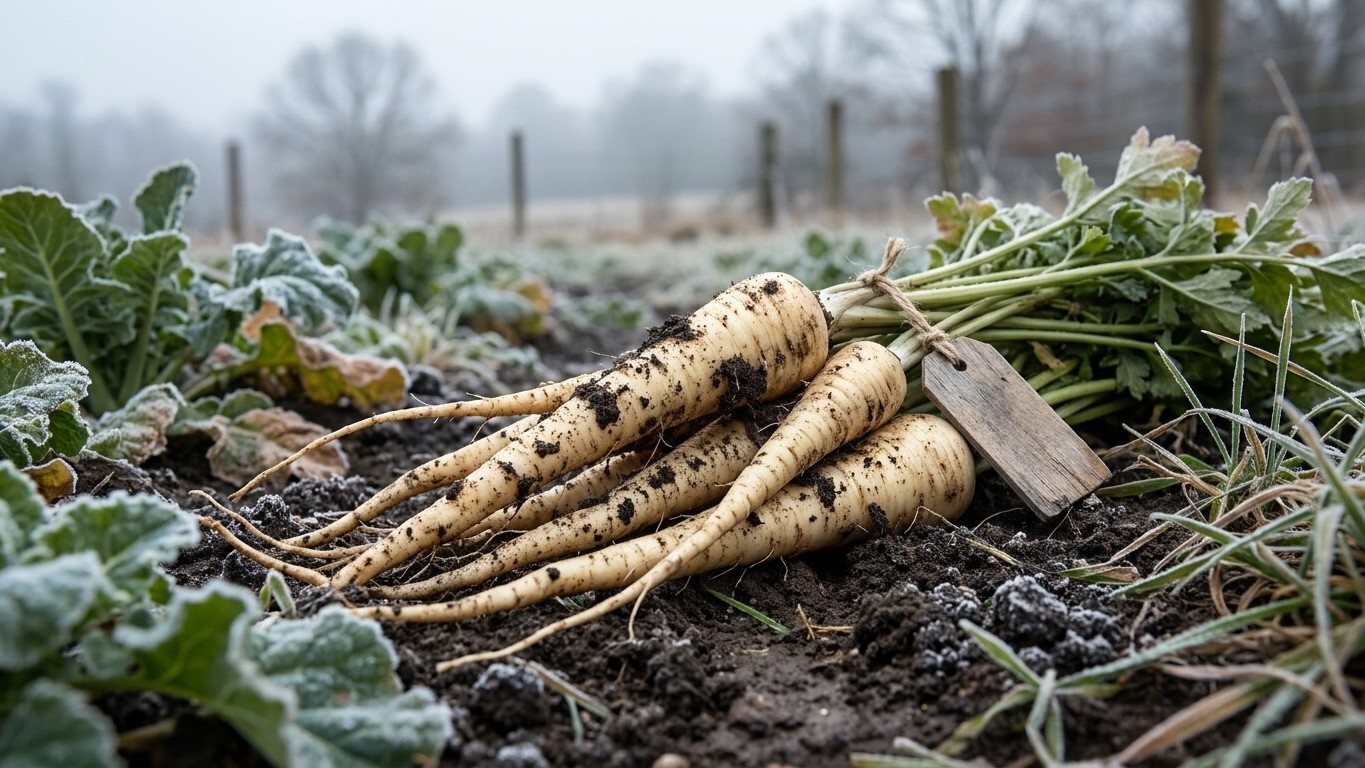

Yes, but modestly. West of the Cascades, in the Willamette Valley climate that Portland represents, parsnips left in the ground do get exposed to frost, and that conversion of starch to sugar does happen. The catch is how mild that exposure runs: the coldest month here averages a minimum of just 36.2°F, only a few degrees above freezing, so the “several weeks of frosty weather” a parsnip wants shows up as frequent light chill rather than a hard, sustained freeze.
The short answer
Start with the number that actually decides this, not the zone map. NOAA’s 1991-2020 Climate Normals for the Portland reference station put the mean daily minimum for the coldest month at 36.2°F. That’s a mean, meaning plenty of nights sit right around it, some colder, some milder, but the average never drops meaningfully below freezing across the whole month.
That figure matters because sweetening isn’t triggered by a single hard frost. It comes from an extended run of cold nights working on the root while it’s still in the ground, breaking down stored starch into sugar over time. A mean minimum of 36.2°F tells you the coldest stretch of a typical Portland-area winter hovers just above that threshold, with individual nights dipping below 32°F often enough to matter, but not with the depth or consistency you’d get in a continental climate where the coldest month averages well into the 20s.
So will a parsnip sweeten here? It will get some sweetening, because frost does arrive and does linger into the cooler months. But it won’t be the dramatic, deeply sweet parsnip you’d pull from a garden where the coldest month’s average minimum sits ten or fifteen degrees lower. Think of it less as an on-off switch and more as a dimmer: the Willamette Valley’s maritime winter turns the sweetness up, but not all the way.
This is a different question than hardiness zone, and it’s worth separating the two clearly. A hardiness zone tells you the average annual extreme minimum temperature, useful for deciding whether a perennial survives winter. It says nothing about how many cold nights a root vegetable sits through in autumn and early winter, which is the actual mechanism behind parsnip flavor. Two locations can share a hardiness zone and have very different frost-exposure patterns, one with long, repeated freezes and one with brief, mild dips like Portland’s. For parsnips, the frost data is the number that counts.
Gardeners east of the Cascades, in the high desert parts of the state, are working with a completely different pattern. Colder winters there mean more reliable, deeper frost exposure, which generally makes for a sweeter parsnip, though it also comes with a shorter growing season to work around, covered next.
Does the season fit?
Parsnips are direct-seeded, not transplanted, and the clock starts the day seed goes into the ground. Utah State University Extension puts the full run at 100 to 120 days from seeding to maturity, with sowing recommended 2 to 3 weeks before the last expected spring frost. Lay that timeline over Portland’s frost data and here’s how the arithmetic works out.
- Last spring frost: the NOAA Climate Normals for this reference station put the 30-70% probability window for a 32°F freeze between March 6 and March 21. That’s the marker for figuring out when it’s safe to sow.
- Sowing date: counting back 2 to 3 weeks from that window lands sowing somewhere in mid-to-late February, occasionally slipping into early March depending on how the season is running.
- Germination: parsnip seed is slow, taking 14 to 21 days to come up. That’s easy to forget when the soil still looks bare after a week or two. Resist the urge to re-sow; give it the full three weeks before assuming failure.
- Maturity window: add the full 100 to 120 days from the seeding date, and roots reach full size somewhere between late May and mid-July, well ahead of any fall cold.
- First fall frost: the same NOAA dataset puts the first 32°F freeze between November 11 and November 27, which is when the sweetening clock actually starts, since roots are typically left in the ground through the cool season rather than pulled the moment they size up.
- Gap between maturity and frost: that leaves roughly four to five months of roots sitting mature in the soil before the first meaningful cold arrives, and then several more weeks of frosty nights through November and beyond before digging.
That’s a comfortable fit, not a tight one. The season here gives plenty of buffer on both ends, plenty of time to germinate slowly, plenty of time to size up, and a long stretch of cool weather afterward for the sugar conversion to work. The caveat: this whole window applies to the Willamette Valley and similar areas west of the Cascades. Central and eastern Oregon sit in high desert conditions with a noticeably shorter frost-free season, and gardeners there need to check local frost dates rather than borrow this Portland-based window.
What goes wrong here
- Forked roots from heavy or stony ground. Parsnips push a long taproot straight down, and anything that gets in the way, compacted clay, rocks, old root channels, splits it into forks. Utah State University Extension recommends deep sandy soil for parsnips and, where that’s not available, double digging heavy ground to at least a foot before sowing so the root has a clear, loose path downward.
- Forked roots from overwatering. This is a separate cause from soil texture, not a variation on it. Inconsistent or excessive watering encourages the root to branch as it searches for moisture unevenly, even in soil that’s otherwise loose enough. Even, moderate watering through the growing season keeps the taproot growing straight rather than splitting.
- A season that runs out before frost does its work. This isn’t the typical Willamette Valley problem, given the generous gap between maturity and first frost, but a late sowing (pushed past early March, say by a wet spring that delays working the soil) can compress that buffer. Sowing as close to the recommended 2-to-3-week-before-last-frost window as ground conditions allow protects the margin.
- A winter too mild to sweeten fully. With the coldest month averaging a minimum of 36.2°F, some winters here simply don’t deliver enough sustained frost for a dramatic sweetness. There’s no fix for this beyond patience: leaving roots in the ground through as much of the cold season as practical, rather than digging early, maximizes whatever frost exposure the winter does provide.
Common questions
Can I sow parsnips earlier to dodge the mild-winter sweetening problem?
Sowing earlier changes when the root matures, not how cold the winter gets. The sweetening depends on frost exposure after the root has sized up, so an earlier sowing just means a longer wait in the ground before the cool weather arrives, not a sweeter result.
How do I know when parsnips are ready to dig?
Utah State University Extension’s guidance centers on the 100-to-120-day maturity window from seeding, combined with waiting through frosty weather for flavor. In this climate, that generally means roots reach size by early-to-mid summer and are best left in place through at least the first frost, and ideally longer, before harvesting.
Does mulching the bed change the sweetening outcome?
The source material doesn’t address mulch specifically. What it does establish is that the sweetening mechanism depends on the root’s actual exposure to cold, so any practice that insulates the soil and blocks that cold contact would work against the flavor development described here.
Is Portland’s frost data representative of the whole state?
No. The frost windows and coldest-month figure cited here come from a Portland-area reference station and describe the Willamette Valley’s maritime pattern. Central and eastern Oregon’s high desert climate runs colder in winter and has a shorter frost-free season, so gardeners there should look up their own local frost normals rather than apply these dates.