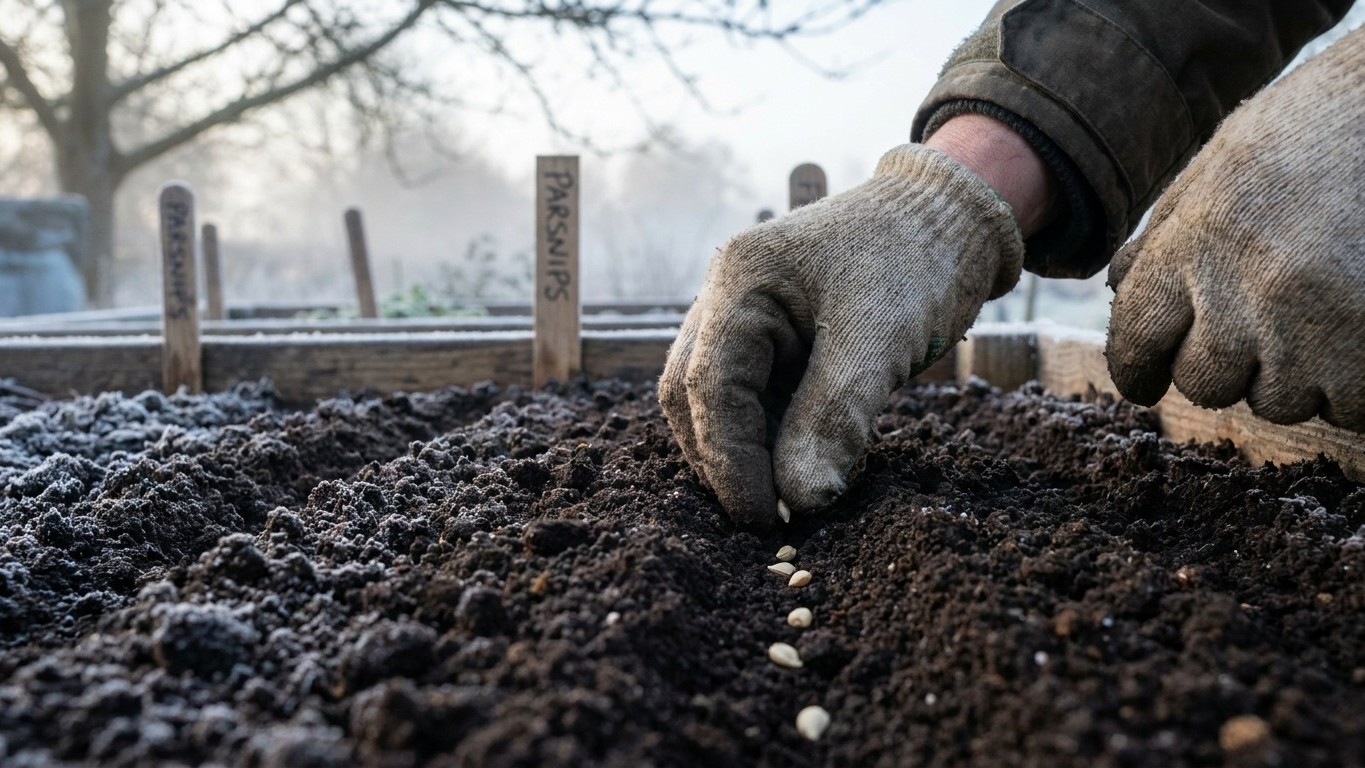

Pennsylvania parsnip growers get a straightforward answer: sow in place two to three weeks before the last spring frost, typically mid-to-late March around Philadelphia and into April farther north, and plan on a fall or early-winter harvest after several hard frosts have swept the garden. The state’s cold winters do the sweetening work naturally, so timing here is more about patience with slow germination than about racing a short season.
The short answer
Frost exposure, not the hardiness zone printed on a seed packet, is what decides whether a Pennsylvania parsnip turns sweet or just sits in the ground tasting like a bland carrot. The number that matters is the mean minimum temperature of the coldest month, and for the Philadelphia reference station that figure is 26.0 degrees Fahrenheit, according to NOAA NCEI Climate Normals for 1991-2020. That is not a record low or a casual average. It is what a typical night looks like during the coldest stretch of a Pennsylvania winter, and it sits comfortably below freezing.
A mean minimum of 26 degrees means hard frost is not a rare event here. It is routine, repeated, and long-lasting across weeks, not days. That matters because parsnip roots convert stored starch into sugar only after sustained exposure to cold, according to Utah State University Extension. A single light frost does nothing. Several frosty weeks do everything.
Why Philadelphia is the floor, not the ceiling
Philadelphia sits in the mildest corner of Pennsylvania. Every other part of the state, from the Alleghenies to the northern tier, runs colder and holds onto winter longer. If 26 degrees is the average nightly low in the state’s warmest pocket, gardeners in the Poconos, the Laurel Highlands, or anywhere near the New York border can expect winters that deliver frost exposure with room to spare. That is good news for parsnip flavor. It means the crop’s sweetening requirement, several consecutive weeks of freezing or near-freezing nights, is met almost everywhere in the state, not just in favored microclimates.
So the plain answer is yes: Pennsylvania parsnips will sweeten, not merely grow. The climate does the heavy lifting. The gardener’s job is getting the timing of sowing and harvest right so the roots are still in the ground when that cold arrives.
Does the season fit?
Parsnips need 100 to 120 days from seeding to maturity, and that clock starts the day seed goes into the soil, not the day it germinates, according to Utah State University Extension. Pennsylvania’s frost calendar gives that timeline plenty of room, but the arithmetic is worth walking through so nothing gets rushed.
- Find your local last frost date. Around Philadelphia, NOAA NCEI’s 1991-2020 normals put the last spring frost between March 29 and April 6. Farther north and at higher elevation, that date typically slides two to four weeks later.
- Sow two to three weeks before that date. For the Philadelphia area, that lands seed in the ground roughly mid-to-late March. In the colder counties, expect early-to-mid April instead.
- Wait out germination. Parsnip seed is famously slow, taking 14 to 21 days to sprout, according to Utah State University Extension. Nothing visible happens for two or three weeks. Resist the urge to dig up what looks like bare dirt and re-sow.
- Count 100 to 120 days from the sowing date, not from sprouting. A mid-March sowing reaches maturity somewhere around late June to mid-July. A mid-April sowing in colder counties lands closer to early-to-mid August.
- Compare that maturity date against the first fall frost. Philadelphia’s first fall frost, per the same NOAA NCEI normals, falls between November 5 and November 16. That leaves the roots sitting mature in the ground for three to four months before frost even arrives, plenty of time to hold them there through the cold once it does.
The season fits comfortably almost anywhere in Pennsylvania. Even in the colder counties, where both the last spring frost and the sowing date shift later, the 100-to-120-day window still closes well before the ground freezes solid. There is no version of a Pennsylvania growing season where parsnips run out of time, which is not something every root crop in this state can claim. NOAA does not publish a separate fall frost figure for the northern tier and the Alleghenies, but given that Philadelphia represents the state’s mildest reference point, gardeners in colder regions should expect frost to settle in earlier than the Philadelphia dates suggest, not later, and should plan harvest timing with that in mind rather than assuming an identical calendar.
What goes wrong here
- Forked roots from heavy or stony ground. A lot of Pennsylvania soil, especially in the Piedmont and the ridge-and-valley regions, runs clay-heavy or rocky. Parsnip taproots hit resistance and split rather than growing straight. Utah State University Extension recommends deep sandy soil for this crop, and where the native ground isn’t sandy, double digging to loosen and de-stone the bed at least a foot down before sowing.
- Forked roots from overwatering. This is a separate cause from soil texture, and it happens even in well-prepared beds. Inconsistent or excessive watering encourages the taproot to branch as it searches for a steady moisture level instead of driving straight down. Even, moderate watering through the season, not heavy soaking followed by dry stretches, keeps the root growing in one direction.
- A season that runs out because sowing got delayed. Waiting until after the last frost to sow, or pushing sowing into May “to be safe,” eats into the 100-to-120-day window and can leave roots immature when the ground starts to freeze in the colder counties. Sowing two to three weeks before the local last frost date, as calculated above, is the buffer that keeps this from happening.
- A winter too mild to sweeten. This is the least likely failure in Pennsylvania given a 26-degree coldest-month minimum even in the mildest corner of the state, but it can still happen in unusually warm winters or in sheltered urban microclimates near Philadelphia. The remedy is patience: leave roots in the ground through several hard frosts rather than harvesting at the first light frost, since one cold night does not deliver the sugar conversion that weeks of sustained cold do.
Common questions
Can parsnips survive a Pennsylvania winter left in the ground?
Yes. Given a coldest-month mean minimum of 26 degrees Fahrenheit at the Philadelphia reference station, and colder conditions across most of the rest of the state, parsnip roots left in place through winter are exposed to exactly the sustained frost that converts their starch to sugar. Many gardeners harvest through winter as needed rather than pulling the whole crop at once.
Should I start parsnip seeds indoors before transplanting them in Pennsylvania?
No. Parsnips are sown directly in place. Utah State University Extension does not describe a transplant method for this crop, and the long taproot does not tolerate the disturbance of transplanting well. Sow the seed where the mature root will grow.
Why haven’t my parsnip seeds sprouted after a week?
That is normal. Germination takes 14 to 21 days, according to Utah State University Extension. A week of bare soil is not a failed sowing; it is the expected wait.
Do I need to mulch parsnips over a Pennsylvania winter?
The sourced information here does not address mulching directly, so no specific recommendation is published for this page. What is established is that the roots need sustained frost exposure to sweeten, so any winter protection strategy should still allow the cold to reach the soil rather than sealing it off entirely.