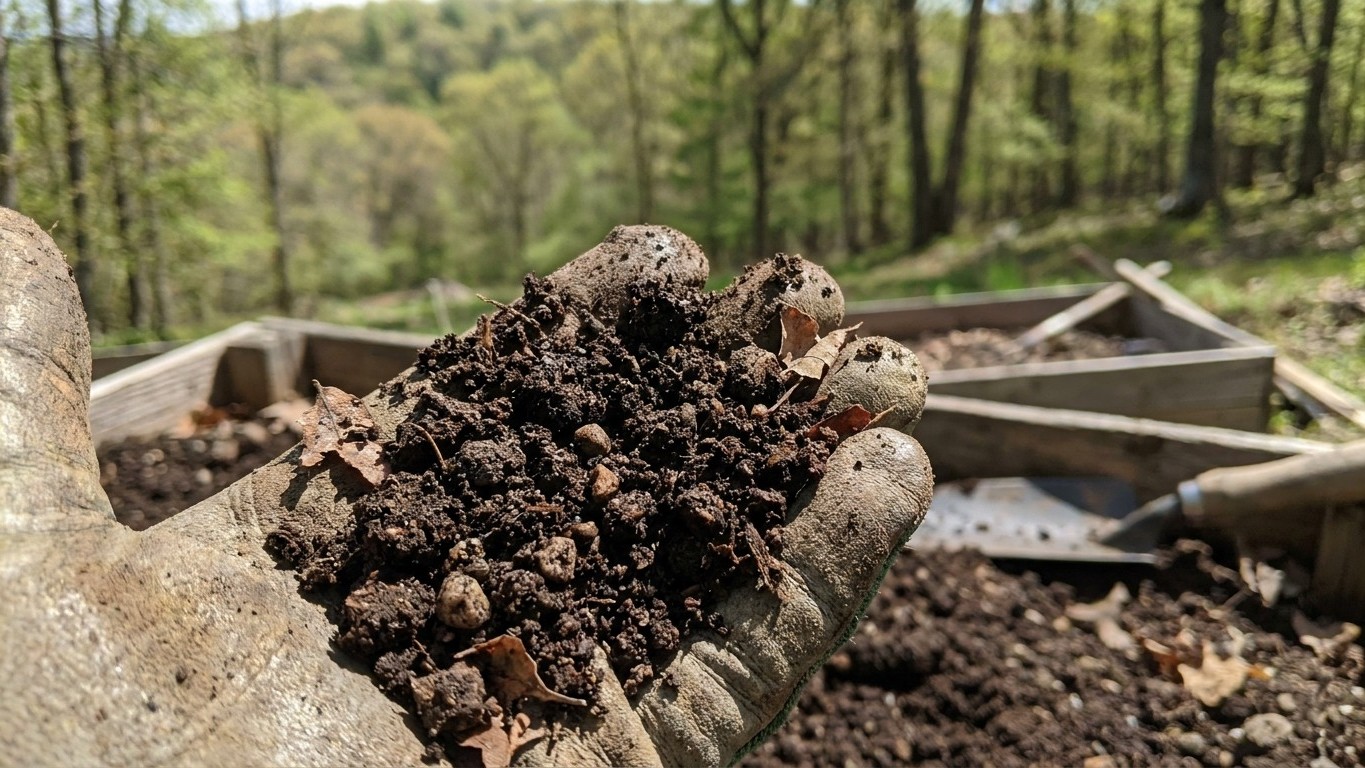

Pennsylvania’s official state soil, the Hazleton series, is a strongly acid, well-drained loam that blankets ridges and forested slopes across much of the state. It’s a young soil, an Inceptisol that hasn’t had time to build the deep, layered horizons older soils show. Knowing its baseline numbers gives you something real to compare your own dirt against, instead of guessing at amendments that might do nothing, or worse, work against you.
What is under your garden

The USDA lists the Hazleton series as representative of Pennsylvania, and the figures behind that label are specific, not rounded, not softened into a range. Hazleton is an Inceptisol, a soil order defined by its youth: it hasn’t developed the strong, distinct layers that mature soils accumulate over thousands of years. Its surface horizon runs strongly acid, about pH 4.6. The texture falls into loam-to-silt territory, built from 46 percent sand, 12 percent clay and 42 percent silt. Organic matter sits around 3.0 percent, and the drainage class is well drained. Those numbers come from USDA NRCS Soil Data Access, averaged across 389 mapped components of the series statewide.
| Surface pH | about 4.6 (strongly acid) |
| Sand | 46 percent |
| Silt | 42 percent |
| Clay | 12 percent |
| Organic matter | about 3.0 percent |
Here’s the honest catch. Hazleton is the soil chosen to represent Pennsylvania on a map, not a measurement of what’s under your tomato bed. A state this size holds hundreds of distinct soil series. River bottoms in Lancaster County, limestone valleys in the Cumberland Valley, and any lot a builder scraped and refilled during construction will look nothing like Hazleton. If your yard was graded for a subdivision in the last thirty years, the topsoil you’re standing on may have been trucked in from somewhere else entirely, or stripped down to subsoil and never replaced properly.
Read your own soil in five minutes
You can get a rough read on texture without sending anything to a lab. Grab a pinch of moist soil, roll it between your thumb and forefinger, and try to form a ribbon. Soil that won’t hold together at all is sandy. A ribbon that forms but breaks after an inch or two suggests loam, the kind Hazleton represents. A ribbon that stretches two inches or more without cracking points to heavy clay.
The jar test tells you more. Fill a clear glass jar about a third full of soil, top it with water, shake hard for a minute, then let it sit overnight. Sand settles first and forms the bottom layer within a minute. Silt follows over the next hour. Clay stays suspended longest and settles last, often leaving the water still cloudy after several hours. The relative thickness of each layer the next morning gives you a rough percentage breakdown you can compare against the Hazleton numbers above.
Testing before you amend
Guessing at pH or nutrients wastes money twice: once on the wrong amendment, and again when you have to correct the correction. A soil test tells you things your eyes simply cannot, like whether your phosphorus is already high enough that another bag of fertilizer is pouring money into ground that doesn’t need it.
Given that Hazleton runs strongly acid at pH 4.6, you can reasonably expect acidic soil if you’re gardening on forested ridge ground in the northern or central parts of the state. But expecting is not the same as knowing. Limestone-derived soils in valleys like the Cumberland or Lebanon Valley run alkaline, sometimes well above pH 7.3, and no amount of assuming will catch that difference. Only a test will.
Taking a sample correctly matters as much as sending it in. Follow these steps standing in the garden with a trowel:
- Pick 8 to 10 spots scattered across the bed, avoiding edges, low spots that flood, and anywhere you’ve dumped ashes or lime before.
- Dig a small core at each spot, going down 6 to 8 inches for vegetable beds and lawns, since that’s the depth most roots actually work.
- Combine all the cores in a clean plastic bucket and mix them thoroughly by hand.
- Let the mixed sample air dry for a day if it’s wet, then scoop about two cups into the test bag or box.
- Label it with the bed location and the crop you plan to grow there, since recommendations differ between vegetables, lawn and ornamentals.
When results come back, focus on three numbers: pH, phosphorus and potassium. The lab report usually flags each as low, adequate or high, which tells you exactly what to add and, just as often, what to skip.
Amending it
Pennsylvania’s representative soil sits at pH 4.6, well below the 5.5 threshold where lime becomes the obvious lever. If your own test comes back in that acid range, sulphur is the wrong tool entirely, since it pushes pH down further when you need it to climb. Acid ground like this locks up phosphorus, making it unavailable to roots even when soil tests show plenty is present, and it hits brassicas particularly hard, since cabbage, broccoli and their relatives struggle with the clubroot disease that acidic soil favors.
Lime for acid ground
Ground limestone raises pH slowly. Expect the reaction to unfold over one to two growing seasons, not weeks, since lime has to dissolve and react with soil particles before it changes anything. Apply it in fall so winter freeze-thaw cycles help work it into the root zone before spring planting. Retest after a year rather than assuming one application solved the problem permanently.
Sulphur only if your test comes back alkaline
If your own soil test shows pH above roughly 7.3, which happens in Pennsylvania’s limestone valleys despite the statewide Hazleton baseline running acid, lime must never go on that ground. Elemental sulphur, worked in gradually along with organic matter, is the slow honest route down. At high pH, iron becomes chemically locked out of reach for plant roots, and that’s exactly what yellow leaves with distinctly green veins are telling you, a classic symptom of iron chlorosis on alkaline ground.
Organic matter for clay-leaning or sandy ground
Hazleton’s own texture, 12 percent clay against 46 percent sand, sits in comfortable loam territory, but plenty of Pennsylvania yards lean harder one way or the other. On heavier clay, work in compost or aged manure, and resist the old advice to add sand to clay, since that combination tends toward something closer to concrete than better drainage. Never work clay while it’s wet; you’ll compact it into clods that take a season to break down. On sandy ground, organic matter helps hold both water and nutrients that would otherwise wash straight through, but expect to water more often in shorter sessions rather than less often in long soaks, since sandy soil simply won’t hold a deep soak the way loam does.
Texture fixes take longer than pH fixes. A lime application shows measurable change within a year. Rebuilding structure in heavy clay or thin sand through organic matter typically takes three seasons of consistent additions before the soil behaves noticeably differently.
Drainage and compaction
The Hazleton series carries a well drained classification, meaning water moves through it without pooling for long after a normal rain. If your own yard holds standing water for more than a day after a storm, you’re not gardening on anything resembling the state’s representative soil, and that distinction matters more than the pH number.
A simple percolation test settles the question. Dig a hole about a foot deep and a foot wide, fill it completely with water, and let it drain once to saturate the surrounding soil. Fill it a second time and time how long it takes the water level to drop one inch. A drop of one to three inches per hour is typical, workable garden drainage. Faster than that and the ground drains almost too quickly, needing more frequent watering. Slower than half an inch per hour signals poor drainage that will drown roots in wet years.
Compaction compounds bad drainage fast. Foot traffic, riding mowers and parked equipment press soil particles together, squeezing out the air pockets roots and water both need. Double digging, once the standard fix, has fallen out of favor because it disturbs soil biology and often creates a new compacted layer just below where the shovel stopped. Consequences of poor drainage or heavy compaction show up in predictable ways:
- Avoid working or walking on wet clay soil, since that’s when compaction does the most damage.
- Route foot traffic and equipment onto fixed paths instead of across planting beds.
- Skip deep-rooted vegetables like carrots and parsnips on ground that drains slower than half an inch per hour; grow them elsewhere or in containers instead.
On ground that fails the percolation test badly, or on a lot where builders compacted the subsoil during construction, a raised bed is the honest answer. Three years of amending poorly drained clay might improve it somewhat; a raised bed filled with decent topsoil solves the problem the first season.
Local help
Penn State Extension runs soil testing through its Agricultural Analytical Services Laboratory, and county extension offices help interpret the results alongside the gardener who submitted them. Testing is inexpensive relative to the cost of guessing wrong on lime or fertilizer. Find your county office and submission instructions through Penn State Extension.
Common questions
Is all Pennsylvania soil acidic like the Hazleton series?
No. Hazleton represents the state on USDA maps, but limestone valleys in areas like the Cumberland and Lebanon Valleys run alkaline, sometimes well above pH 7.3. Only a soil test tells you which side of that line your own yard falls on.
How often should I retest my soil?
Every two to three years for an established garden, or annually while you’re actively correcting a pH problem with lime or sulphur, since both amendments react slowly and you’ll want to track progress rather than assume it happened.
Can I fix heavy clay by mixing in sand?
Don’t. Adding sand to clay without enough organic matter tends to create a dense, cement-like mixture rather than looser soil. Compost and other organic matter, added consistently over seasons, is the proven route to better clay structure.
Why do my plants show yellow leaves with green veins even though I fertilize regularly?
That pattern usually points to iron chlorosis, which shows up when soil pH climbs too high for roots to access iron that’s chemically present but locked out of reach. It’s a pH problem, not a fertilizer problem, and a soil test will confirm it before you spend more on iron supplements that won’t work until the pH comes down.
Related guides
- New York Soil: What You Are Digging Into, and How to Improve It
- New Jersey Soil: What You Are Digging Into, and How to Improve It
- Rhode Island Soil: What You Are Digging Into, and How to Improve It
- Colorado Soil: What You Are Digging Into, and How to Improve It
- Idaho Soil: What You Are Digging Into, and How to Improve It