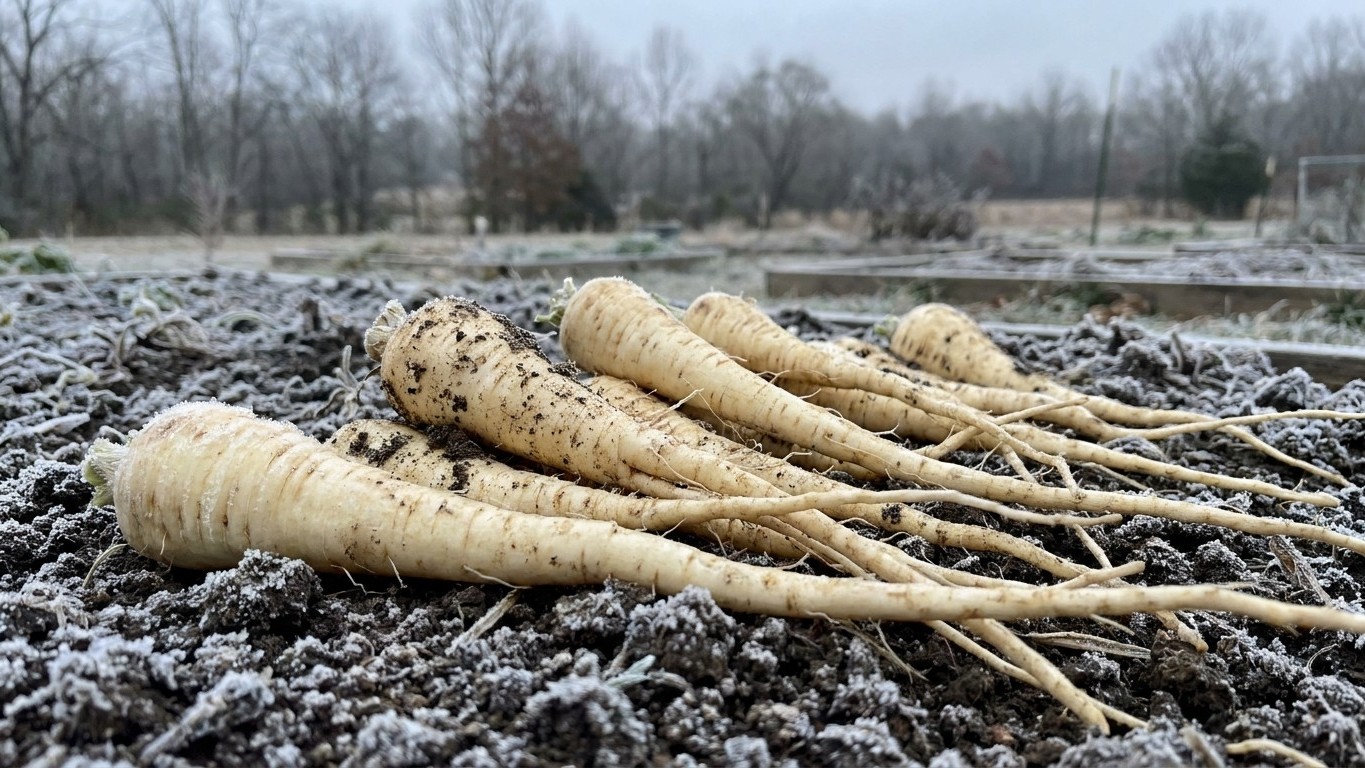

Yes, but the sweetness depends on frost, not zip code. Tennessee’s growing season is long enough to raise a full parsnip crop almost anywhere in the state, and the cooler pockets, especially East Tennessee and the Cumberland Plateau, get the frosty stretch that turns a bland root into a genuinely sweet one. In the milder valleys around Nashville, the roots still grow fine. Whether they sweeten is a separate question entirely.
The short answer
Here’s the question that actually decides this, and it isn’t “what zone am I in.” It’s this: does this spot get several weeks of hard, consistent cold once the calendar turns to late fall? That’s what converts the starch stored in a parsnip root into sugar. A hardiness zone tells you what a plant can survive over winter. It says nothing about whether a root crop left in the ground develops flavor.
For the Nashville reference station, NOAA’s 1991-2020 Climate Normals put the mean daily minimum for the coldest month at 30.1°F. That’s not a record low, and it’s not a single overnight dip. It’s the average low across the coldest month of the year, which means freezing or near-freezing nights are the norm, not the exception, once winter sets in around Middle Tennessee. That’s enough sustained chill to trigger the sugar conversion in parsnips left in the ground.
So for a gardener in the Nashville area, or anywhere with a similar winter profile, the answer is yes: parsnips grown here will sweeten, provided they’re left in the ground (or mulched heavily and dug as needed) through several weeks of that cold rather than pulled the moment they reach size. Pull them in September and you’ll get a parsnip. Leave them through a string of frosty nights in November and December, and you’ll get the flavor the crop is actually known for.
East Tennessee and the Cumberland Plateau run cooler and later in the season than the Nashville figures suggest, which works in a parsnip grower’s favor here. Colder winter nights at higher elevation mean an even more reliable frosty stretch, and less risk of a fluke mild winter skipping the sweetening window entirely. The lower, warmer river valleys are where that risk shows up, since a genuinely mild winter can leave a root crop grown-but-bland even when everything else about the season went right.
Does the season fit?
Parsnips need 100 to 120 days from the day they’re seeded, not from transplanting, since this is a crop sown directly in place. That number has to be checked against how much frost-free growing time this territory actually offers, plus a slow, easy-to-underestimate germination period.
- Start with the sowing date. Parsnip seed goes into the ground 2 to 3 weeks before the last spring frost. For Middle Tennessee, that frost falls between March 31 and April 12, which puts a realistic sowing window in mid-to-late March.
- Add germination time before counting any growth. Parsnip seed is notoriously slow, taking 14 to 21 days just to sprout. A gardener who doesn’t see green after a week and re-sows, thinking the first batch failed, often ends up with two overlapping plantings and a mess to thin out later.
- Count forward 100 to 120 days from seeding, not from sprouting. From a mid-to-late March sowing, 120 days lands in mid-to-late July, well before any frost concern.
- Compare that to the first fall frost, which runs October 28 to November 8. From a March sowing to early November is roughly 220 to 230 days of frost-free-to-frosty growing time, nearly double what the crop needs to simply mature.
- Use the extra time for sweetening, not more sowing. The season here doesn’t just fit, it leaves slack. That slack is exactly what lets a gardener leave parsnips in the ground through the frosty weeks that make them worth growing in the first place, rather than rushing to harvest the moment they’re technically done.
East Tennessee’s later last frost and earlier first frost trims that margin somewhat, but the arithmetic still clears the 100-to-120-day requirement comfortably in nearly every part of the state.
What goes wrong here
- Forked, twisted roots from heavy or stony ground. Tennessee’s clay-heavy soils in many counties resist the deep, loose penetration parsnip roots need. The fix is deep digging, ideally to at least a foot, breaking up clay and removing rocks before sowing, since the root will fork around any obstruction it meets.
- Forked roots from a completely different cause: overwatering. This is a separate problem from soil texture, and mixing the two up leads to the wrong fix. Inconsistent or excessive watering causes the root to split as it grows, even in decent soil. Even, moderate moisture, not frequent heavy soaking, keeps the root growing straight.
- Poor or patchy germination. Parsnip seed is slow and loses viability fast, so old seed or a soil surface that crusts over before the 14-to-21-day germination window closes leaves gaps in the row. Keeping the seedbed consistently moist (not soggy) during that stretch, and using fresh seed each season, solves most of it.
- A mild winter that never delivers the sweetening chill. In the warmer river valleys, a run of unusually mild weeks in late fall and early winter can leave a fully grown root without the sustained cold it needs to convert starch to sugar. There’s no fix for the weather itself, but leaving roots in the ground as long as possible into the cold season, rather than harvesting early out of habit, gives them the best shot at catching whatever frost the winter does bring.
A safety note before you pull them
North Carolina State Extension puts it plainly: “All parts of this plant contain furocoumarins which can make skin sensitive to light causing burns so be sure to wear gloves, long sleeves and long pants when dealing with it.” That’s not limited to the leafy tops. It covers the whole plant, root included.
The mechanism is what makes this catch people off guard. The burn doesn’t come from the sap alone. It comes from sap on the skin combined with sunlight. That’s why it happens on a bright afternoon spent pulling tops or harvesting roots, why the reaction often doesn’t show up until hours later, and why the real protection is covering up beforehand, not washing up afterward. A gardener working a shaded row on an overcast day faces a different risk profile than one out in full sun handling the same plant. Gloves, long sleeves, and long pants during handling are the actual safeguard here, not soap after the fact.
Checking this against your own county
The frost dates and winter temperature figures used here are pulled from the Nashville reference station, and Tennessee’s terrain varies enough, from the Cumberland Plateau to the river valleys to the mountains further east, that a county-level check is worth the five minutes it takes. The University of Tennessee Institute of Agriculture Extension maintains county offices across the state that can confirm local frost windows and soil conditions specific to that spot, rather than relying on a single statewide reference point. That local read matters most for anyone near the edges of the state’s growing regions, where a few hundred feet of elevation change shifts frost dates by more than a week.
Common questions
Can I harvest parsnips before the first frost?
Yes, the roots will have grown to full size if the 100-to-120-day count is complete, but pulling them before any sustained cold means they’ll taste starchy rather than sweet. The sugar conversion happens during the frosty weeks, not before them.
Do parsnips need to be covered or mulched over winter?
A layer of mulch helps keep the ground workable for digging once hard freezes set in, and it protects the roots from extreme swings, but it isn’t required to trigger sweetening. The frost exposure itself is what matters, not insulation from it.
Why did my parsnip seed not come up?
Most often it’s old seed, since parsnip seed loses viability quickly, or a soil surface that dried out or crusted during the 14-to-21-day germination window. Fresh seed and consistent surface moisture solve most no-show rows.
Is it safe to eat a parsnip that caused a skin reaction while harvesting?
The skin reaction comes from external contact with the plant’s sap under sunlight, not from anything internal to the cooked root. The safety concern here is entirely about handling the plant during harvest, not about eating it afterward.