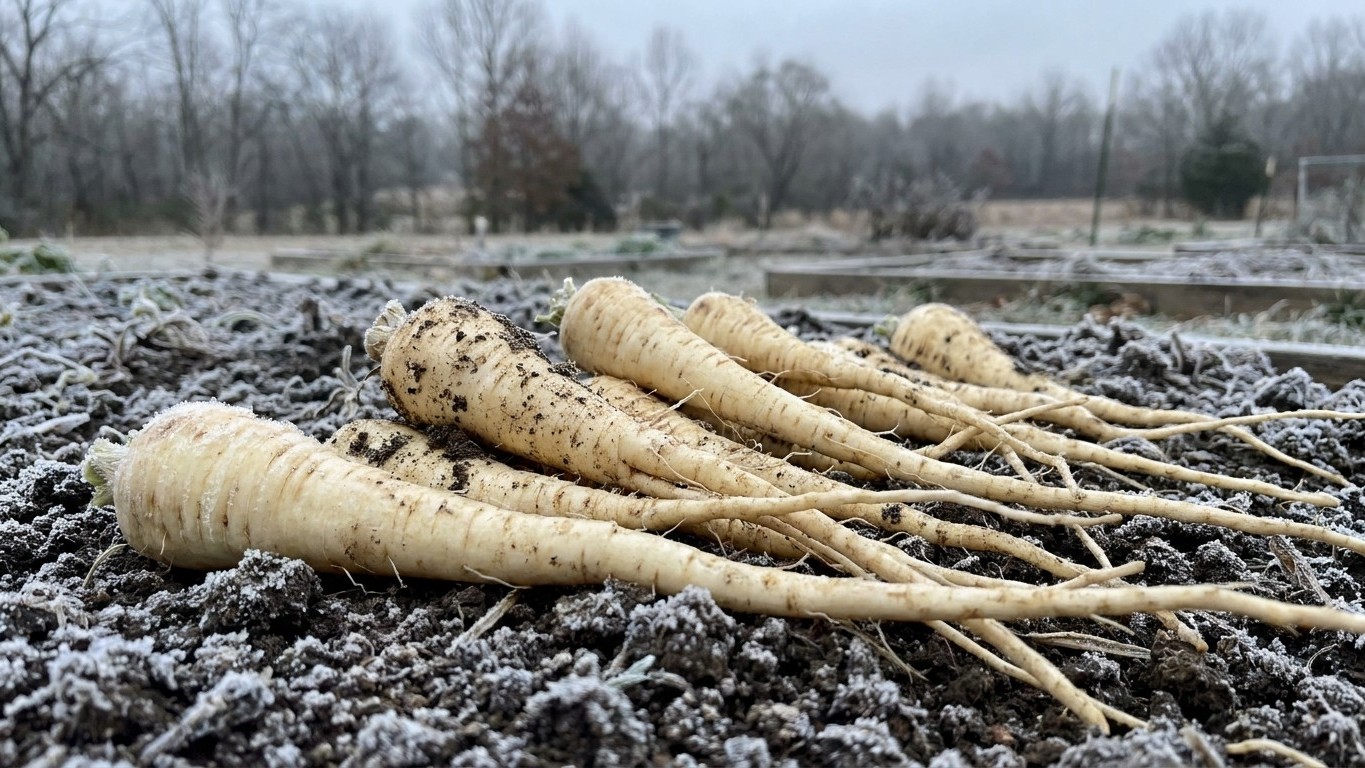

Manitoba’s winters run cold enough, and long enough, that a parsnip left in this ground doesn’t just mature. It sweetens. The frost exposure here is severe by continental standards, which settles the sweetening question outright. The part that actually needs planning is timing: getting seed into the ground early enough that the root reaches size before that same cold shuts the growing window down for the year.
The short answer
Does this province deliver several frosty weeks in a row? Yes, decisively. Winnipeg’s coldest month averages a daily minimum of -6.6°F, a figure from Environment and Climate Change Canada’s 1981-2010 climate normals for the Winnipeg Richardson International Airport station. That’s not a record low pulled from one brutal night. It’s the average low across an entire month, which means cold deep enough to convert stored starch into sugar isn’t a maybe here. It’s the baseline.
That distinction matters because gardeners often reach for a hardiness zone number when the real question is frost exposure. A hardiness zone tells you whether a perennial plant survives a winter dormant underground. Parsnip sweetening works on a different mechanism entirely: the root needs repeated exposure to cold, ideally several weeks of it, while it’s still sitting in the soil after growth has slowed. A comfortable hardiness zone doesn’t guarantee that exposure. A harsh one, like this one, delivers it without much effort from the gardener.
So the short answer holds: a parsnip grown in Manitoba’s climate won’t just grow, it will sweeten, and by a wide margin compared with milder parts of the continent. The starch-to-sugar conversion that turns an otherwise starchy, faintly bland root into something nutty and sweet needs sustained cold, not a single overnight frost. Manitoba’s fall and early winter supply that in quantity, well past what the crop actually requires.
None of this means the crop takes care of itself. The cold that sweetens a mature parsnip is the same cold that ends the growing season, and if the root hasn’t reached size by the time hard frost sets in for good, sweetening becomes irrelevant. Getting the sowing date right, so the plant has its full 100 to 120 days before that cold arrives, is where the real planning happens, and it’s the subject of the next section.
Does the season fit?
Utah State University Extension puts parsnip maturity at 100 to 120 days from seeding, with sowing recommended 2 to 3 weeks before the last spring frost. Lined up against Manitoba’s frost dates, the arithmetic runs like this:
- Start with the last spring frost. Environment and Climate Change Canada’s normals put the average last spring frost at the Winnipeg Richardson International Airport station on May 23. That’s a mean date, not a guarantee: in one year out of two, frost arrives even later, so treat it as the midpoint of a window rather than a safe planting cutoff.
- Move the sowing date back 2 to 3 weeks. That lands seeding somewhere between roughly May 2 and May 9, depending on how much risk a gardener is willing to accept on a late frost.
- Add germination time. Parsnip seed is slow to sprout, typically 14 to 21 days. Seeded May 2, expect seedlings breaking the surface closer to mid-to-late May, not the following week. Digging up the row before then, assuming the sowing failed, is a common early mistake.
- Count 100 to 120 days from the seeding date, not from germination. A May 2 sowing reaches the 100-day mark around August 10 and the 120-day mark around August 30.
- Compare that to the first fall frost. The average first fall frost at the same station falls on September 22. Both maturity windows land three to seven weeks ahead of that date.
- Read the margin. That gap is exactly what the crop needs: time to finish sizing up, then time in the ground through the early frosty weeks that convert starch to sugar, before a hard freeze locks the soil for good.
The season fits comfortably here, with room to spare on both ends. A gardener who sows in early May and leaves the roots in place through several weeks of fall frost, digging in October rather than rushing to beat the first freeze, gets the full sweetening benefit the crop is capable of. Sow later than mid-May, though, and that comfortable margin narrows fast, since the September 22 average is itself just a midpoint, and a year with an early frost can arrive weeks ahead of it.
What goes wrong here
- Forked roots in heavy or stony ground. Much of Manitoba’s clay-heavy soil, especially through the Red River Valley, holds together in dense clumps that split a taproot as it tries to push down. Working the bed two spades deep before sowing, clearing stones, and mixing in enough organic matter to loosen the top 12 to 15 inches solves this, as does sticking to a lighter, sandy patch of the garden where one exists.
- Forked roots from overwatering. This is a separate cause from soil texture, and it shows up even in loose, well-worked beds. A taproot that gets an inconsistent supply of water, a heavy soak followed by a dry stretch, followed by another heavy soak, tends to branch as it chases moisture. Steady, moderate watering through the season, rather than occasional deep soaks, particularly during the first six weeks while the taproot is establishing, fixes it.
- A season that runs out before maturity. Sowing after the third week of May eats into the margin described above, and a slow, cool spring can push germination past the usual 14 to 21 days. Sow as early as the soil can be worked, rather than waiting for a calendar date if the ground is fit sooner.
- A winter too mild to sweeten. This is the failure mode that defines parsnip growing in warmer regions, not here. Manitoba’s average coldest-month minimum of -6.6°F guarantees weeks of hard cold well beyond what starch-to-sugar conversion requires, so a parsnip left in this ground through fall sweetens without difficulty. The risk in this province runs the opposite direction: leaving roots too long and losing them to ground that has frozen solid before they’re dug.
Handling parsnip foliage and roots carries a risk few garden guides mention. North Carolina State Extension’s Plant Toolbox states plainly: “All parts of this plant contain furocoumarins which can make skin sensitive to light causing burns so be sure to wear gloves, long sleeves and long pants when dealing with it.”
The mechanism explains why this catches gardeners off guard. Furocoumarins on their own don’t burn skin. The reaction needs two things present at once: sap on the skin, and sunlight hitting that same patch of skin shortly after. That combination is why a burn tends to show up after a bright afternoon spent pulling tops or hauling roots out of a bed, and why the mark can take several hours to appear, well after the work is done and the sap has already dried. By the time redness or blistering turns up on a forearm or the back of a hand, the moment of contact is easy to have forgotten entirely.
Because the reaction depends on sunlight exposure after contact, scrubbing the skin once a burn has started doesn’t undo damage already set in motion. What actually works is keeping the sap off skin in the first place: gloves, long sleeves, and long pants whenever handling any part of the plant, roots included, not just the leafy tops, on any bright day spent in the parsnip bed.
Checking this against your own county
Winnipeg’s frost dates and coldest-month minimum make a solid provincial benchmark, but Manitoba stretches from open prairie in the south to boreal forest well to the north, and that range shifts both frost timing and the depth of cold considerably. A garden near Brandon or Portage la Prairie tracks close to the numbers used here. A garden farther north, near The Pas or Thompson, faces a shorter, colder season with an earlier fall frost and a later spring one.
Manitoba Agriculture is the extension service to check against local conditions rather than leaning on a single reference station. Its horticulture and crop production resources cover regional planting windows and soil advice specific to Manitoba’s clay belts and sandy pockets, broken down by district rather than one airport station. That’s worth checking before locking in a sowing date, especially for anyone gardening outside the Red River Valley.
The provincial baseline says a Manitoba-grown parsnip will sweeten, and the season fits with room to spare. Confirming that against local frost records through Manitoba Agriculture turns a provincial average into a planting date matched to the actual garden.
Common questions
Can parsnips be left in the ground all winter in Manitoba?
The several weeks of frost the crop needs to sweeten arrive reliably here, but a specific safe date for leaving roots past the point the ground freezes solid isn’t published in the figures behind this page. The practical approach is digging once several frosty weeks have passed and before the ground turns unworkable, rather than gambling on the whole winter.
Do parsnip seedlings need to be started indoors first?
No. Parsnips are sown directly in place outdoors, not transplanted, because the developing taproot doesn’t tolerate the disturbance of moving young plants. Seed goes straight into the bed where the crop will finish growing.
Does Manitoba’s clay soil need special treatment before sowing parsnips?
Heavy soil, which describes much of Manitoba’s clay-belt ground, needs double digging before sowing according to Utah State University Extension’s guidance, loosening well past the depth a single pass with a spade reaches. Deep, sandy loam is the crop’s preferred texture, and it’s worth using if any part of the garden offers it.
Why does it matter that parsnip seed takes 14 to 21 days to germinate?
Because the 100 to 120 days to maturity count from the seeding date, not from the day seedlings appear. A gardener who forgets the germination lag and starts counting maturity from emergence risks pulling roots weeks before they’ve actually finished sizing up, or worse, assumes a slow-germinating row has failed and re-sows over seed that was simply taking its time.