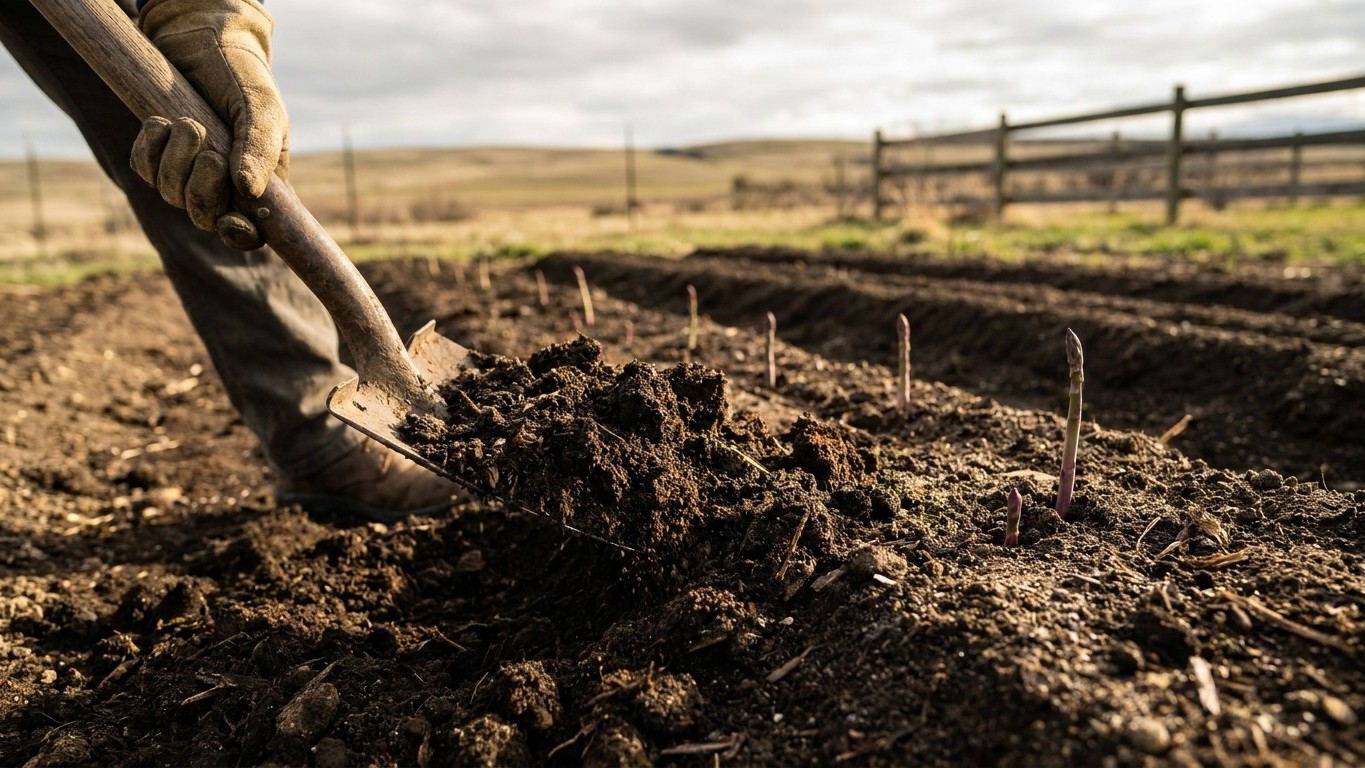

New York’s growing conditions can support an asparagus bed that produces for a decade or more, but the answer depends less on the state as a whole and more on what’s actually happening six inches under your boots. Drainage is the one non-negotiable. Get that wrong, and no amount of care fixes it later.
The short answer
Asparagus is planted once and then left alone for a long time. A bed put in correctly runs 10 to 15 years before it needs to be dug up and started over, and that clock doesn’t start ticking on the first harvest, it starts the moment the crowns go in the ground. That’s the commitment: whatever spot you pick has to keep draining well for over a decade, through wet springs, dry Augusts, and whatever else the weather sends, which raises the real question of Will New York Soil Hold an Asparagus Bed for Fifteen Years?. The plant itself isn’t fussy about soil type. Most soils will grow it fine. The one thing it cannot tolerate is standing water around the crown, which will rot the root system long before it ever gets the chance to fail from anything else. Getting the timing right matters too, and knowing When to Plant Asparagus Crowns in New York can make the difference between a bed that establishes well and one that struggles from the start.
The soil that USDA lists as representative of New York is the Honeoye series, a forest soil built on a loam-to-silt mix, roughly 26 percent sand, 19 percent clay, and 55 percent silt, with a surface pH around 6.3, slightly on the acid side. It’s classified as well drained, and organic matter sits around 3 percent, which is a reasonable, workable number for a cultivated bed. On paper, that’s a soil asparagus can live in for its full lifespan without complaint.
Here’s the catch, and it matters more here than it would for a crop you replant every spring. The Honeoye series describes what USDA maps as typical across the state. It says nothing about the low corner of your yard where water pools every March, or the compacted fill a contractor left behind, or the clay pocket two counties over that behaves nothing like the state average. A soil test on your own plot is the only way to know what you’re actually dealing with. If the ground stays soggy a day or two after a normal rain, that’s your answer already, and no test is needed to tell you it drains poorly.
When a spot doesn’t drain the way asparagus needs, the fix isn’t to abandon the crop, it’s to change the bed. Raised beds or mounded rows lift the crowns above the slow-draining layer entirely, and working coarse sand or compost into a heavy patch loosens it enough to matter. Given that this bed is meant to outlast most other decisions made in a garden that year, it’s worth spending an afternoon with a shovel checking how water actually moves through the soil before a single crown goes in.
Will the summer here water it for you?
Asparagus has a simple watering rule that changes as the bed matures. For the first two growing seasons, while the root system is still establishing itself, it wants 1 to 2 inches of water every other week. Once the bed is past that stage, the interval stretches out to every three weeks. The question for anyone in New York is whether the sky is already doing that job.
- Look at what summer actually delivers. Across June, July, and August, the region averages about 13.7 inches of rain, with June the driest of the three at 4.54 inches, July at 4.6, and August at 4.56. Spread evenly, that’s roughly an inch of rain a week, which lands close to the low end of what a young bed needs every other week.
- Remember that rain rarely arrives evenly. Those totals are monthly averages built from thunderstorms and multi-day soaks, not a steady drizzle. A bed can go two dry weeks in the middle of July even in a summer that hits its seasonal average, so a rain gauge on the actual bed matters more than the regional number.
- Factor in what the soil is holding onto. A silt-and-loam soil like the Honeoye series retains moisture better than a sandy one, which means the same inch of rain does more work here than it would on a lighter, fast-draining soil. That’s a point in favor of the region’s typical ground, provided it’s actually draining, not just holding water.
- Plan to supplement during dry stretches. In a year running below normal, or during a hot, rainless week in a normal year, add water directly rather than trusting the monthly average to even itself out. For a bed in its first two years, that means checking soil moisture at the root zone, not just watching the sky.
- Ease off once the bed matures. After year two, the three-week interval means New York’s typical summer rainfall pattern, uneven as it is, usually covers most of what’s needed on its own, with supplemental watering reserved for genuinely dry spells rather than a routine chore.
When to put the crowns in
Crowns go into the ground in early spring, set into furrows about 8 inches deep. The furrow isn’t backfilled all at once. Soil gets pulled in gradually over the course of the year, about two inches every other month, as the new growth pushes up, rather than burying the crown completely on planting day.
Timing that against the calendar means working around the last spring frost, which for the New York City reference station falls somewhere between March 23 and April 3. That’s a mean date built from 1991 to 2020 freeze-probability data, not a guarantee, so it’s better read as a window than a deadline, and the word “around” is doing real work in that sentence. Anyone gardening upstate or in the Adirondacks should expect that window to land considerably later than the city figure, since a dense urban site holds heat that open, rural land simply doesn’t have. Crowns are dormant when planted, which gives some cushion against a late cold snap, but working soil that’s still waterlogged from snowmelt does more harm than waiting another week or two.
Seed is the alternative route, and it exists mainly for gardeners who want to raise their own crowns rather than buy them started. It’s the slower path. Seeds need to be started, grown into small plants, and only then set out to become the crowns that would otherwise have gone straight into the furrow, which pushes the entire timeline back by a full growing season before you’re at the same starting point as someone who planted crowns directly. For most home gardeners, particularly ones already committing to a bed that will sit in one place for over a decade, starting from crowns is the more direct route, and the extra year of patience seed requires is worth weighing against how much of a hurry you’re in to reach that first harvest, still years away either way.
On variety, the published information is limited to which plants carry male and female flowers and which don’t. Jersey Giant and Jersey Knight are all-male varieties, while UC 157 F1 and Purple Passion carry both male and female plants. No flavor comparison, yield figure, or regional recommendation is attached to any of them in the available guidance, so the choice comes down to what a local nursery actually stocks rather than a documented performance difference between the four.
Checking this against your own county
Every figure here, the state soil series, the rainfall averages, the frost window, describes a broad regional pattern, not the specific dirt behind your house. The most direct way to close that gap is a call to your local extension office, which can run a soil test, confirm your actual frost pattern, and flag anything particular to your county, whether that’s a shorter growing season near the Canadian border or heavier clay in a specific valley.
In New York, that means Cornell Cooperative Extension, which operates offices across the state’s counties. A soil test through them is inexpensive relative to the fifteen years you’re about to ask that soil to perform, and it answers the one question none of the statewide averages can: what your particular patch of ground is actually going to do.
Common questions
Can asparagus grow in clay soil in New York?
Only if that clay drains reasonably well. Heavy, slow-draining clay holds water around the crown and leads to rot over time, which matters more for a fifteen-year bed than for a crop replanted annually. Raised beds or working in coarse organic matter are the usual fixes when a soil test shows poor drainage.
How many years until the first harvest?
None of it can be cut in the first two years. Harvest doesn’t begin until year three, and even then it starts light, building from a short early window to longer ones as the plant matures, before settling into full seasonal harvest.
How do I know when to stop cutting spears each season?
Stop once most of the spears coming up are thinner than a pencil. That’s the signal the plant needs to redirect its energy into foliage rather than continued cutting, and it’s a condition to watch for rather than a date to circle on the calendar.
Which asparagus variety is best for New York?
There’s no published ranking by flavor, yield, or regional performance among the commonly available varieties. The documented difference is limited to sex type, all-male varieties like Jersey Giant and Jersey Knight versus the male-and-female UC 157 F1 and Purple Passion, so the practical choice usually comes down to availability at a local nursery.