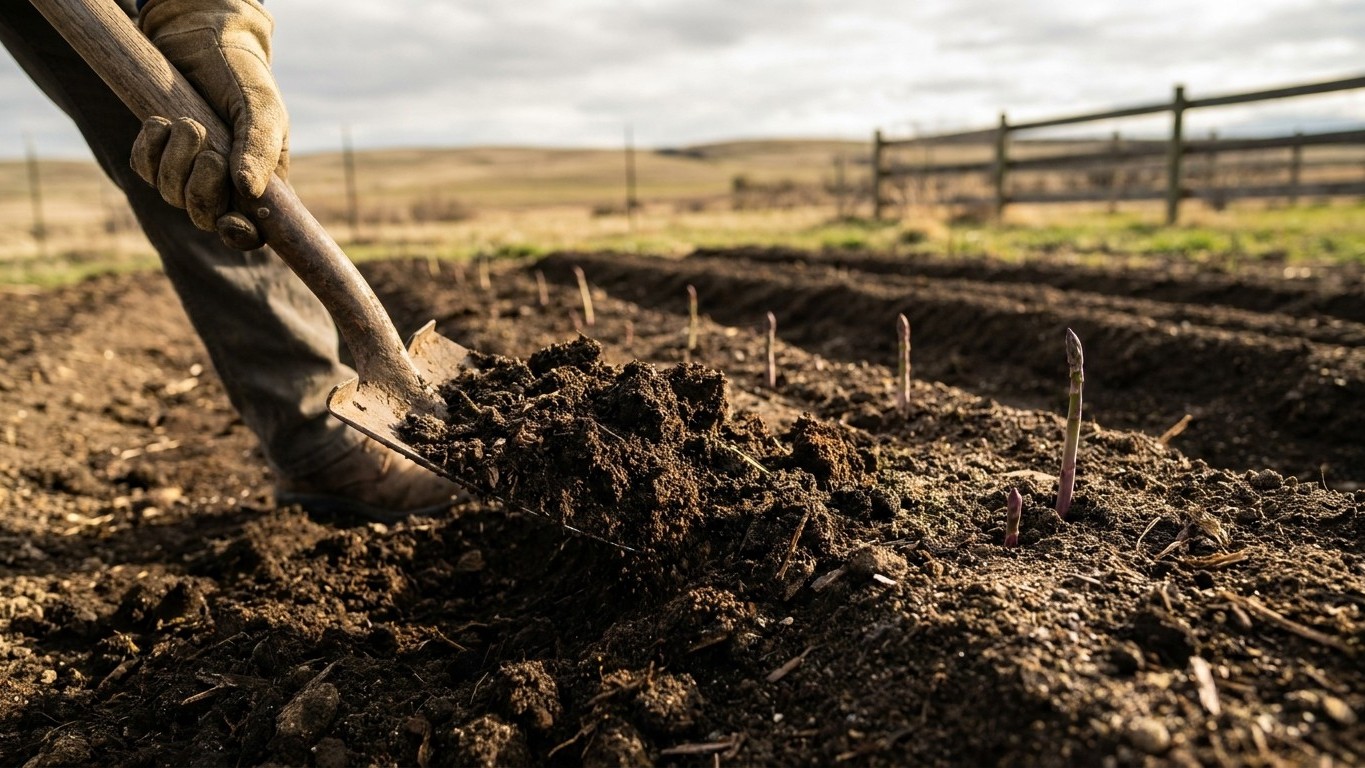

A bed of asparagus planted in British Columbia today can still be feeding a household in a decade and a half, provided the ground it goes into drains. Will British Columbia Soil Hold an Asparagus Bed for Fifteen Years? The province’s dominant soil does drain well, on paper. Summer rain falls short of what the plant wants by midsummer, so watering fills the gap. And crowns go in around mid-March, though “around” is doing real work in that sentence.
The short answer
Fifteen years is not a figure of speech here. Utah State University Extension is blunt about it: an asparagus bed, once established, produces for 10 to 15 years, and the only requirement it lists for soil is that the ground be well drained. No pH range, no fertility target, just drainage. That single condition matters more for asparagus than for almost anything else grown in a home garden, because a tomato bed forgives a bad soil year to year, you amend it each spring and move on. An asparagus bed does not give you that chance. Whatever ground you choose is the ground that crop lives in for the next decade and a half.
British Columbia’s most commonly mapped soil is a Brunisol, a young soil whose horizons have only just begun to separate, typical of ground formed on recent or coarse parent material. It covers about a third of the province’s mapped agricultural surface, more than any other order, with Podzolic soils close behind. Where this profile holds, drainage tends to be good, the texture runs to a loam with roughly half sand, a bit of clay and the rest silt, and the surface reads slightly acid. That is a starting point, not a verdict on any one yard. A river-bottom lot, land that has been filled or graded for a house pad, or ground in the province’s wetter coastal pockets can behave nothing like that median.
If your own patch holds water after a heavy rain, sits soggy for days, or grows moss thick on bare soil, treat that as your answer regardless of what the provincial norm says. The fix is not complicated: raise the bed six to eight inches above grade, work in coarse material to open up the structure, or move the planting to higher ground on the same lot. What you should not do is plant crowns into standing water and hope fifteen years of drainage problems will sort themselves out.
Four varieties, one detail published
Utah State University Extension names four varieties without ranking them on flavor or yield, only on sex, which affects how much volunteer seedling growth you get later.
| Variety | Type |
|---|---|
| Jersey Giant | All-male |
| Jersey Knight | All-male |
| UC 157 F1 | Male and female |
| Purple Passion | Male and female |
That is the full extent of what’s published. No source here compares their taste or output, so treat any stronger claim you read elsewhere as someone’s opinion, not a documented fact.
Will the summer here water it for you?
The bed’s own water rule, from Utah State University Extension, is 1 to 2 inches every other week for the first two years, easing to every three weeks once established. Set that against what Environment and Climate Change Canada’s 1981-2010 normals for Vancouver Int’l A actually record for a coastal British Columbia summer, and the gap becomes obvious fast.
- June: normal rainfall runs about 2.12 inches for the month, roughly on pace with the bed’s every-other-week target if it fell evenly, which it rarely does in a single dry spell or a single downpour.
- July: the driest month of the summer, at only 1.4 inches. This is the point in the season where an establishing bed, still on its every-other-week schedule, is most likely to run short without help from a hose.
- August: barely better at 1.45 inches, so the shortfall from July tends to carry straight into it.
- The three months together: about 5.0 inches across June, July and August, against a full year total of 46.8 inches. Almost all of the province’s rain, falls outside the exact window an asparagus bed needs it most.
- What that means for the hose: a first- or second-year bed will likely need supplemental watering through July and August in most years, and a mature bed on its lighter every-three-weeks schedule should still be checked during that July dip rather than assumed to be fine.
None of this is a forecast for your yard specifically. It describes what the reference station near Vancouver has recorded on average over a thirty-year period, and a garden further inland, at elevation, or in a rain shadow can see meaningfully less. A rain gauge staked next to the bed settles the question for your own ground far better than a provincial average can.
When to put the crowns in
Utah State University Extension gives the planting method plainly: crowns go into furrows about 8 inches deep, set in early spring, then the furrow is backfilled gradually as the season goes on, adding about two inches of soil back every other month rather than all at once. That gradual fill matters because it lets the emerging spears keep pushing up through loose soil instead of being buried under a heavy load on day one.
“Early spring” needs a local anchor, and the closest one available is the mean last spring frost date recorded at Vancouver Int’l A: around March 18. That figure comes from Environment and Climate Change Canada’s 1981-2010 climate normals, and it is a mean, not a guarantee. In roughly half of all years on record, frost at that station has arrived later than March 18, not earlier. Treat the date as the midpoint of a window you should watch, not a green light to plant the moment the calendar turns. Gardeners in colder interior valleys or at higher elevation within the province should expect that window to sit weeks later still, since a single coastal airport station cannot describe a province with this much variation in terrain.
Seed is the other route in, and it’s the slower one. Starting asparagus from seed adds a full extra year to the wait before any harvest at all, since seedlings need a season in a nursery bed before they’re ready to go into their permanent spot as young crowns. Most home gardeners skip that year by buying dormant crowns directly, which is why crown planting, not seed, is the method described for the early spring window above. Either way, the harvest clock doesn’t start ticking until the plants are in their final bed, and it runs long from there regardless of how you started them.
Once planted, patience is the whole first act of growing this crop. Utah State University Extension is explicit that no harvest happens in year one or year two. Year three brings the first cutting, and even then it’s limited to about four weeks of picking. That window lengthens to six weeks the following year, then eight weeks once the bed is fully mature. The signal to stop cutting each season isn’t a date on a calendar either, it’s the spears themselves: when most of what’s coming up runs thinner than a pencil, that’s the plant telling you it needs its energy back to build the fern growth that feeds next year’s crop.
Checking this against your own county
A provincial soil profile and a single airport’s climate normals are useful for planning, but they were never built to describe one specific backyard. British Columbia doesn’t run a county-by-county extension network the way some other places do, so the equivalent local checkpoint is the Government of British Columbia’s Ministry of Agriculture and Food. Its agriculture and seafood pages cover regional growing conditions, soil resources, and crop guidance specific to different parts of the province, well beyond what a single coastal station’s numbers can capture.
Before committing a fixed spot to asparagus for a decade or more, a simple soil test through a local lab, paired with whatever regional guidance the ministry publishes for your district, tells you far more than any provincial average. That combination, not this article, is what should decide the exact corner of the yard the bed goes into.
Common questions
Can I harvest any spears in the first two years?
No. Utah State University Extension is explicit that harvest doesn’t begin until year three. Cutting earlier weakens the crown before it has built the root reserves the bed depends on for the next decade of production.
What soil pH does asparagus need in British Columbia?
That figure isn’t published in the source this article relies on. The province’s dominant mapped soil reads a median surface pH around 5.8, slightly acid, but that’s a provincial norm, not a target for asparagus specifically, and not a substitute for testing your own ground.
Does asparagus need a certain amount of winter chill in this climate?
No chilling requirement is published in the source used here, and none should be assumed from British Columbia’s hardiness zones. Treat that question as unanswered by the available data rather than filled in with a guess.
How do I know When to Stop Cutting each season?
Watch the spears, not the calendar. Once most of what emerges is thinner than a pencil, that’s the plant’s own signal to let the season’s growth go to fern and rebuild the crown for next year.