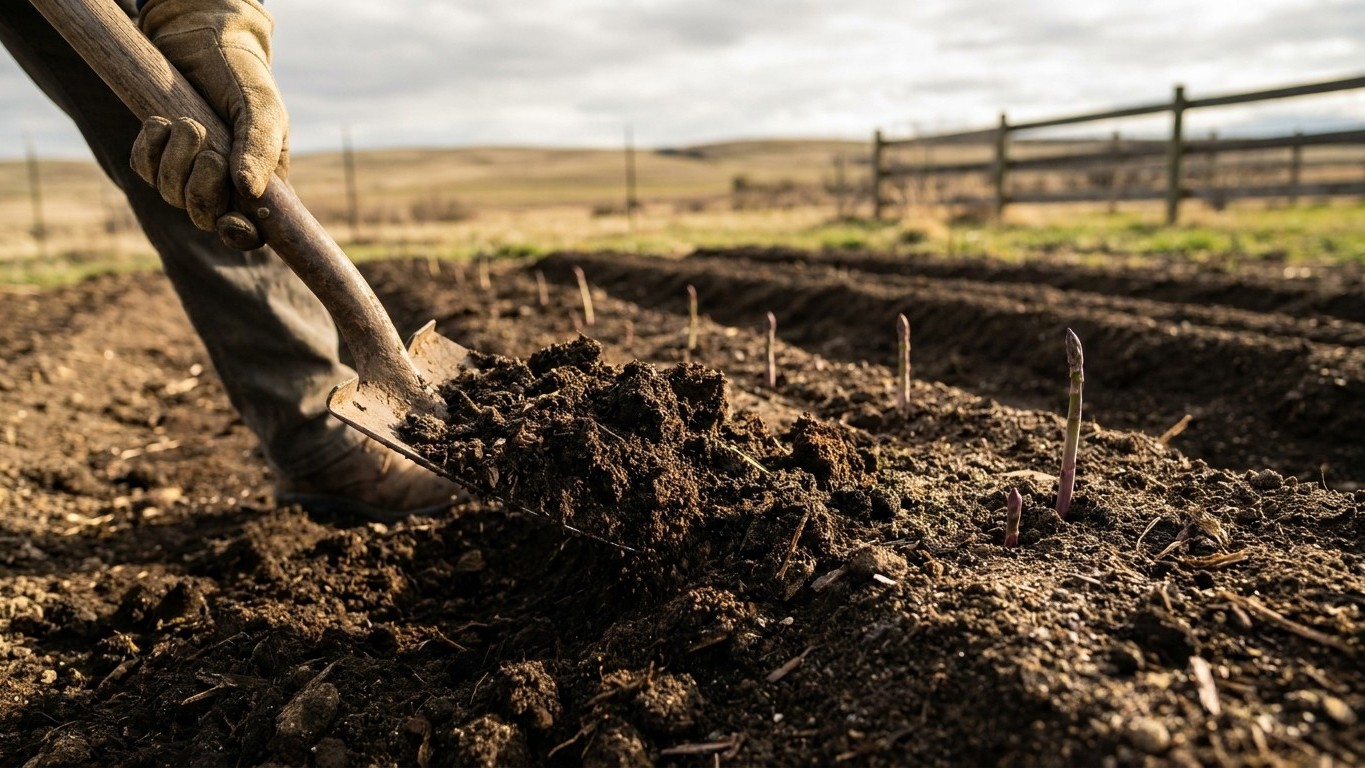

Fifteen years is the commitment: an Asparagus Bed planted today in Ontario will still be feeding the same kitchen when it’s a teenager. That length only makes sense on ground that drains, and the province’s most common soil profile does. Before you dig a furrow anywhere, the real question is whether your particular patch matches that province-wide tendency, or whether it’s one of the pockets that don’t — and knowing When to Plant Asparagus Crowns in Ontario matters just as much as knowing where.
The short answer
Utah State University Extension puts it plainly: asparagus will grow in most soils, provided they are well drained. That’s the only real requirement published for the bed itself, and it matters more here than for almost any other vegetable on this site, because you’re not choosing a spot for one season. You’re choosing it for ten to fifteen years, with a root system that goes deep and hates sitting in water.
Ontario’s dominant mapped soil profile is a Luvisol, a forest soil where clay has washed down out of the topsoil over time, leaving the surface lighter and looser while the layer beneath it runs denser. Luvisols cover 39 percent of the province’s mapped surface, more than any other order, with Gleysolic soils (the wetter, poorly drained kind) coming in second. The texture on that typical surface layer runs loam to silt: 43 percent sand, 17 percent clay, 41 percent silt, with organic matter around 4.3 percent and a median pH near 6.5, just on the acid side of neutral. Classified by drainage, that surface horizon reads as well drained.
That’s good news in general terms. A loam-to-silt topsoil with a well-drained rating is close to what an Asparagus Bed wants, and the near-neutral pH doesn’t need correcting for this crop. But the source is silent on soil pH preferences for asparagus specifically, so treat 6.5 as a fact about the province’s ground, not a target to hit.
The catch is the layer underneath. A Luvisol’s whole identity is built on clay having moved downward, which means the subsoil is denser than the surface, exactly where a fifteen-year taproot system will eventually be working. On a gentle slope, in an open field, that subsoil clay usually still lets water move through slowly enough. In a low spot, a former streambed, or anywhere a foundation or driveway has compacted the ground, that same clay layer can turn into a bathtub after spring rain.
This is where the province-wide number stops being useful, and it’s the heart of Will Ontario Soil Hold an Asparagus Bed for Fifteen Years?. The 39-percent figure describes the commonest profile across almost 850 mapped soil components in the agricultural regions of Ontario. It says nothing about the low corner of your own yard, and it doesn’t cover the far north of the province at all, where the survey has little agricultural data. A raised bed, four to six inches above grade, is the standard fix wherever water is slow to leave after a storm. Working a couple of inches of compost into the top foot before planting helps the topsoil breathe without changing what the clay below is doing. Either way, don’t guess: dig a hole a foot deep after a rain, fill it with water, and time how long it takes to disappear. Slow drainage there is your answer, whatever the provincial average says.
Will the summer here water it for you?
Rain alone rarely carries an asparagus bed through an Ontario summer, and the extension guidance is specific about what the plant wants: one to two inches of water every other week for the first two seasons, tapering to about every three weeks once the crowns are established. Set that against what Environment and Climate Change Canada’s 30-year normals show for the region, and the gap becomes obvious.
- What the bed asks for: 1 to 2 inches every two weeks through the first two years, then 1 to 2 inches roughly every three weeks afterward.
- What June typically delivers: about 2.81 inches for the whole month, the driest of the three summer months on the reference station’s normals.
- What July typically delivers: about 2.98 inches for the month, still well under two applications of the bed’s two-week ask if the rain arrives unevenly.
- What August typically delivers: about 3.07 inches, the wettest of the three, but still only around three-quarters of an inch a week averaged out.
- What that adds up to: roughly 8.9 inches across the three summer months, against 30.9 inches for the year as a whole, meaning most of Ontario’s annual moisture falls outside the growing season when the bed needs it least.
- What that means for your hose: in a normal June or July, expect to top up with irrigation most weeks rather than occasionally, especially in the newly planted bed’s first two seasons when the root system is shallow and unforgiving of a dry spell.
None of this is a forecast. These are 30-year normals from a single reference station, and rainfall in any given June can run well above or below that average. A thunderstorm that dumps an inch in twenty minutes mostly runs off rather than soaking into even a good loam, so the monthly total can flatter what the plant actually receives. A rain gauge staked next to the bed, checked weekly against that every-other-week target, tells you far more than any normal ever will.
When to put the crowns in
Crowns go into the ground in early spring, planted about eight inches deep in a furrow, according to Utah State University Extension. The trick with the furrow is patience: you don’t fill it in at planting. Cover the crowns with about two inches of soil to start, then add roughly two more inches every other month across the season as the shoots grow, backfilling gradually rather than burying the crown all at once.
Anchoring “early spring” to an actual calendar is where a mean frost date helps, and where it can also mislead. Environment and Climate Change Canada’s 1981-2010 normals put the average last spring frost around April 30 at the Toronto Lester B. Pearson station. That’s a mean, not a guarantee: in roughly half of all years on record, frost arrived later than that date. Treat late April as the middle of a window, not a green light, and watch your own local forecast before crowns go in the ground, especially since districts north or inland of the reference station typically run behind it by weeks.
Starting from seed is the alternative the extension source lists, though it adds a full season to an already long timeline before the first harvest. Whichever route you take, don’t expect to cut anything the first two years. Harvest doesn’t start until year three, and even then it’s staged: about four weeks of cutting the first harvest year, six weeks the year after, working up to a full eight-week season once the bed is mature. The signal to stop each season isn’t a date on the calendar. It’s the spears themselves: once most of what you’re cutting has gone thinner than a pencil, that year’s harvest is over, whatever week it happens to be.
On variety, Utah State University Extension names four without ranking them on flavor or yield, distinguishing them only by sex, which affects how much the plants spend energy on seed production versus root growth:
| Variety | Type |
|---|---|
| Jersey Giant | All-male |
| Jersey Knight | All-male |
| UC 157 F1 | Male/female |
| Purple Passion | Male/female |
All-male types tend to put more of their energy into spear production rather than seed-set, which is why they’re often favored, but the source doesn’t publish a reason to prefer one over another, so that choice is left open here rather than invented.
Checking this against your own county
A provincial soil profile and a single reference station’s climate normals are a starting point, not a verdict on your particular lot. Drainage varies field to field, and frost timing shifts with elevation and distance from the lake. For a check that’s closer to your own address, Ontario’s Ministry of Agriculture, Food and Agribusiness (ontario.ca/page/agriculture-and-food) is the named place to start, with local extension staff and soil-testing resources that can speak to conditions in your specific county rather than the province as a whole. A dig-and-fill drainage test on your own bed site, paired with a real soil test rather than an assumption based on the provincial median, is the cheapest insurance you’ll buy for a bed you’re planting to outlast most other things in the yard.
Common questions
Can I harvest anything the first two years after planting crowns?
No. The extension guidance is clear that harvest doesn’t begin until the third year after planting, regardless of how vigorous the ferny top growth looks in years one and two.
How do I know when to stop cutting spears each season?
Stop when most of the spears you’re harvesting have gone thinner than a pencil. That’s the signal the source gives, rather than a fixed week count, and it will shift slightly from year to year.
Does Ontario’s soil need lime or sulfur before planting asparagus?
The source for asparagus is silent on soil pH preferences, so no adjustment is specified here. The province’s median surface pH runs near 6.5, slightly acid, but that’s a description of the ground, not a recommendation for this crop.
Is there a winter chilling requirement I should plan around?
Not published. The extension source used for this page doesn’t address chilling hours for asparagus, and the plant’s hardiness zone rating shouldn’t be read as a chilling figure, since that’s a different measurement entirely.