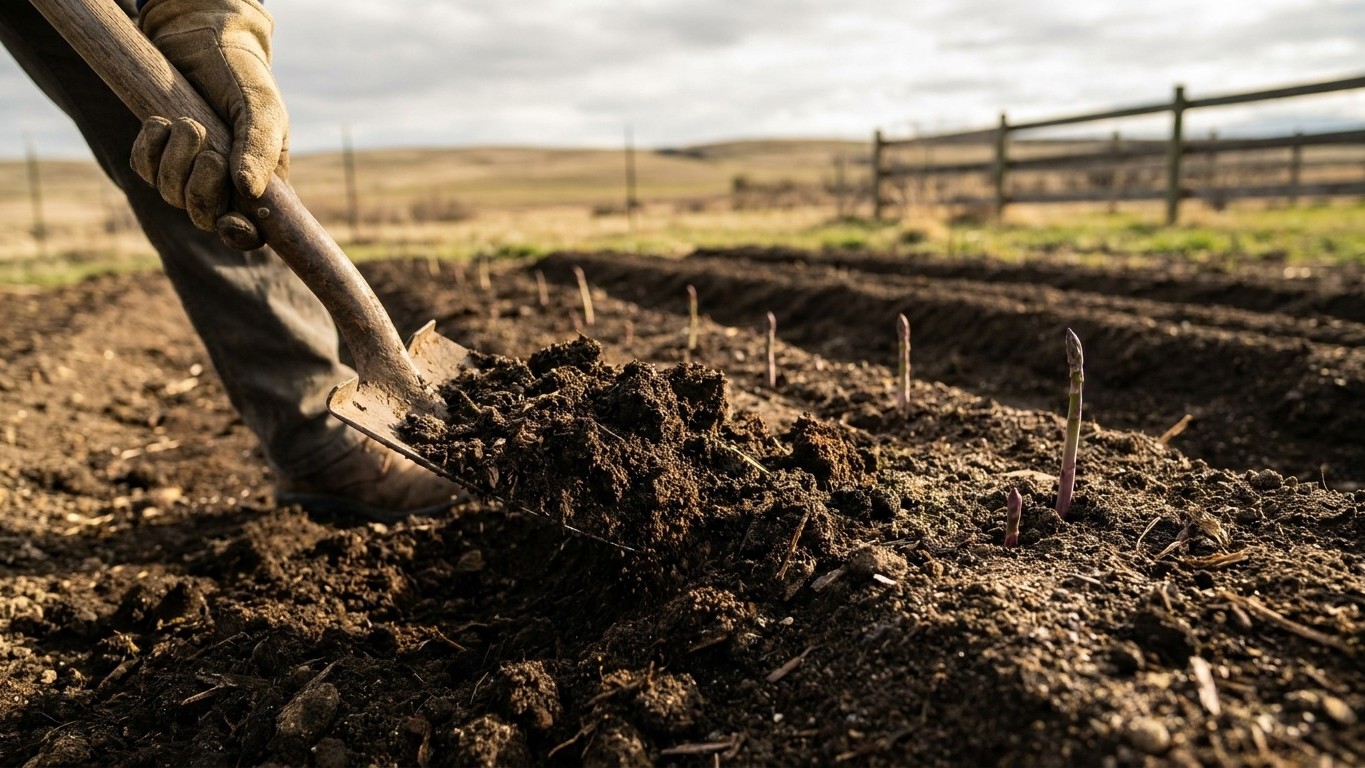

A bed that sits on the Hilo series, Hawaii’s representative soil, has the one thing this crop actually asks for: drainage. That series is well drained by definition, so Will Hawaii Soil Hold an Asparagus Bed for Fifteen Years? is workable here, provided the summer’s near-total lack of rain gets made up with a hose, and provided planting timing follows rainfall and elevation rather than any frost date, because in the inhabited lowlands of this state, frost simply does not happen.
The short answer
Start with what the crop actually needs, because the source is blunt about it: asparagus wants soil that drains, and almost nothing else. Utah State University Extension lists no other soil requirement for a bed that, once established, will occupy the same patch of ground for ten to fifteen years without being dug up and moved. That single condition matters more here than for any other vegetable on this site, because a bed of lettuce forgives a bad soil choice by next season. An asparagus bed does not. Whatever ground gets chosen this spring is the ground that bed lives in for a decade or more.
Hawaii’s representative soil, the Hilo series, is an Andisol, meaning it formed from volcanic ash rather than from the weathered rock and sediment that build most mainland soils. That origin gives it an unusual profile: light and porous despite carrying a heavy amount of silt (55 percent, against 35 percent clay and just 10 percent sand), with a surface pH of about 5.8 and organic matter around 9.0 percent. And it is, per USDA’s own survey data, well drained. That is the one fact that matters for a fifteen-year bed, and it happens to be favorable.
None of that settles the question for any one garden, though. The Hilo series is what USDA lists as representative of the state as a whole, not a soil test of a particular backyard. Hawaii’s terrain changes by the acre: windward slopes soaked by trade winds sit a few miles from leeward ground baked dry, lava flows of wildly different ages produce wildly different soils, and any lot that has been graded, filled or built on carries none of the natural profile this series describes. A garden sitting on compacted fill, or on a low spot where water pools after a downpour, does not get to borrow the Hilo series’ drainage rating just because it shares a zip code with it, which is exactly why When to Plant Asparagus Crowns in Hawaii depends on reading each site’s own drainage and elevation rather than following a single statewide date.
If a plot does not drain the way this bed needs, the fix is not exotic. Raising the bed six to eight inches above grade, working in coarse material to break up compaction, or simply choosing a different corner of the property that visibly sheds water after rain, are the standard responses. What does not work is planting into standing water and hoping the fifteen-year clock resets itself. It does not.
Will the summer here water it for you?
The bed’s own rulebook is specific: 1 to 2 inches of water every other week for the first two years, then a lighter schedule of every three weeks once the planting is established. Measured against what a typical summer here actually delivers, the numbers do not close the gap on their own.
- What a young bed needs. Across a three-month summer (roughly thirteen weeks), watering every other week works out to six or seven applications of 1 to 2 inches each, somewhere between 6 and 13 inches of water over June, July and August for a bed still in its first two seasons.
- What summer actually brings. The 1991-2020 climate normals put summer rainfall at about 1.9 inches total across June, July and August, with June the driest month at 0.5 inches, July at 0.52 inches, and August a bit wetter at 0.84 inches. That is a fraction of an inch shy of two, for the entire three-month stretch a new bed needs several times over.
- What an established bed needs. Once a planting reaches its third summer, the schedule eases to roughly every three weeks, meaning four to five applications of 1 to 2 inches, or 4 to 8 inches over the same three months. The gap with 1.9 inches of natural rain narrows, but it does not close.
- What that means in practice. A young bed here needs supplemental water covering nearly the entire requirement through irrigation, not a top-up. An established bed needs less help but still cannot rely on summer rain alone. A rain gauge on the actual property, not a regional average, is what tells a gardener how much of that gap their own microclimate is filling.
Those normals come from a single reference station and describe what the region usually delivers over three decades, not a forecast for any given year. A ridge, a valley, or a stretch of coastline a few miles off can shift those numbers considerably, which is exactly why the source keeps pointing back to what falls on the actual bed rather than what a nearby station recorded.
When to put the crowns in
Utah State University Extension’s timing is simple on paper: plant crowns in early spring, setting them into furrows about 8 inches deep. Most calendars built around that instruction lean on a last spring frost date to mark when the ground has warmed enough to work. That anchor does not exist here. NOAA’s climate normals for this state show no freeze at all in the areas where people actually garden, with every frost percentile flagged as not computable and zero days a year at or below 32°F recorded at the reference station. Frost in this state happens on the high volcanic summits, Mauna Kea, Mauna Loa, Haleakala, ground no home garden occupies. “Early spring” here is a rainfall and elevation cue, not a thermometer reading: the safer marker is the start of the wetter season at a given elevation, when the ground is workable and moisture is more reliably on hand to settle newly planted crowns before the drier summer months arrive.
The furrow itself does not get filled in one motion. Crowns go in at that 8-inch depth, and the trench is backfilled gradually across the year, adding roughly two inches of soil back every couple of months rather than covering the crowns all at once. That staged approach lets the emerging shoots push through loose soil rather than being buried under a full furrow’s weight from the start.
Seed is the other route into a bed, and it is a slower one: seed-started plants take longer to reach the point of transplanting than crowns do, which is why most home gardeners default to crowns for a head start on the three-year wait before any harvest begins. Whichever route gets used, the source names four varieties by sex alone: Jersey Giant and Jersey Knight are all-male selections, while UC 157 F1 and Purple Passion carry both male and female plants. No flavor comparison, no yield figure, and no reason to prefer one over another is published alongside those names, so the choice comes down to what a local nursery stocks rather than any documented performance difference.
| Variety | Sex type |
|---|---|
| Jersey Giant | All-male |
| Jersey Knight | All-male |
| UC 157 F1 | Male and female |
| Purple Passion | Male and female |
Checking this against your own county
Everything above describes the state as a whole: a representative soil series, a reference station’s rainfall normals, a statewide absence of frost at inhabited elevations. None of it substitutes for what is actually happening on one particular lot, and that is where the University of Hawaii’s College of Tropical Agriculture and Human Resources extension service comes in. Local extension staff can point to a soil test for the specific parcel, confirm whether a given elevation and exposure runs wetter or drier than the state normals suggest, and flag any local drainage issues a state-level soil series can’t anticipate. Given how long an asparagus bed stays put once it’s planted, that local check is worth the phone call before crowns go in the ground.
Common questions
Can asparagus be grown in a raised bed here instead of in-ground?
The source’s only stated requirement is drainage, and a raised bed is one of the standard ways to guarantee that on ground that doesn’t drain well on its own. Given how long the planting stays in place, raising the bed is a reasonable option on any lot where natural drainage is in doubt.
How long before the first harvest?
No spears are cut until the third year after crowns go in. That wait is not shortened by good soil, favorable rain, or an early start; the source treats it as a fixed rule of the crop, not a target that can be beaten.
How is the end of each year’s harvest window decided?
Not by counting weeks. The signal is the spears themselves: once most of them come up thinner than a pencil, cutting stops for the season and the plant is left to grow ferns that rebuild the crown for next year.
Does the crop need a cold winter to produce?
That is not addressed in the source material used here, and no chilling requirement should be assumed from this state’s hardiness zone. Rather than guess, treat this as an open question best put to the local extension office named above.