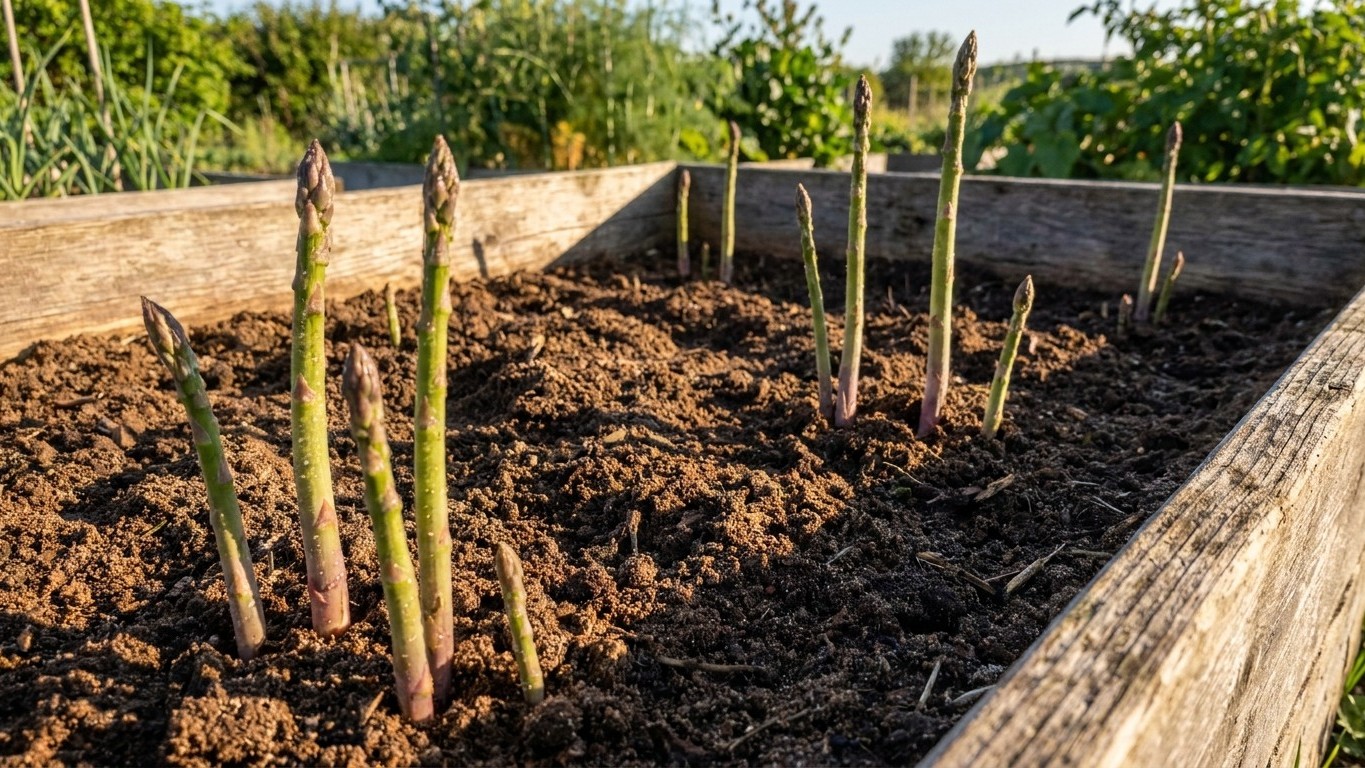

Yes, mostly. The Windsor series, the soil USDA lists as representative of Connecticut, is officially “excessively drained” sandy ground, and the only soil requirement asparagus actually carries is that water not sit around its crowns. That match is good news for a bed meant to stay put for a decade or more. It is not, however, a guarantee for any one particular yard.
The short answer
A cultivated bed of asparagus is unlike almost anything else grown in a home garden. Utah State University Extension is blunt about it: crowns go in as bare-root pieces set in 8-inch furrows, nothing gets cut for two full growing seasons, and the plant only starts giving spears back in its third year. From there it can keep producing for ten to fifteen years straight. That is not a bed you replant if you’re unhappy with the drainage in year six. You pick the spot once, and you live with the choice.
The state soil gives a useful starting point for that choice. The Windsor series carries a surface texture of 82 percent sand, 2 percent clay and 16 percent silt, and USDA classifies it as excessively drained. For a plant whose one stated soil demand is drainage, that is close to ideal. Sand lets water through fast; there is no clay layer underneath to hold moisture around a crown through a wet week, which is exactly the situation asparagus roots resent.
Two things temper that good news. First, the organic matter figure recorded for this series is about 95 percent at the surface, which is not a number a worked vegetable bed will ever show. USDA is describing a natural surface layer, likely a forest litter or organic horizon as originally mapped, not tilled garden soil. A gardener’s actual topsoil, once it has been dug, amended and cropped for a few years, will read nowhere near that high. Second, the recorded pH of 5.1 is strongly acid, and it belongs to that same natural surface reading. Utah State University Extension is silent on what pH asparagus prefers, so nothing here should be read as a target number to hit. The state soil tells you what the ground tends to do, not what your particular sixty square feet will do.
If a soil test on the actual planting site comes back heavy, wet-footed or slow to drain after rain, the fix Extension guidance points toward is straightforward: raise the bed. Building the planting area up eight to twelve inches above grade with amended soil gets the crowns out of standing water without needing to change the native ground underneath. Given the fifteen-year horizon involved, that’s a modest investment of raised-bed lumber weighed against a decade and a half of dead or rotted crowns. Test first. Amend or raise second. Plant third.
Will the summer here water it for you?
Rainfall alone won’t carry a new asparagus bed, and the numbers explain why. Normal summer rainfall across the region, measured June through August at a long-running reference station, totals about 11.1 inches, with July running driest at 3.32 inches, June at 3.77 and August at 3.98. Spread evenly, that sounds close to what a new bed wants. It never arrives evenly, and on sand it drains through before the roots get much benefit.
- What the bed asks for. A newly planted asparagus bed needs 1 to 2 inches of water every other week through its first two seasons of establishment, then can stretch to once every three weeks once it’s mature and cropping.
- What July actually delivers. At 3.32 inches for the whole month, July’s normal rainfall works out to less than an inch every ten days on average, and normals are averages, not weekly guarantees. Some weeks get a soaking thunderstorm; others get nothing.
- Why sand makes it worse, not better. The Windsor series is excessively drained by design. That’s an asset against root rot, but it also means whatever rain does fall passes through the root zone quickly instead of sitting there to be used over the following days.
- What that means for a two-year-old bed. Expect to run a hose or drip line on the weeks rainfall comes up short, particularly through July, rather than assuming the sky will handle it.
- What changes once the bed matures. Once established and cropping, the wider three-week interval gives normal summer rain far more room to cover the gap on its own, especially in a wetter August at 3.98 inches.
- The one number that settles it for a specific yard. A rain gauge on the actual bed, checked weekly against that 1-to-2-inch target, tells a gardener more than any regional normal can, since a slope, a nearby building or a particularly sandy pocket all shift the real figure.
When to put the crowns in
Crowns go into the ground in early spring, before the plant has broken dormancy and while the soil is workable. For timing that locally, the last spring frost at a coastal reference station in the region normally falls around April 2 to April 12. That coastal station sits in the mildest part of the state; inland and northwest areas run measurably colder and typically see their last frost land later, so a gardener working further from the coast should expect to push planting back accordingly rather than working off that same window.
The furrow itself is dug about 8 inches deep, and the crown is set at the bottom, roots spread out, with just enough soil pulled over it to cover it at first. The rest of the furrow is not filled in all at once. Instead, soil gets added back gradually across the season, roughly 2 inches every other month, as the emerging shoots grow taller. That staged backfilling is part of how the planting is meant to work, not an optional shortcut, and skipping straight to filling the furrow full at planting time isn’t what the guidance describes.
Seed is the other route in, and it’s cheaper, but it costs a year of patience: asparagus grown from seed needs an extra full season before it reaches the size of a purchased crown, pushing that first light harvest out further still. For a gardener already committing to a bed that won’t fully pay off for three years no matter what, starting from crowns is the faster path to that first cutting.
On which variety to start with, Utah State University Extension names four without ranking them on flavor, yield or garden performance: Jersey Giant and Jersey Knight are all-male types, while UC 157 F1 and Purple Passion are male-and-female. The distinction that’s actually published is reproductive, not culinary, and no nursery or supplier is specified as the source for any of them.
The harvest itself follows a schedule that shouldn’t be softened. Nothing gets cut in the first two years, full stop. In the third year, harvest is limited to about four weeks. The following year stretches that to six weeks, and after that, to eight. The point at which cutting should stop each season isn’t a date on a calendar; it’s a visual cue. Once most of the spears coming up are thinner than a pencil, harvesting for that season is done, regardless of what week it happens to be.
Common questions
Does asparagus need a particular soil pH to grow well in Connecticut?
The published guidance from Utah State University Extension doesn’t specify a pH preference for asparagus, and no pH target should be assumed from the state soil reading. That 5.1 figure belongs to a natural surface horizon, not a cultivated bed, so it isn’t a number to plant toward.
Can asparagus handle Connecticut winters without special protection?
Winter chilling requirements for asparagus aren’t addressed in the sourced guidance, and nothing here should be taken as a chilling figure derived from hardiness zone. What is published is the growing calendar: crowns planted in early spring, harvest withheld for two years, and a gradual furrow backfill through the first season.
What if a soil test shows my yard doesn’t drain like the state soil suggests?
Raise the bed. Building the planting area up above grade with amended soil is the straightforward fix when native ground holds water too long, and given how long an Asparagus Bed is meant to last, it’s worth doing before crowns go in rather than after.
How soon can I expect to actually eat asparagus from a new bed?
Not before the third year, and even then only for about four weeks. That climbs to six weeks the following year and eight weeks after that, with the cutoff each season determined by spear thickness, not a fixed date, once most spears run thinner than a pencil.