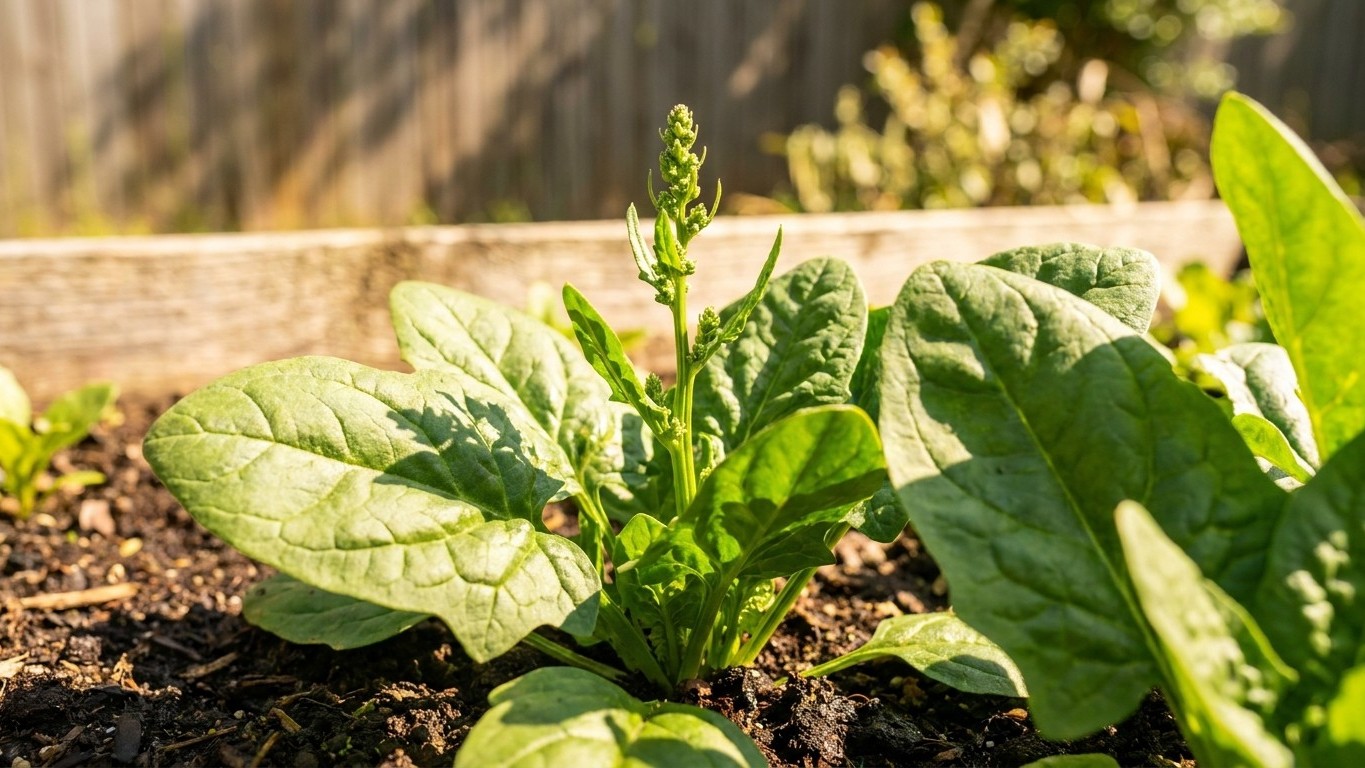

In lowland Hawaii, spinach bolts early almost every time it’s grown outside the coolest stretch of the year. The culprit isn’t unusually long days, Hawaii’s longest day is actually shorter than a mainland summer, but a heat load that rarely lets up and a growing season with no frost to reset the clock. Both day length and warmth push the plant toward flowering here, and warmth does most of the damage.
The short answer
On the summer solstice, Hawaii gets 13 hours and 18 minutes of daylight. That’s shorter than what a gardener in Minnesota or Maine sees in June, where the sun barely sets before 9 p.m. If day length alone decided the fate of spinach, Hawaii would actually have an advantage over the northern tier of states. It doesn’t work that way in practice.
Spinach bolts under long days and warm temperatures together, and it grows best where temperatures stay under 75 F. That ceiling is the real problem in Hawaii, not the clock. The reference station for the islands logs an average of 18.7 days a year at 90 F or hotter, a heat load that has no real off-season at sea level the way a temperate mainland climate does. There’s no winter cold snap to force temperatures down for weeks at a stretch. Instead, the islands cycle between warm and less-warm, and “less-warm” at low elevation still frequently pushes past the point where spinach holds its leaves and stays sweet.
So the honest answer to which factor limits spinach here is both, but heat carries more of the blame. Day length in Hawaii is genuinely shorter than in most of the continental United States during the growing months that matter, which is one small mercy. But the 75 F ceiling, doubling as both a growth limit and the point past which leaves turn bitter, gets crossed often enough at low elevation that the window for clean, non-bolted spinach stays narrow no matter how the daylight hours fall.
| Factor | What triggers bolting | Hawaii’s numbers | Effect here |
|---|---|---|---|
| Day length | Long days push spinach toward flowering | 13 h 18 min on the longest day | Contributes, but shorter than mainland peak daylight |
| Heat | Growth ceiling and bitterness threshold at 75 F | 18.7 days a year at 90 F or above | Dominant driver of early bolting |
A gardener at elevation, upcountry on Maui or in the cooler pockets of the Big Island, sees a different balance. Temperatures there sit closer to that 75 F line more of the year, which buys real time. At sea level in Honolulu or similar low, warm locations, the math is much less forgiving.
How long the spring window really is
The standard mainland rule for spinach, sow 2 to 3 weeks before the last frost, simply has no anchor point in lowland Hawaii. There is no frost season here. NOAA’s 1991-2020 climate normals for the reference station show zero days a year at or below 32 F, with every freeze percentile flagged as not computable. Frost in Hawaii exists only on the summits of Mauna Kea, Mauna Loa, and Haleakala, thousands of feet above any garden bed. A calendar built around a last frost date is not usable here, and trying to force one onto a Hawaii garden plan will just produce a wrong answer.
Working out the real spring window means throwing out the frost anchor and using the 75 F ceiling instead. Here’s how that reasoning runs, step by step:
- Start by discarding the “weeks before last frost” formula entirely, since lowland Hawaii has no last frost to count from.
- Identify the actual gatekeeper: the 75 F ceiling, above which spinach growth suffers and leaves turn bitter.
- Recognize that with 18.7 days a year reaching 90 F or higher at the reference station, the low-elevation year has no long, reliable stretch that stays under 75 F.
- Look to the wetter, cooler months of the year, the closest thing lowland Hawaii has to a temperate spring, as the only realistic sowing window, understanding that even then, warm spells can push past the ceiling with little warning.
- Look upward instead of forward: gardens at real elevation run cooler for more of the year and stretch that window out considerably, sometimes into something closer to a genuine multi-month spring season.
The upshot is that lowland Hawaii doesn’t get a clean, predictable spring window the way a mainland garden does. It gets a shorter, less certain stretch of cooler weather, bounded not by a date on a calendar but by how long the thermometer behaves itself. Elevation is the single biggest lever a Hawaii gardener has for lengthening that window, more useful than picking a different sowing date at the same low altitude.
The autumn crop, and when the soil lets you sow
Fall Spinach in Hawaii runs into two separate obstacles, and neither of them is a hard freeze. Utah State University Extension, the only source behind these numbers, says to plant a fall crop 50 to 75 days before the date you want to harvest. No days-to-maturity figure is published for spinach by that source, and none should be borrowed from another crop. Four varieties, Bloomsdale, Melody, Teton, and Olympia, are named by that same source with no performance data attached to any of them, so there’s nothing further to say about how they compare here.
Warm soil delays germination
The first obstacle shows up before the seed ever sprouts. Spinach seed germination drops off once soil temperature climbs above 80 F, according to Utah State University Extension. In a climate where 18.7 days a year reach 90 F or hotter at the reference station, soil temperature at low elevation stays above that 80 F mark for long stretches, especially through summer and into early autumn. The practical fix isn’t a calendar date, it’s a soil thermometer. Sowing has to wait until the ground itself cools below that threshold, which in a hot lowland location may happen later in the year than a mainland gardener would expect, and may not happen reliably at all in some low, dry, leeward spots.
No frost to end the season, but heat still does
The second obstacle, in most of the country, is the first fall frost killing the crop outright. That doesn’t apply here. NOAA’s climate normals for the reference station show the same result for fall as for spring: zero days a year at or below 32 F, every freeze percentile not computable. Frost never arrives to end a Hawaii lowland garden. What ends the autumn spinach crop instead is the return of warmth, either a stretch of days climbing back past 75 F or the general drift toward a warmer part of the year, both of which trigger the same bolting response covered earlier. Counting back 50 to 75 days from a harvest target set inside the coolest, wettest stretch of the year gives a workable sowing window, but that window still has to clear the 80 F soil hurdle first. In practice, that means the fall sowing date in lowland Hawaii is set by two moving thresholds, soil cooling down and air staying down, rather than by any single date on a printed frost map.
Common questions
Does higher elevation in Hawaii really change the spinach outlook that much?
Yes, in principle. Since the entire problem for lowland Hawaii is staying under the 75 F growth ceiling and clearing the 80 F soil germination hurdle, any location that runs naturally cooler, meaning higher elevation, has more days a year that satisfy both conditions. The reference station’s figures apply to the lowland site itself, not to upcountry locations.
Can I use a frost date chart from a mainland gardening guide for Hawaii?
No. NOAA’s climate normals for the reference station show zero freeze days a year with every freeze percentile flagged as not computable. A frost-based planting chart has no valid anchor point in lowland Hawaii and will produce wrong sowing dates.
Is a cool Hawaii summer enough to stop spinach from bolting?
No. Bolting is triggered by long days together with warmth, and Hawaii’s summer daylight, 13 hours 18 minutes at the longest, still falls within the range that contributes to flowering once combined with the heat load the islands carry, an average of 18.7 days a year at 90 F or above.
Which spinach variety bolts slowest in Hawaii?
That isn’t something the available data answers. Utah State University Extension names Bloomsdale, Melody, Teton, and Olympia as spinach varieties, but publishes no comparative bolting or performance figures for any of them, and no other sourced data fills that gap here.