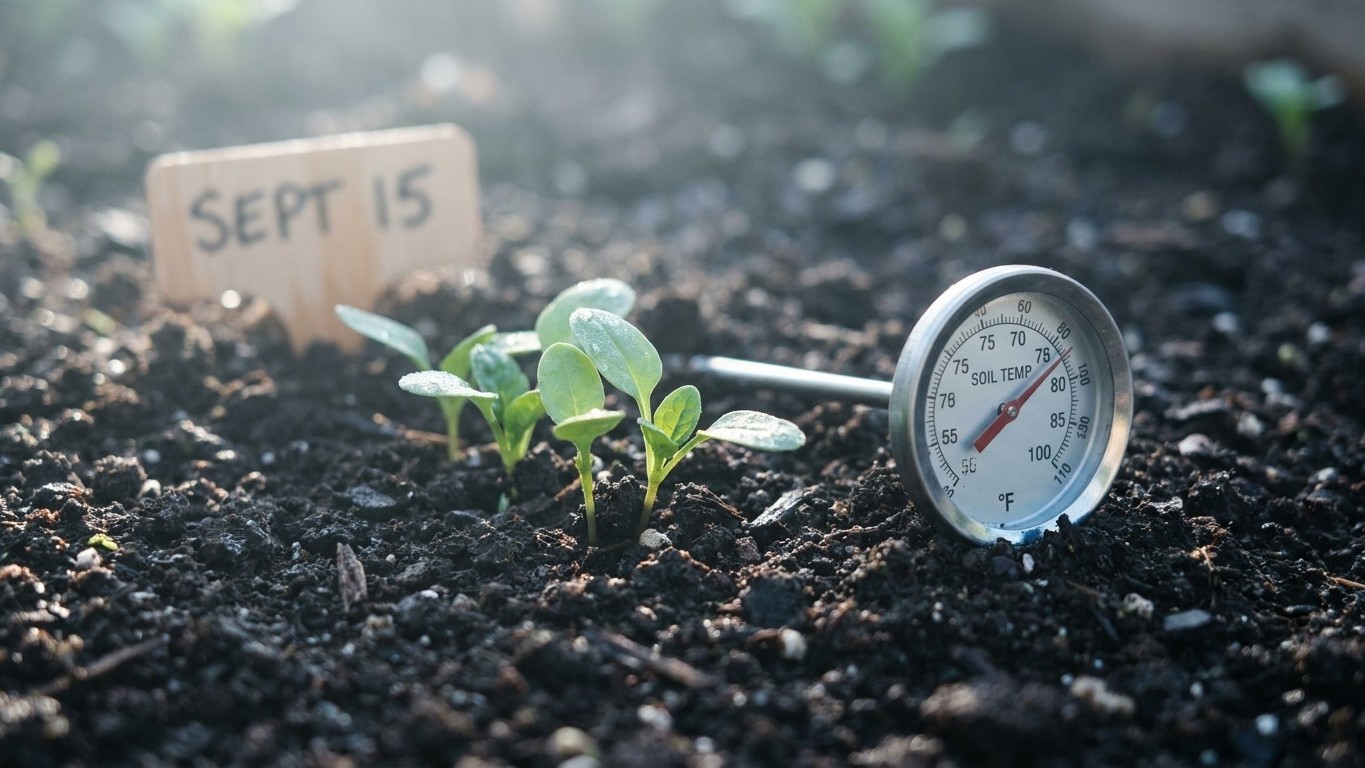

Autumn Spinach in Hawaii goes into the ground once soil temperature drops out of the germination danger zone, not on a date pulled from a frost calendar. Count back 50 to 75 days from the harvest you actually want, and expect that window to open later at sea level than it does upcountry, where cooler soil and milder afternoons arrive sooner in the cool season.
The short answer
Start with the number that surprises most gardeners moving to Hawaii from anywhere else: 13 hours and 18 minutes of daylight on the longest day of the year at the reference city. That is a shorter summer day than almost anywhere on the mainland, because Hawaii sits close enough to the tropics that day length barely swings across the year. For a crop like spinach, where long days combined with warmth are what trigger the plant to throw a flower stalk and turn bitter, that modest summer daylight matters, but it is not the dominant force pushing the calendar here.
Heat is. The reference station logs an average of 18.7 days a year at 90 F or hotter, and that figure only counts the days that cross the 90-degree line. It says nothing about the long stretch of afternoons sitting in the low-to-mid 80s, which is already well above the 75 F ceiling where spinach growth quality falls apart and leaves turn bitter. In most of temperate North America, gardeners fight day length in June and heat in July. In lowland Hawaii, the two arrive together and stay for most of the year, because the tropical climate does not hand out a sharp, cool shoulder season the way a mid-latitude spring or fall does.
So the honest framing is this: day length sets a ceiling that spinach in Hawaii will bump into for a few weeks around midsummer, but heat is the obstacle that dominates the calendar almost every other month. A gardener at sea level in Honolulu is not choosing between “long day” and “short day” windows the way a Minnesota or Montana grower does. They are choosing between “too hot to grow spinach well” and “cool enough, for now.” That distinction changes everything about how the rest of this calendar gets built, because it means elevation, not date, becomes the real lever a Hawaii gardener can pull. A garden at 2,000 feet in upcountry Maui or in Waimea on the Big Island runs several degrees cooler on an average afternoon than one at sea level, and that gap can be the difference between spinach that stays sweet and spinach that bolts before it fills a bowl.
None of this means spinach is impossible in the islands. It means the crop behaves less like a seasonal vegetable with a fixed start and stop date, and more like a cool-microclimate crop that has to be timed around heat spikes and, secondarily, around the handful of weeks near the solstice when daylight itself pushes the plant toward flowering.
How long the spring window really is
Utah State University Extension frames the general spinach rule in two parts: sow 2 to 3 weeks before the last expected frost, and expect growth quality to drop once temperatures climb above 75 F. Applying that logic to Hawaii takes some translating, since frost is not part of the local picture at all.
- There is no last frost date to count back from. NOAA’s 1991-2020 climate normals for the reference station show a not-computable flag for every freeze percentile at 32 F and 36 F, with zero days per year at or below freezing. Frost in Hawaii only occurs on the summits of Mauna Kea, Mauna Loa and Haleakala, altitudes no garden occupies.
- The real starting signal is soil and air temperature falling, not a calendar frost date. That happens gradually as the cool season sets in, and it happens sooner and more decisively at elevation than at sea level, where afternoons routinely sit close to or above the 75 F ceiling year-round.
- The window closes the moment temperatures climb back above 75 F, which at sea level can be a matter of weeks rather than months. At higher elevations, that ceiling is crossed less often, stretching the usable stretch considerably.
- Net result: lowland Hawaii has a narrow, temperature-limited spring-equivalent window, while upcountry gardens get something closer to a genuine multi-week season. Neither is governed by frost, and neither should be planned around one.
Four spinach varieties come up repeatedly in extension guidance, Bloomsdale, Melody, Teton and Olympia, though the source material does not publish days-to-maturity or heat-tolerance data for any of them individually. Choosing among them on the basis of Hawaii-specific performance is not something the available data supports, so it is worth treating variety choice as secondary to timing and elevation.
The autumn crop, and when the soil lets you sow
Fall spinach in Hawaii runs into two separate obstacles, and they show up at opposite ends of the season rather than as a single planting rule.
Soil still too warm to germinate
Utah State University Extension notes that spinach seed germination drops once soil temperature climbs above 80 F. That threshold, not a calendar month, is what actually blocks an early fall sowing in Hawaii. Lowland soils that have been baking through a summer averaging 18.7 days a year at 90 F or hotter hold heat well into what would be considered fall elsewhere, and they do not necessarily fall below 80 F on any predictable date. Gardeners who wait for cooler mornings and check soil temperature directly, rather than sowing on a fixed week, avoid the frustration of seed that simply fails to come up.
What actually ends the season
Because there is no autumn frost in Hawaii’s inhabited areas, the fall crop is not cut short by a freeze the way it would be in most of the continental United States. NOAA’s climate normals confirm the same not-computable freeze flag for fall as for spring, with zero days per year at or below 32 F at the reference station. What ends the productive window instead is the return of sustained heat and the lengthening days that follow the shortest day of the year, both of which push spinach back toward the 75 F growth ceiling and eventual bolting.
Put together, that means the practical way to plan an autumn sowing is to pick a realistic harvest date sometime during the coolest stretch of the year, then count back 50 to 75 days from it, the range Utah State University Extension gives for fall spinach generally. A gardener at elevation, where soil cools below 80 F earlier and stays below 75 F longer, has more flexibility in choosing that harvest date than a sea-level gardener working with a much tighter margin.
Common questions
Does Hawaii ever get a frost that would end a spinach crop?
No, not in any area where gardening happens. NOAA’s 1991-2020 climate normals for the reference station return a not-computable flag for freeze percentiles at both 32 F and 36 F, with zero recorded days per year at or below freezing. Frost is confined to the summits of Mauna Kea, Mauna Loa and Haleakala.
Why does long daylight matter for spinach if Hawaii’s days aren’t that long compared to the mainland?
At 13 hours 18 minutes on the longest day, Hawaii’s summer daylight is shorter than most of the continental United States sees, but it still crosses the threshold that, combined with warmth, pushes spinach toward flowering. It is a secondary factor here, with heat carrying most of the weight.
Is soil temperature or air temperature the better guide for sowing?
Soil temperature is the direct trigger for germination, with the 80 F ceiling coming from Utah State University Extension. Air temperature above 75 F is the separate threshold that limits growth quality and encourages bitterness and bolting once plants are established.
Should a gardener at higher elevation follow a different calendar than one at sea level?
Yes, in practice. Neither NOAA nor the extension source publishes elevation-specific dates for Hawaii, but the same 75 F growth ceiling and 80 F germination limit apply everywhere; they are simply crossed less often and later in the year at elevation, which extends the usable window without changing the underlying rule.