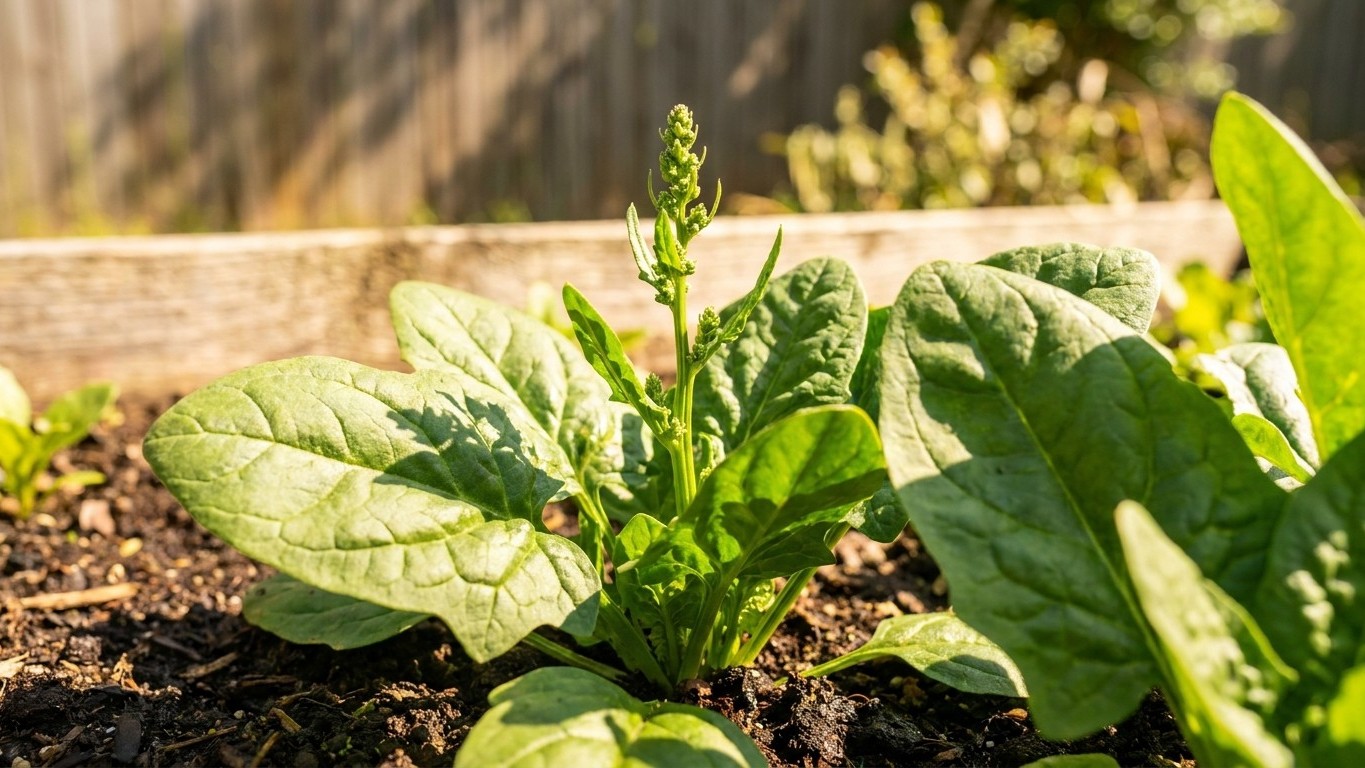

In Idaho’s low valleys, the answer is yes. Spinach will bolt early, and it isn’t really a question of how cool the summer feels. The trigger is day length, and the Boise valley’s summer days run far longer than what keeps spinach leafy. Add nearly fifty days a year over 90°F, and the crop faces a double squeeze: light that pushes it toward flowering and heat that pushes it toward bitterness at the same time.
The short answer
On the longest day of the year, the Boise area gets 15 hours and 15 minutes of daylight. That’s the number that matters most here, more than any thermometer reading. Spinach bolts under long days combined with warm temperatures, and once daylight stretches past whatever threshold triggers flowering in a given planting, the plant switches from making leaves to sending up a seed stalk. No amount of shade cloth or clever siting changes how many hours the sun is up. A gardener a few counties over with milder summer temperatures still gets the same 15-hour daylight, because day length depends on latitude, not on local weather.
This is where a lot of gardeners get tripped up. A cool summer feels like it should buy extra weeks of harvest, the same logic that works for lettuce or broccoli in a lot of climates. Spinach doesn’t play by that rule. Long days alone are enough to flip the switch, whether the air is 70°F or 95°F. So a mild June in the foothills doesn’t rescue a spring spinach patch the way it might for other greens.
That said, heat isn’t a bystander here. Idaho’s low-elevation valleys average 47.5 days a year at or above 90°F, and spinach grows best when temperatures stay under 75°F. Once the mercury climbs past that ceiling, growth slows and the leaves turn bitter, on top of whatever bolting the long days are already causing. So the honest answer is both: day length sets the calendar for when bolting starts, and heat load makes the decline sharper and the flavor worse once it does.
Elevation changes the heat side of this equation but not the light side. Gardens up in the mountains or on the Snake River Plain’s higher benches see fewer 90°F days than the Boise valley, which softens the bitterness problem somewhat. But those same gardens sit under the identical 15-hour-15-minute summer sky, so the bolting trigger arrives on roughly the same schedule regardless of altitude. Higher ground buys a slightly gentler decline, not a longer season.
How long the spring window really is
Working out the usable spring window means stacking a few known numbers against each other, since no single figure hands you the answer directly.
- The last spring frost across the reference area falls between April 23 and May 7. That’s the anchor date for everything that follows.
- Spinach seed goes in the ground 2 to 3 weeks before that last frost date, which puts sowing somewhere between early April and late April, depending on how the season is running and which end of that frost range applies locally.
- From sowing, the plant needs enough cool weeks to size up before daylight and heat converge. Growth stays good as long as temperatures don’t climb past 75°F, and Idaho’s valleys typically hold under that ceiling through much of April and into May before the warm-season days above 90°F start accumulating later in the summer.
- Daylight keeps lengthening through the whole stretch, moving toward that 15-hour-15-minute peak at the June solstice. Since bolting responds to long days as well as warmth, the plant is working against a clock that’s ticking whether the thermometer cooperates or not.
- Put together, that leaves a real harvest window of roughly six to eight weeks from sowing to bolt, a stretch that closes not because the calendar says summer has arrived, but because the combination of lengthening days and rising heat crosses the plant’s tolerance somewhere in late May to mid-June.
None of this is a fixed schedule. A colder pocket in the state, sitting higher than the reference valley, pushes the last frost date later and the whole window later with it, but the same daylight ceiling still closes it down at roughly the same point on the calendar, because day length doesn’t shift with elevation the way frost dates do.
The autumn crop, and when the soil lets you sow
Fall spinach gets around the long-day problem simply because days are shortening by then, not lengthening. But it runs into two separate obstacles that don’t show up in spring, and each one deserves its own look.
Soil still too warm to germinate
Spinach seed germinates poorly once soil temperatures climb above 80°F, and Idaho’s valleys spend a good part of summer well past that mark. With 47.5 days a year hitting 90°F or higher in the air, the soil beneath a garden bed stays hot for a stretch afterward too, since ground temperature lags behind air temperature by days or weeks. That means an early-August sowing attempt, timed purely off the calendar, can still land on soil too warm for the seed to sprout reliably. The practical fix is waiting for soil to cool rather than counting days from the last heat wave, since the source data ties germination failure to a specific soil threshold, not a fixed date.
The frost that ends the season
The other end of the fall window is set by the first fall frost, which arrives between October 7 and October 21 across the reference area. Utah State University Extension recommends sowing a fall crop 50 to 75 days before the target harvest date, and no days-to-maturity figure is published for spinach beyond that guidance. Counting back from the earlier end of the frost range, October 7, at 75 days out lands sowing around late July. Counting back from the later end, October 21, at 50 days out lands sowing around early September. That gives a realistic fall sowing window somewhere between late July and early September, with the earlier part of that stretch still running up against the warm-soil problem described above. In practice, the workable sowing days cluster in August, once soil has had time to cool from midsummer highs but while there’s still enough calendar left before the October frost line to reach harvest size.
The source material names four spinach varieties, Bloomsdale, Melody, Teton, and Olympia, but publishes no specific data comparing how they perform under these conditions. Choosing among them for an Idaho fall or spring planting isn’t something the available data supports one way or the other.
Common questions
Does a shady spot delay bolting?
Shade lowers leaf temperature somewhat, which can ease the bitterness that comes with the 75°F growth ceiling, but it does nothing about day length. Since long days trigger bolting on their own, a shaded bed still sees the same 15-hour-15-minute summer daylight and bolts on a similar schedule to a bed in full sun.
Is there a difference between spring bolting and fall bolting risk?
Yes, and it’s the reason fall planting is generally more forgiving. Spring sowing runs straight into lengthening days heading toward the June solstice, so bolting pressure builds throughout the growth period. Fall sowing happens after the solstice, with days shortening, so the long-day trigger isn’t in play the same way. The obstacles in fall are warm soil blocking germination and the arrival of the first frost, not day length.
Can higher elevation Idaho gardens grow spinach longer into summer?
Cooler high-elevation summers reduce how many days climb past 90°F, which softens the heat-driven bitterness and slows decline somewhat. But elevation doesn’t change day length. Gardens at higher elevation still reach the same 15-hour-15-minute peak on the summer solstice, so the bolting trigger tied to long days arrives on a similar timeline even where the air stays cooler.
Why does spring frost timing vary so much across Idaho?
The April 23 to May 7 range comes from the reference station in the Boise valley, a low-elevation site. Most of Idaho sits higher and colder, meaning last frost dates in mountain valleys and higher benches typically run later than this range, which shortens the frost-free season and shifts spring sowing dates back accordingly.