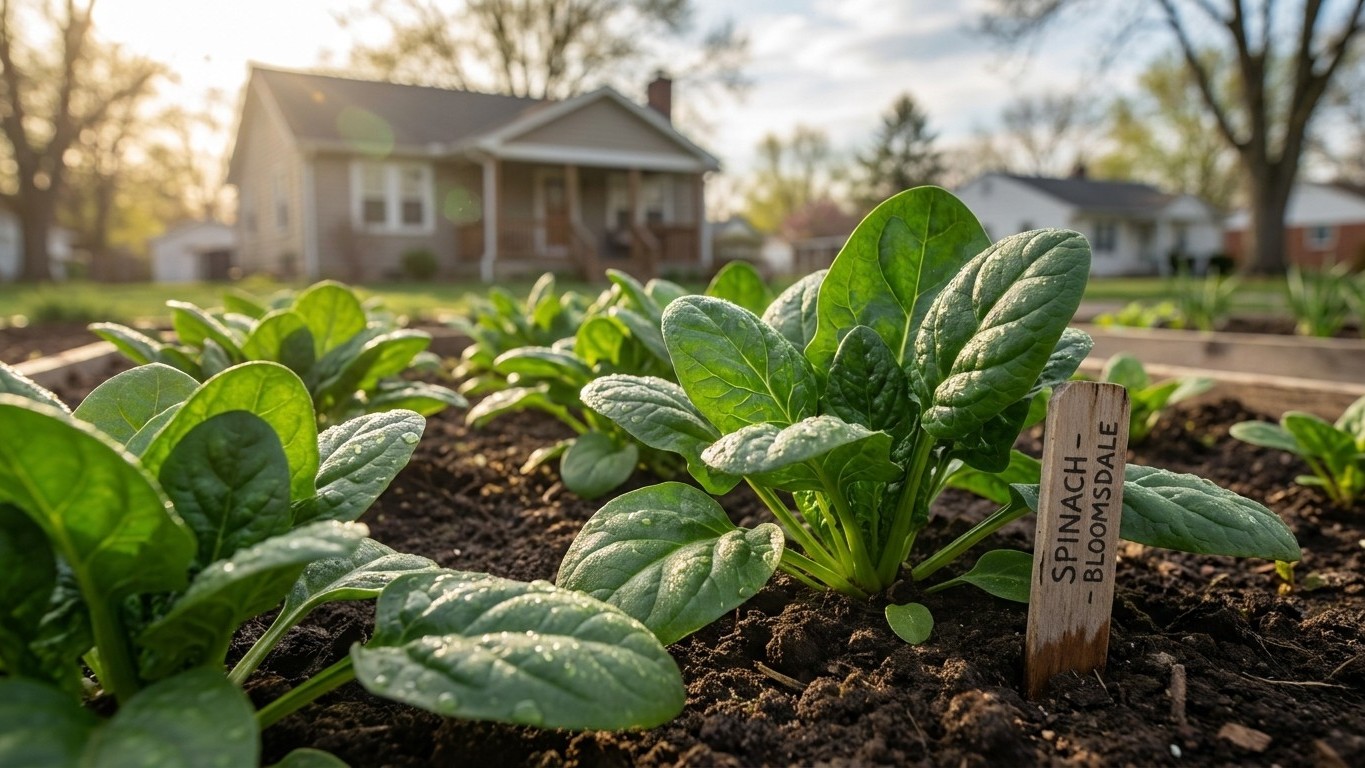

Spinach bolts fast in Idaho’s Treasure Valley because the crop answers to two triggers at once: long summer daylight and heat above 75 F. Boise’s growing season delivers both by early June, which squeezes the spring crop into roughly six to eight weeks and pushes gardeners toward a fall planting instead, one that has its own timing puzzle involving warm soil and the first frost.
The short answer
On the longest day of the year, the Boise area sees 15 hours and 15 minutes of daylight. That number matters because spinach treats long days as a flowering signal, not a growing bonus. Once daylight stretches past a certain point, the plant shifts its energy from leaf production to sending up a seed stalk, a shift gardeners call bolting. A cool summer does nothing to slow that clock. The plant is responding to the angle of the sun and the length of the day, not to the thermometer alone, so even a mild June in the foothills won’t buy extra weeks of harvest.
Heat piles on top of that daylight trigger. Idaho’s reference station in Boise averages 47.5 days a year at 90 F or hotter, a heat load that starts building well before the solstice and often overlaps with the same weeks when daylight is already long. Utah State University Extension notes that spinach grows best where temperatures stay under 75 F, a ceiling that Boise’s spring routinely clears by late May or early June. So the honest answer is that the limit here is both day length and heat, arriving almost together rather than one after the other. That’s a tougher combination than a purely hot climate with short days, or a purely cool one with long days, because there’s no calendar gap between the two pressures for the plant to slip through.
What that means for a home garden is straightforward, if a little frustrating: the spring spinach window in the valley floor is genuinely short, and it closes early. Higher elevations across Idaho, where summer arrives later and cools off sooner, get a bit more slack because the heat threshold is delayed, but the daylight trigger stays exactly the same no matter the altitude. Fifteen hours and fifteen minutes of June daylight falls on Boise, Idaho Falls, and Coeur d’Alene alike. Only the heat side of the equation shifts with elevation. That’s worth remembering before assuming a mountain garden gets a much longer spinach season than a valley one, and it’s the same question worth asking anywhere in the state: Will Spinach Bolt Early in Idaho? Given how short that spring window runs, many gardeners shift their focus to When to Sow Autumn Spinach in Idaho instead.
How long the spring window really is
Working out the usable spring stretch means lining up the frost date, the sowing rule, and the heat ceiling in order.
- Start with the last frost. NOAA’s 1991-2020 climate normals put Boise’s last spring freeze between April 23 and May 7, based on station USW00024131.
- Sow two to three weeks earlier. Spinach seed tolerates cold soil, so the planting date lands somewhere between roughly April 2 and April 23, depending on how the season is running.
- Count forward to the heat ceiling. Growth stays good only while temperatures hold below 75 F. In the valley, that ceiling is typically crossed sometime between late May and mid-June, well before the summer solstice even arrives.
- Add the daylight trigger on top. Even where a stretch of cooler weather delays the heat problem, daylight keeps climbing toward that 15-hour-15-minute peak, and once day length alone is long enough, bolting starts regardless of temperature.
- Total usable window. That leaves roughly six to eight weeks of productive spring growth in the Boise area, from early April sowing to a late May or early June finish, shorter at lower elevations and slightly longer where cooler valleys or higher benches delay the 75 F threshold.
Higher, colder parts of Idaho change the frost math but not the daylight math. A garden a few thousand feet up may sow later and still dodge the 75 F ceiling longer into June, stretching the harvest by a couple of weeks. But nowhere in the state does the plant escape the long-day trigger once June daylight arrives.
The autumn crop, and when the soil lets you sow
Fall spinach avoids the daylight problem entirely, since day length is shrinking rather than growing through August and September. That leaves two separate obstacles to plan around, and they sit at opposite ends of the calendar.
Soil too warm to germinate
Utah State University Extension notes that spinach germination drops off once soil temperature climbs above 80 F. Late July and August in the Treasure Valley run hot enough, especially given those 47.5 average days a year at 90 F or above, that soil several inches down often stays above that mark well into the month. Sowing directly into that warm ground usually means poor, patchy germination rather than an outright failure, but it’s a real drag on stand quality. The practical fix is to wait for soil to cool, which in most years means holding off until late August, and to water the seedbed ahead of sowing since damp soil sheds heat faster than dry soil baking in direct sun.
The frost that ends the season
Boise’s first fall frost, per the same NOAA NCEI normals, arrives between October 7 and October 21. Utah State University Extension’s guidance for a fall crop is to plant 50 to 75 days before the date you want to harvest. Counting back from an October 7 target puts the sowing date around July 24; counting back from October 21 pushes it to around September 1, though a harvest that late leaves almost no buffer if frost arrives on the early side of the window. A more workable middle ground for most Boise-area gardens lands sowing somewhere between mid-August and the very end of August, balancing the need for cooler soil against the need to get a full 50 to 75 days of growth in before the ground freezes hard.
Four spinach varieties come up often in extension guidance for home gardens: Bloomsdale, Melody, Teton, and Olympia. Utah State University Extension names these but publishes no specific days-to-maturity or bolt-resistance figures for any of them, so choosing among them comes down to what’s available locally rather than a documented performance edge for Idaho conditions.
Checking this against your own county
Boise sits in a low valley, and its frost dates and heat load don’t necessarily match a garden up in the panhandle, out in eastern Idaho’s higher basins, or tucked into a mountain valley where the growing season runs shorter and colder on both ends. The daylight trigger for bolting stays fixed everywhere in the state, but frost timing and heat accumulation shift a lot with elevation and latitude.
Before locking in a planting date, it’s worth checking current local guidance through University of Idaho Extension, which can point to frost data and planting calendars specific to a given county rather than the single Boise reference station used here.
Common questions
Can shade delay spinach bolting in Idaho’s hot summers?
Shade can lower the temperature a plant experiences, which helps with the heat side of bolting, but it does nothing about day length. Since daylight alone can trigger flowering once it’s long enough, shade only buys partial relief, not a full extension of the harvest.
Is a fall spinach crop more reliable than a spring one in Boise?
Fall sowing sidesteps the long-day trigger since daylight is shrinking, not growing, through late summer and early fall. The tradeoff is warm soil at sowing time and a hard stop at first frost, so it’s a different set of constraints rather than an easier season outright.
Does elevation change when spinach bolts in Idaho?
Elevation changes how fast heat builds and when frost hits, but not the daylight hours on the longest day, which stay essentially the same across the state’s latitude range. Higher gardens can delay the heat-driven side of bolting somewhat, but the daylight trigger arrives on schedule everywhere.
Should Idaho gardeners choose a specific spinach variety to fight bolting?
Bloomsdale, Melody, Teton, and Olympia all show up in extension references for home gardeners, but there’s no published days-to-maturity or bolt-resistance data behind any of them for this region. Picking one comes down to seed availability rather than a documented advantage for Idaho’s day length and heat pattern.