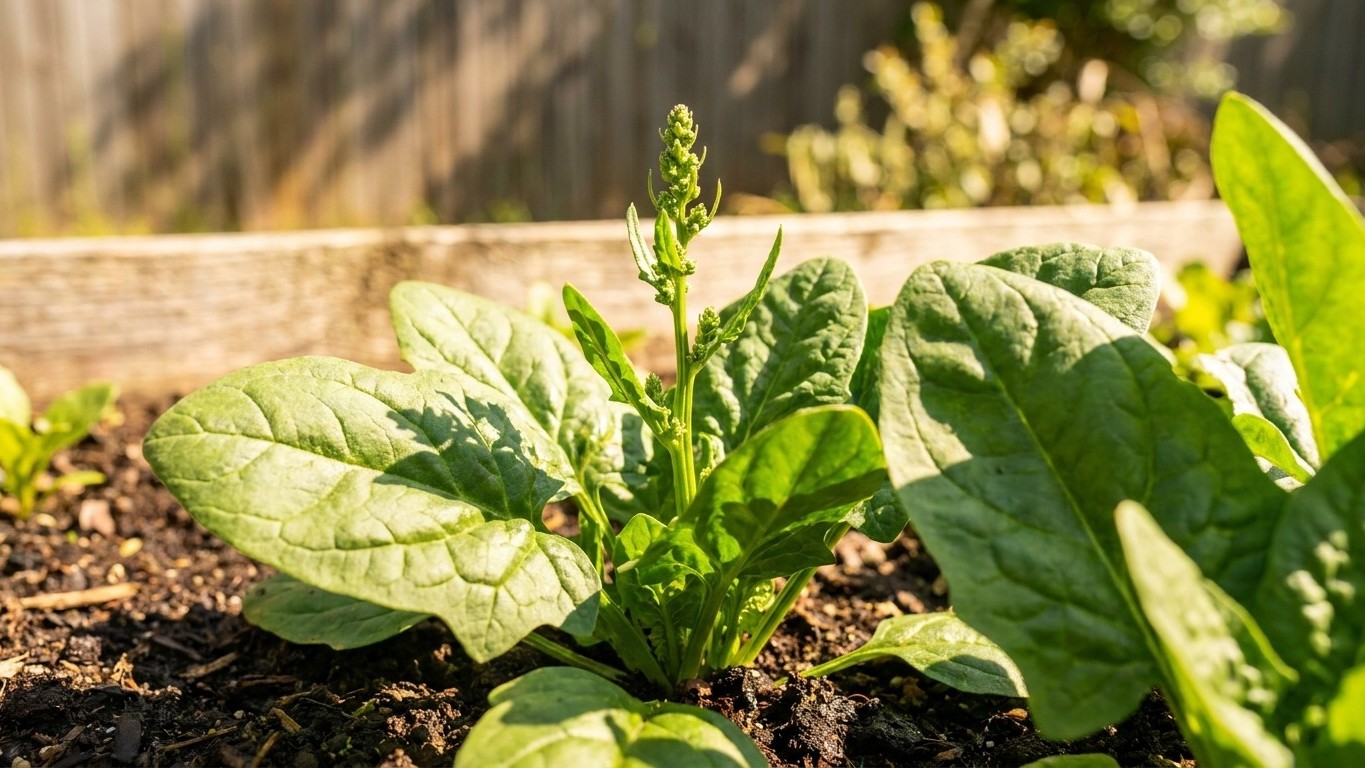

Yes, spinach bolts early almost everywhere in Illinois, and the driving force is day length, not heat. Once the calendar rolls toward the June solstice, the days grow long enough to flip spinach into flowering mode no matter how mild the temperature stays. That means the real skill in growing this crop here is picking the right calendar window, spring or fall, rather than hoping for a cool stretch to buy extra time.
The short answer
At the reference city, the longest day of the year delivers 15 hours and 4 minutes of daylight. That number matters because spinach flowers in response to long days combined with warm temperatures, and 15 hours and 4 minutes is well past the point where flowering gets triggered. A gardener in Illinois cannot outsmart this by waiting for a cooler-than-average June or July. The day length itself is doing the work, and it arrives on schedule whether the thermometer cooperates or not.
That’s the first mechanism. The second is heat, and in Illinois it piles on rather than acting alone. Spinach grows best where temperatures stay under 75 degrees Fahrenheit, and the reference station averages 14 days a year at 90 degrees or hotter. Those 14 days aren’t the whole story, since plenty of spring and early summer afternoons climb into the 70s and 80s without ever hitting 90, but they signal a summer heat load that pushes soil and air temperatures past the spinach comfort zone well before the hottest days actually arrive. By the time the calendar reaches the days with the longest daylight, the air is usually warm enough on its own to finish the job that the daylight started.
So the honest answer is both. Day length sets the trigger, and Illinois summer heat backs it up. Neither factor works in isolation here, and neither one is optional. A cool, cloudy June in Illinois still delivers over 15 hours of daylight at the solstice, and that alone is enough to push spinach toward flowering stalks, tough leaves, and a bitter taste. Seed catalogs list named varieties like Bloomsdale, Melody, Teton, and Olympia, but the extension source behind these figures publishes no bolt-resistance ratings or days-to-maturity numbers for any of them. That leaves timing, not variety choice, as the tool a gardener actually has control over.
Practically, this means treating spinach as a two-season crop in Illinois: a spring planting that beats the solstice, and a fall planting that beats the first hard frost. Anything sown to mature during the long-day stretch of June and early July is fighting a losing battle against biology that no amount of watering or shade cloth fully reverses.
How long the spring window really is
Working out the spring window means lining up three numbers: the last frost date, the 2-to-3-week head start spinach seed tolerates before that frost, and the point where daylight and heat together shut the crop down.
- The reference station’s last spring frost falls between April 11 and April 22, based on 1991-2020 climate normals. That’s a airport-station figure, and suburban and rural gardens across Illinois often see frost linger one to two weeks longer, so a home gardener should treat this as a starting point to check against local conditions, not a fixed date.
- Spinach seed can go into the ground 2 to 3 weeks before that last frost date, since the crop tolerates cold soil far better than heat. That puts sowing somewhere in the last third of March through the first week or so of April for most of the state, earlier for gardens that reliably see their frost pass sooner, later for those with a documented later last frost.
- From there, the plant has a run of cool weeks before daylight and warming air start working against it. Growth stays productive as long as conditions stay under that 75-degree ceiling, and that generally holds through most of April and into May across Illinois. The clock really starts running out as the calendar approaches the solstice, when daylight crosses well past 15 hours and afternoon temperatures start regularly testing that 75-degree line.
- Add it up and the usable spring stretch runs somewhere around seven to nine weeks: sow in late March or early April, harvest steadily through April and May, and expect the crop to bolt or turn bitter as June’s long days and rising heat converge. Gardens with a later last frost lose some of those weeks off the front end; gardens with an earlier one gain a few.
That window is tighter than most people expect from a “cool-season” vegetable. It rewards an early, even slightly risky, sowing date more than it rewards patience.
The autumn crop, and when the soil lets you sow
Fall spinach in Illinois runs into the opposite problem from spring. Instead of racing daylight, it has to wait out summer’s leftover heat before the seed will even germinate, then race the calendar to get enough growth in before frost shuts things down.
Soil still too warm to germinate
Spinach seed germination drops off sharply once soil temperatures climb above 80 degrees Fahrenheit, according to Utah State University Extension. Illinois soil in August routinely sits well above that mark, carrying the heat of a summer that averages 14 days a year at 90 degrees or hotter at the reference station. That means an early-August sowing attempt often just sits in the ground doing nothing, or germinates so unevenly that the stand isn’t worth the effort. The practical fix is waiting for soil to cool, which typically happens as the calendar moves deeper into late August and September and nights start losing their summer warmth.
Racing the first frost
The reference station’s first fall frost arrives between October 24 and November 3, based on the same 1991-2020 climate normals. As with the spring date, suburban and rural gardens across the state often see frost show up one to two weeks earlier than that, so this figure works better as a benchmark to check locally than as a guarantee. Utah State University Extension frames fall sowing as 50 to 75 days before the target harvest date, and no other days-to-maturity figure is published here for spinach. Counting back 50 to 75 days from an October 24 harvest lands somewhere between early August and early September. Counting back from a more cautious mid-October harvest date, to build in a buffer against an early frost, pushes that sowing window into mid-August through mid-September.
Put both obstacles together and the practical fall sowing window in Illinois sits in late August into early-to-mid September: late enough that soil has cooled below the 80-degree germination barrier, early enough that the plant still gets 50 to 75 days of growth before the first realistic frost date. It’s a narrower gap than the spring window, and it depends heavily on how quickly a given piece of ground cools after summer, something that varies with soil type, mulch, and how much shade a garden bed gets in late afternoon.
Common questions
Does a cooler-than-normal summer delay bolting in Illinois?
Not by much. The trigger is day length as well as heat, and day length arrives on the same schedule every year regardless of temperature. A mild June still delivers the same 15 hours and 4 minutes of daylight at the solstice, and that alone pushes spinach toward flowering.
Can shade cloth or row covers extend the spring harvest?
Shade can lower leaf temperature somewhat and may buy a few extra days, but it does nothing about day length, which is the primary trigger described by the research behind spinach bolting. Treat any extension as marginal, not a substitute for sowing early.
Is there a bolt-resistant variety that solves this for Illinois gardens?
Named varieties like Bloomsdale, Melody, Teton, and Olympia show up regularly in seed catalogs, but the extension source used for this article publishes no bolt-resistance data or days-to-maturity figures for any of them. Timing the sowing date remains the tool with documented backing here.
What if my garden’s frost dates don’t match the reference station?
That’s common. The last spring frost and first fall frost figures here come from an airport weather station, and suburban and rural gardens typically see frost arrive later in spring and earlier in fall, sometimes by one to two weeks, more at higher elevation. Check county-level records or local observation before locking in a sowing date.