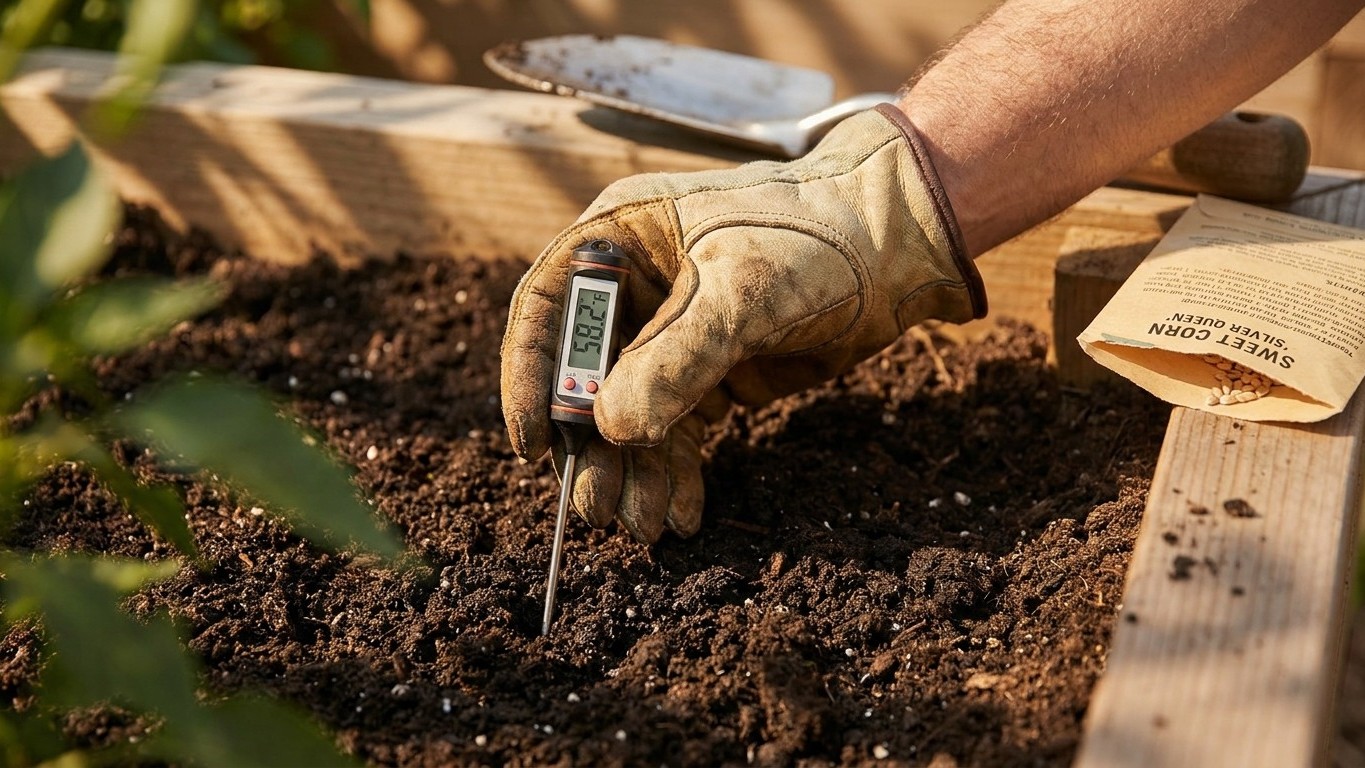

Soil above 60°F is the real trigger for sweet corn in Illinois, and that mark shows up well after the last spring frost, not on the same calendar page. At the reference weather station, that frost falls between April 11 and April 22, but soil doesn’t catch up to 60°F until weeks later. Once it does, a 60- to 90-day variety has room to mature before the first fall frost arrives between October 24 and November 3, so the window here is generous rather than tight.
The short answer
Air and soil don’t warm at the same speed. Air temperature can swing 20 degrees in an afternoon; soil holds onto cold for weeks after the last freeze because it’s slower to release winter’s chill. That’s the mechanism behind the gap between “last frost” and “soil ready for corn.” A gardener who plants the week after the last frost date, treating that date as the green light, is usually planting into soil still too cold for germination. Sweet corn seed sitting in cold, wet ground doesn’t sprout evenly. It can rot outright, or come up so thin and patchy that the stand never fills in.
The fix is patience measured in soil, not sky. Wait until the ground itself reads above 60°F before dropping seed, regardless of how warm the air feels on a sunny afternoon. In much of Illinois, that point typically lands well into May, sometimes closer to the back half of the month depending on how wet the spring has been. A rainy spring keeps soil cold longer because wet ground releases heat more slowly than dry ground.
Once soil clears that 60°F bar, the math on the growing season gets easier. Sweet corn needs 60 to 90 days from planting to harvest. Between a mid-to-late-May start and a fall frost that doesn’t show up until late October or early November at the reference station, there’s a stretch of five months or more to work with. That’s a wide margin for a crop that only needs three.
Two things narrow that margin, and both deserve attention before you commit to a variety. First, the reference frost dates come from an airport weather station. Suburban yards and rural gardens tend to see the last spring frost later and the first fall frost earlier than that station records, often by one to two weeks, more if your property sits in a low spot or at higher elevation. Second, summer heat load matters more than people expect. The reference station averages 14 days a year at 90°F or hotter. Those days spike water demand and can stress corn during pollination, which is the single most heat-sensitive stage in the whole crop cycle. A planting timed to avoid tasseling during the hottest stretch of July tends to set a fuller ear than one that tassels squarely inside a heat wave.
Does a late variety fit here?
Given the length of the frost-free stretch at the reference station, both ends of the sweet corn spectrum have a real shot in Illinois. But the two varieties get there differently, and it’s worth walking through each one.
A 60-day variety
A fast variety planted once soil clears 60°F, call that a mid-May start in an average year, matures by mid-July. That leaves the entire back half of summer and all of fall as buffer, which is more insurance than most gardeners need but never hurts. The upside of going fast isn’t just safety margin. A 60-day variety also tends to tassel earlier in the season, before the year’s hottest stretch sets in, which can mean better pollination and fuller ears. The tradeoff is flavor and yield per stalk: faster varieties are often bred for speed over the deep sweetness some slower types deliver, though that’s a genetics question tied to the specific variety, not something climate decides.
A 90-day variety
Run the same math with a 90-day type and the picture still works. Planted in mid-to-late May, it matures in the second half of August, roughly two months before the earliest date the first fall frost tends to show up at the reference station. Even accounting for a rural garden that sees frost a week or two earlier than the airport reading, there’s still real cushion left. That’s not a given everywhere. In shorter-season states, a full 90-day variety can bump right up against the first frost with no room for a cool, wet spring that delays planting. Illinois isn’t one of those places. As long as soil actually clears 60°F before you plant, rather than jumping the gun on a warm afternoon, a 90-day variety fits comfortably here.
The one scenario where a late variety gets risky is a spring that keeps soil cold well past the average, pushing planting into June. Losing three or four weeks off the front end eats directly into that cushion. In that case, dropping to a mid-season or 60-day variety is the safer call rather than gambling on the full 90 days.
What goes wrong here
- Soil sown too cold. Planting on the calendar instead of by soil temperature is the most common mistake. Seed sitting below 60°F germinates slowly if at all, and cold, wet ground invites rot before the first shoot ever breaks the surface. The remedy is simple: check the soil itself, with a thermometer pushed a couple inches down, rather than counting days from the last frost date.
- A variety too late for the season. This is less of a problem here than in shorter-season states, but it still bites when a cold, wet spring delays planting into June. A 90-day variety planted late can end up racing the first fall frost with little room to spare, especially in a rural garden where frost tends to arrive earlier than the airport reading. Switching to a faster-maturing variety once planting slips is the safer move.
- Sweetness lost because two types tasselled together. This one has nothing to do with weather. Standard (su), sugar-enhanced (se), and supersweet (sh2) types cross-pollinate if their tassels release pollen at the same time, and the result is starchy, disappointing ears on plants that were supposed to be sweet. There’s no published isolation distance to lean on here, so the fix is timing, not spacing: stagger planting dates so different types don’t tassel in the same week, or grow only one type in a given season. Planting each type in its own block of three or more rows, rather than a single thin row, also helps ensure each block pollinates itself rather than drawing pollen from a neighboring variety.
Common questions
How do I check if soil has actually reached 60°F?
A soil thermometer pushed a few inches into the ground, checked in the morning before the sun heats the surface, gives the most reliable reading. Relying on air temperature or the calendar alone tends to encourage planting too early.
Is the 60-to-90-day maturity window the same as the time from tasseling to harvest?
No, and mixing these up causes confusion. The 60-to-90-day figure counts from planting and tells you whether the crop fits the season at all. A separate, shorter clock runs from silk emergence, roughly 17 to 24 days, and that one tells you which week to actually pick.
How do I know an ear is actually ready to pick?
Look for three signs together, not just one: silks that have turned dry and brown, husks that are still moist and green, and a kernel that releases milky juice when punctured. Any one sign alone can be misleading.
Does a rural garden really run on a different schedule than the nearest city?
Often, yes. Suburban and rural properties commonly see the last spring frost later and the first fall frost earlier than an airport weather station records, sometimes by one to two weeks, and more at higher elevation. Treat the reference dates as a starting point and track your own yard’s pattern over a season or two.