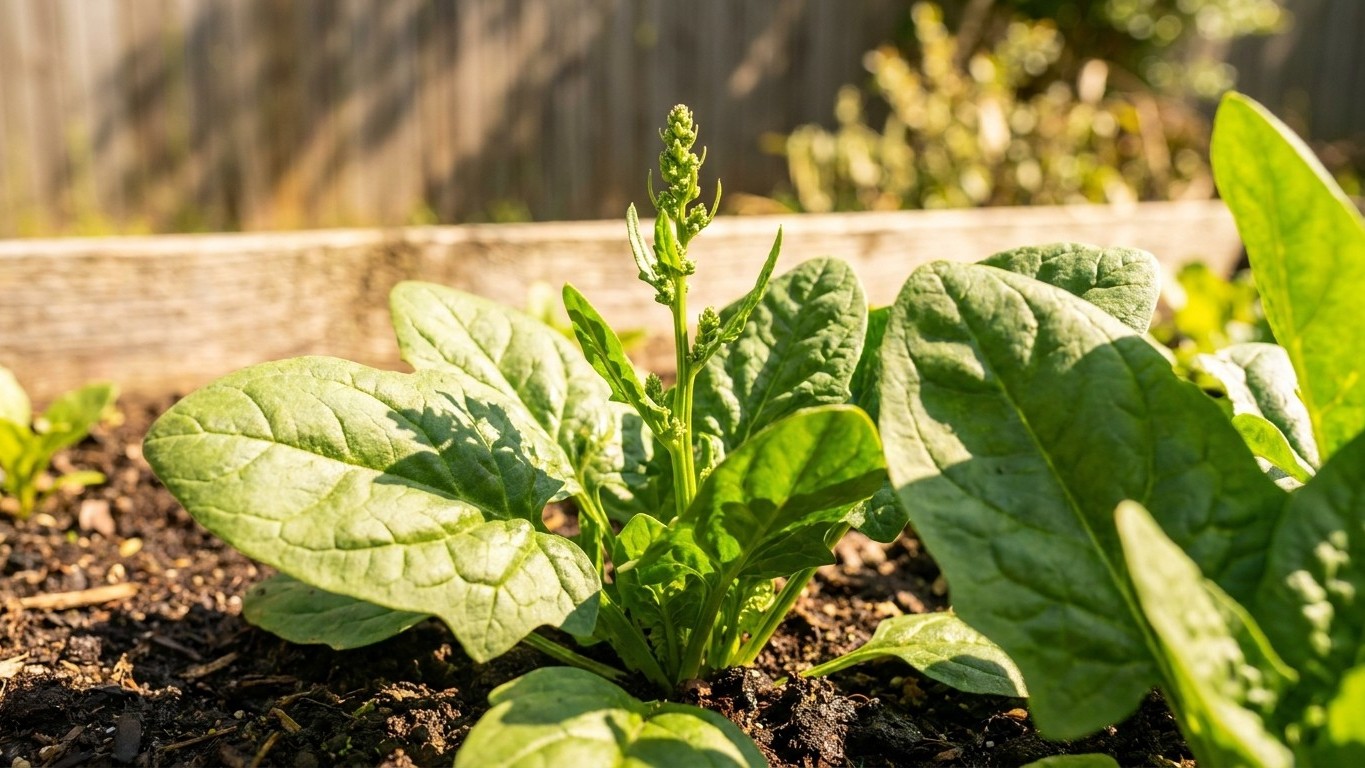

Spinach bolts early almost everywhere in Maine, and the reason isn’t really the state’s mild summer heat. It’s daylight. Portland logs 15 hours and 15 minutes of sun on the longest day of the year, and that alone is enough to flip spinach into flowering mode no matter how cool the air stays. Heat plays a supporting role, but day length is the trigger that closes the window.
The short answer
Fifteen hours and fifteen minutes. That’s how much daylight the Portland area gets at the June solstice, and it matters more to a spinach plant than any thermometer reading. Spinach is wired to read day length as a signal to flower, and once the days stretch past a certain point, the plant starts putting energy into a seed stalk instead of leaves. A cool, foggy Maine June does nothing to stop that clock. The plant doesn’t care that the air feels comfortable; it cares that the sun is up for over fifteen hours.
That’s the mechanism that separates this from a simple heat problem. If bolting were only about temperature, Maine’s climate would be an advantage. The reference station here averages just 3.8 days a year at 90 degrees or hotter, which is a genuinely low heat load compared to most of the country. A grower in a hotter state might reasonably hope that Maine’s cooler air buys extra weeks of spinach production. It doesn’t, because the long-day trigger fires regardless of how mild the afternoons feel.
Heat still matters, just in a secondary way. Spinach grows best where temperatures stay at or below 75 degrees, and that same 75-degree mark is also where the leaves start turning bitter. Maine doesn’t hit 90 often, but ordinary summer afternoons climb into the 70s well before the solstice, and that’s enough to push the crop past its comfort zone even without a heat wave. So the honest answer is both factors are in play, but they’re not equal partners. Day length sets the outer limit on the season no matter what you do. Heat mostly worsens flavor and slows growth within whatever window the day length allows. If you’re troubleshooting a spinach bed that bolted despite a cool week, look at the calendar before you look at the thermometer.
One caution worth repeating: the 3.8-day heat figure and the 15-hour-15-minute daylight figure both come from the coastal reference station, which represents the mildest part of Maine’s climate. Inland and northern parts of the state run colder in spring and fall, which shifts the frost dates discussed below, but the daylight trigger itself is a function of latitude and season, not local microclimate, so it applies broadly across the state.
How long the spring window really is
Working out the usable spring stretch means lining up three separate limits: the frost date, the heat ceiling, and the daylight trigger. Here’s how that plays out through the season.
- Sowing date. Spinach seed goes in the ground 2 to 3 weeks before the last spring frost. With the last frost falling between April 22 and May 1 at the coastal reference point, that puts a realistic sowing window in early-to-mid April. Inland and northern Maine gardeners should expect this to shift later, since their last frost dates run later than the coastal figure.
- Early growth. April and much of May sit comfortably under the 75-degree ceiling, so the first several weeks after sowing are close to ideal for leaf production. This is the period when spinach performs best and tastes best.
- The heat creep. By late May and into June, daytime highs start brushing against and then passing 75 degrees on a regular basis, even though the region rarely reaches true heat-wave territory. This is where growth quality starts to slip and flavor starts to turn.
- The daylight cutoff. Independent of temperature, day length keeps climbing toward that 15-hour-15-minute peak at the solstice. Somewhere in this stretch, the photoperiod trigger takes over as the dominant force pushing the plant toward flowering, whether or not the weather cooperates.
- Net result. Counting from an early-to-mid April sowing to the point where both the heat ceiling and the lengthening days converge, the realistic productive window runs somewhere around six to eight weeks, closing out by mid-to-late June. After that, bolting becomes the expected outcome rather than the exception.
The autumn crop, and when the soil lets you sow
Fall Spinach in Maine has to thread a narrower needle than most gardeners expect, because it’s boxed in on both ends. Late summer soil is too warm for reliable germination, and the calendar runs out fast once the first frost arrives.
The soil is still too warm
Spinach seed germination drops off once soil temperatures climb above 80 degrees. That threshold, published by Utah State University Extension, is the real gatekeeper for an autumn sowing, not the air temperature and not the calendar date. Given that Maine’s summer heat load is modest overall, with only 3.8 days a year reaching 90 degrees at the reference station, soil temperatures likely climb above that 80-degree mark during the warmest stretch of July and into early August, then start cooling as the season turns. Practically, that means waiting until the soil has cooled back down, which for most Maine gardens points toward mid-to-late August before conditions become favorable for seed to sprout reliably.
The frost that ends the season
The first fall frost at the coastal reference station arrives between October 9 and October 21. Working backward from that window using the 50-to-75-day range for planting to harvest, a harvest targeted for October 9 means sowing between July 26 and August 20. A harvest targeted for October 21 pushes that back to a window between August 7 and September 1. Combining both frost dates, sowing anywhere from late July through early September can work, depending on which end of the frost range you’re planning around and which end of the 50-to-75-day range applies to your conditions.
Put the two obstacles together and the practical sowing window narrows considerably: soil needs to have cooled below that 80-degree mark, which points toward mid-to-late August, while the frost countdown wants seed in the ground no later than early September for a harvest before the earliest frost dates. That leaves a fairly tight but workable window in the second half of August for most Maine gardens, shifting earlier for inland and northern areas where frost arrives sooner.
Common questions
Does a cooler summer in Maine delay bolting compared to warmer states?
Not meaningfully. The long-day trigger fires the same way regardless of how mild the air feels, so Maine’s cooler summers don’t buy extra weeks. Heat mostly affects flavor and growth rate within the window that day length allows, not the timing of the trigger itself.
Are some spinach varieties more resistant to bolting in Maine?
Utah State University Extension names four varieties, Bloomsdale, Melody, Teton, and Olympia, but publishes no comparative data on bolt resistance or days to maturity for any of them. There isn’t a sourced basis here for recommending one over another for Maine conditions specifically.
Can I sow a second spring batch a few weeks after the first?
It’s an option, but the daylight trigger and heat ceiling both keep advancing regardless of when you sowed, so a later spring sowing simply has a shorter run before hitting the same limits, not a delayed one.
Why does the soil-temperature limit matter more than air temperature for fall sowing?
Germination happens below the surface, where soil temperature governs whether the seed sprouts at all. Air can feel pleasant on a late-summer afternoon while the soil a couple of inches down is still holding heat from weeks of sun, which is why the 80-degree soil threshold is the number to track, not the forecast high.