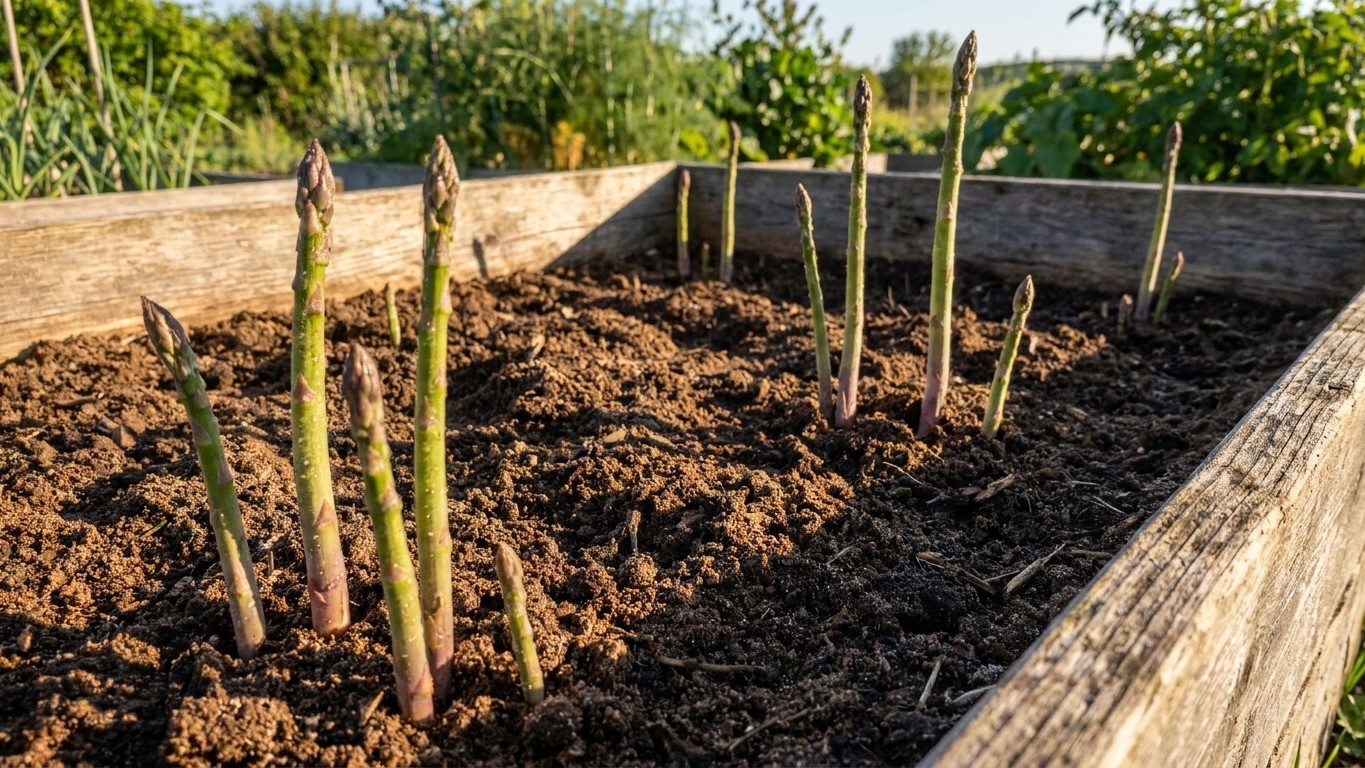

Yes, most Massachusetts ground can carry an Asparagus Bed through its full 10 to 15 year run, provided it drains. The state’s own representative soil, the Paxton series, comes back from USDA testing as well drained by definition, and drainage is the only requirement this crop actually cares about. But “most” is not “yours”: a mapped soil series describes an average, not the compacted clay behind a driveway or the low corner where water pools every April. Before staking out a spot for over a decade, a gardener needs to know which side of that average their own patch falls on.
The short answer
Massachusetts’ official state soil, named by state law and tracked by USDA NRCS, is the Paxton series, an Inceptisol. That word just means a young soil, one that has not had time to build the strong, distinct layers older soils develop. Pulled apart, the surface horizon runs about 61 percent sand, 7 percent clay and 32 percent silt, with organic matter around 5.5 percent and a surface pH near 5.5, slightly on the acid side. Sand-heavy profiles like this one let water move through quickly rather than pooling, which is exactly why USDA classifies the series as well drained.
That matters more here than for almost any other crop grown at home. Asparagus crowns go into the ground as an 8-inch furrow, and once they’re in, they stay. The plant gives no harvest at all in its first two years, offers roughly four weeks of cutting in year three, stretches to about six weeks the year after, and settles into an eight-week harvest window once mature, a bed that keeps producing for 10 to 15 years total. The rule for knowing when to stop cutting each spring isn’t a date on a calendar. It’s a visual cue: once most of the spears coming up are thinner than a pencil, the plant needs its energy for foliage, not for the table. A decision made about drainage in year one is still being lived with in year twelve.
If a plot sits wet, water standing after a hard rain, grass that stays spongy into June, the crowns will rot before they ever produce a real harvest, no matter how good the sun exposure is. The fix isn’t complicated: a raised bed, or a mound built up 8 to 10 inches above grade, gets the crowns out of standing water without changing anything else about the site. What the Utah State University Extension source that documents this crop’s needs does not weigh in on is soil pH or any winter chilling requirement, so neither one belongs in a planting decision here. A Paxton-like reading is a starting point for judging the region’s tendencies, not a verdict on one backyard, and a simple drainage check (dig a hole, fill it with water, see how fast it disappears) tells a gardener more about their own plot than any state soil designation will.
Will the summer here water it for you?
The bed’s own watering schedule is specific: 1 to 2 inches every other week for the first two years while roots establish, then a lighter 1 to 2 inches every three weeks once the plant matures. Lining that up against what a Massachusetts summer actually delivers takes a few steps.
- Local summer rainfall averages 10.4 inches across June, July and August combined, broken down as 3.89 inches in June, 3.27 in July and 3.23 in August, the driest of the three months, based on 1991-2020 normals from a Massachusetts reference station.
- Spread over roughly 13 summer weeks, that works out to a little under an inch of rain per week on average, which sits close to what a young bed asks for in its first two years.
- But the Paxton series is 61 percent sand at the surface, and sandy ground doesn’t hold rain the way a heavier clay soil would. Much of a single storm can drain past the root zone before the plant gets a chance to use it, so the weekly average overstates what the crowns actually receive.
- August, the month when heat and evaporation run highest, is also the driest month on the calendar, a combination that tends to hit newly planted crowns hardest right when the schedule still calls for the heavier every-other-week amount.
- The practical read: rainfall alone gets a Massachusetts asparagus bed partway there in an average year, but a sandy, well-drained site all but guarantees some supplemental watering is needed, especially in the first two summers and especially in dry stretches during August.
- A rain gauge staked next to the bed, not a regional average, is what tells a gardener whether this week needs the hose.
When to put the crowns in
Crowns go into the ground in early spring, timed around the last frost rather than a fixed date, since the goal is soil that’s workable but no longer at serious risk of a hard freeze. For the Massachusetts reference station used for these normals, the mean last spring frost falls somewhere around April 1 to April 8. That’s an average window, not a guarantee, and it comes from a waterfront, urban station that runs milder than most of the state; inland suburbs and hill country routinely see frost linger later into spring, so a gardener working from a garden further from the coast should expect that window to shift later, not earlier.
Once the timing is right, the furrow itself gets dug 8 inches deep, crowns spread out along the bottom, and covered with just a couple inches of soil to start. The rest of the furrow doesn’t get filled in all at once. It’s backfilled gradually across the season, adding about 2 inches of soil every other month as the spears grow, until the trench is level with the surrounding bed by year’s end. That slow fill lets the developing crown build a strong root system without being smothered early.
Seed is the other route in, for gardeners willing to trade time for a lower cost per plant: seedlings are raised for a season before they’re set out as young crowns, adding roughly a year onto the timeline before that three-year wait for a first harvest even starts. Variety choice, meanwhile, comes down mostly to plant sex rather than flavor or yield, at least according to what Utah State University Extension publishes. All-male varieties such as Jersey Giant and Jersey Knight put their energy into spear production rather than seed, while UC 157 F1 and Purple Passion are male-and-female types. No source cited here ranks these on taste or output, so the honest answer for a home gardener is that the choice is about growth habit, not a documented difference in the harvest itself.
Common questions
Does a Massachusetts asparagus bed need special soil amendments before planting?
The only documented requirement is drainage. If a site already sheds water well, the Paxton-type profile common across the state needs no special amendment to support a bed. Soil pH and any chilling requirement simply aren’t addressed in the source used here, so neither should factor into the planting decision.
Can crowns go in before the last frost date?
Early spring planting is timed around that mean window, roughly April 1 to April 8 at the reference station used here, but that’s a multi-decade average, not a promise for any single year. Since the crowns sit 8 inches deep, they’re more insulated from a late cold snap than young foliage would be, which is part of why the recommendation is early spring rather than after all frost risk has passed.
How much watering does a bed need after the first two years?
The schedule eases from 1 to 2 inches every other week down to 1 to 2 inches every three weeks once the plant is established. Given how quickly a sandy, well-drained soil lets water pass through, a gardener should still expect to check moisture rather than assume the lighter schedule takes care of itself.
Why does the harvest wait until year three?
The plant needs those first two seasons to build a root and crown system strong enough to support repeated cutting. Pushing an early harvest weakens the crown for years afterward, which is part of why the timeline (no harvest for two years, four weeks in year three, six the year after, eight once mature) is treated as fixed rather than optional.