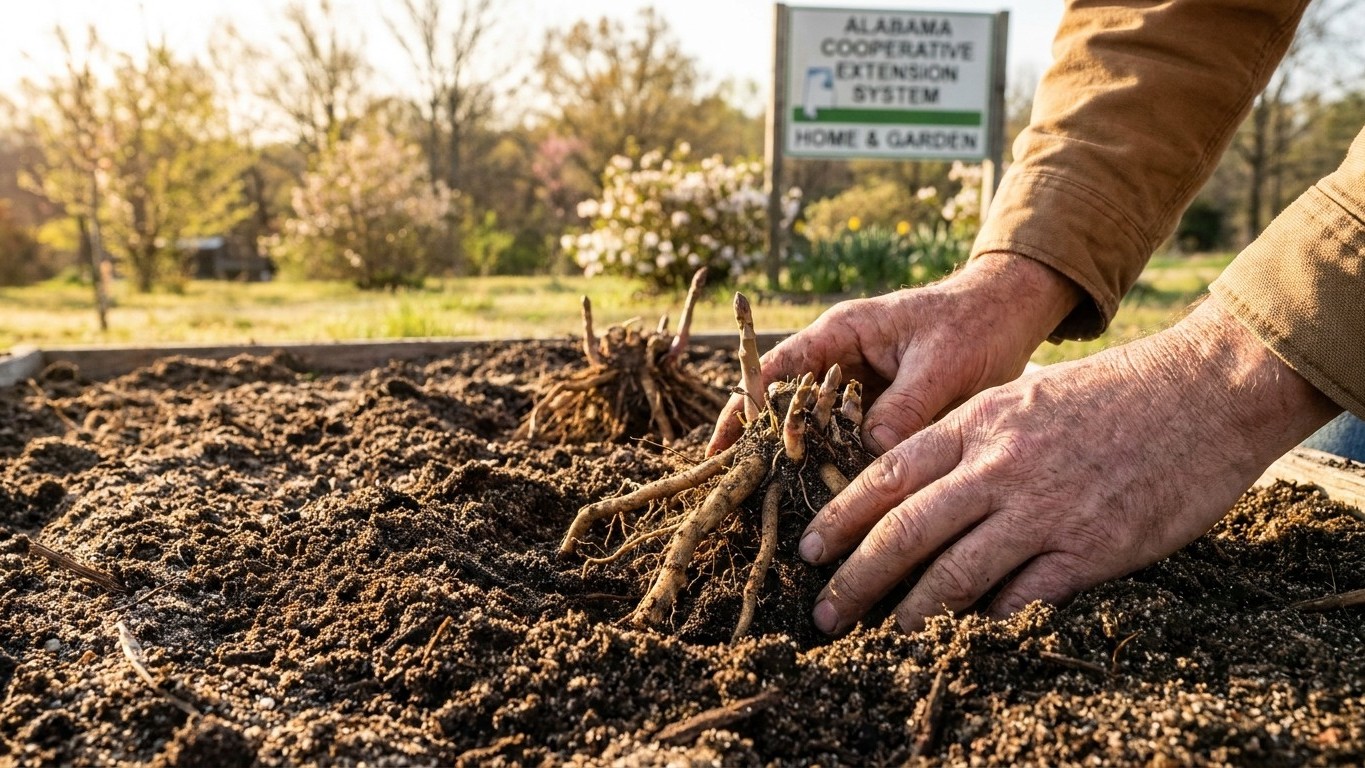

Plant Asparagus Crowns in Massachusetts in early spring, timed close to the region’s last frost, which lands around April 1 to April 8 in the mildest coastal spots. That window lets the crowns settle into cool, workable soil before the plant pushes new growth. But the real decision here isn’t the calendar. It’s the ground itself: asparagus stays in the same spot for 10 to 15 years, and the only hard requirement is soil that drains. Everything else follows from what your patch of dirt does with water.
The short answer
Fifteen years is a long time to trust a single decision. That’s roughly how long an Asparagus Bed produces once it gets going, according to Utah State University Extension, and it’s why the soil question matters more here than with almost anything else you’ll grow. Most crops forgive a bad site in a season or two. Asparagus doesn’t give you that out. Once the crowns go into an 8-inch furrow and start their three-year wait before the first harvest, you’ve committed the ground for over a decade.
Massachusetts’ official state soil, the Paxton series, gives a useful reference point for what the region’s ground tends to do. It’s a young Inceptisol, meaning it hasn’t developed the strong layered structure that older soils show, and USDA NRCS records it as well drained, with a sandy makeup (61 percent sand, 7 percent clay, 32 percent silt) and a surface pH around 5.5, slightly acid. Organic matter sits around 5.5 percent. On paper, that’s a decent starting profile for asparagus: sandy-leaning ground with a fair share of silt tends to shed excess water rather than hold it, which is exactly what a 15-year bed needs.
Here’s the catch, and it’s an important one: the Paxton series describes what USDA mapped for a representative surface horizon across the state, not what’s sitting under your lawn. Massachusetts spans hundreds of distinct soil series. River bottoms, hill country, and any lot a builder has graded or filled will read completely differently from the state’s official profile. A yard in a low spot near a stream can hold water for days after rain even if the county’s dominant soil type drains fine. The state soil tells you what the region tends toward. It says nothing about the specific 20 feet of ground where you’re planning to dig a furrow.
So the practical move is simple: don’t take the state soil’s word for it. Dig a test hole about a foot deep, fill it with water, and watch how long it takes to disappear. If water is still sitting there after several hours, that ground will drown asparagus crowns long before it ever produces a spear. In that case, build a raised bed, at least 10 to 12 inches high, and fill it with a well-draining mix rather than fighting the native soil for the next 15 years. A raised bed costs you an afternoon of building now. A poorly drained in-ground bed costs you a decade of disappointment.
Will the summer here water it for you?
- Know what the bed actually needs. Asparagus wants 1 to 2 inches of water every other week for its first two years while roots establish, then eases to roughly every three weeks once the crown system matures. That’s the target you’re watering toward, not a guess.
- Check what summer delivers on its own. Massachusetts averages about 10.4 inches of rain across June, July, and August combined, per NOAA’s 1991-2020 climate normals for the reference station used for these figures. Broken down by month, that’s roughly 3.89 inches in June, 3.27 in July, and 3.23 in August, the driest of the three.
- Do the math on timing, not just totals. Spread evenly, that’s close to an inch of rain a week in June, tapering slightly through the summer. That sounds like it nearly covers the every-other-week target for an established bed. But summer rain rarely arrives evenly.
- Account for how rain actually falls. A lot of New England’s summer precipitation comes as scattered thunderstorms rather than steady soaking rain. A single downpour can dump an inch in twenty minutes, and on a well-drained, sandy-leaning soil like the state’s representative Paxton series, much of that runs through or off before roots ever draw on it. That means the monthly total can look adequate on paper while the bed still dries out between storms.
- Watch the crowns’ first two summers closely. This is when the every-other-week schedule matters most, since a young crown hasn’t built the root mass to ride out a dry stretch. If two weeks pass without a soaking rain, run a hose or drip line and give the bed its 1 to 2 inches directly rather than hoping the next storm covers it.
- Ease off once the bed matures. By year three or so, roots run deep enough that the every-three-weeks rule applies, and an established Massachusetts bed on decent soil often gets close to what it needs from summer rain alone, with just a supplemental soak during a genuinely dry stretch.
- Put a rain gauge on the actual bed. Climate normals describe what the region usually gets, not what falls on your specific yard. A gauge settles the question a spec sheet can’t.
When to put the crowns in
Crowns go into the ground in early spring, while soil is still cool and workable but past the point of being frozen or waterlogged. In Massachusetts, that timing tracks closely with the region’s last spring frost, which NOAA’s 1991-2020 climate normals put at around April 1 to April 8. That’s a mean date built from three decades of freeze probabilities, not a guaranteed cutoff, so treat it as a target window rather than a hard line. Planting crowns in the days around that stretch gives them a head start on the growing season without risking a hard freeze on newly disturbed soil.
Worth flagging: that April window comes from a coastal, urban reference station, which tends to run milder than inland suburbs or the Berkshires. If you’re gardening well inland or at higher elevation, your own last frost likely lands later, and it’s worth pushing the planting window back accordingly rather than planting strictly by a date that describes the mildest corner of the state.
Crowns are the standard route because they skip a full growing season compared to starting from seed. A crown is essentially a one-year-old root system, and planting one gets you to that first light harvest in year three. Seed is the alternative, and it’s a real option if crowns aren’t available or you’d rather start from scratch, but it adds roughly a year to the timeline: you’re growing seedlings for a season before they’re ready to go into the permanent bed as young crowns, then waiting out the same three-year maturation after that. For most home gardens, the year saved by starting with crowns is worth the modest extra cost.
Either way, the planting method matters as much as the date. Crowns go into an 8-inch furrow, spread out with roots pointing down and out, then covered with just a couple inches of soil at first rather than filled in completely. As the season progresses, more soil gets added gradually, about 2 inches every other month, rather than backfilling the whole trench in one pass. That gradual fill lets the emerging shoots push through loose soil instead of fighting their way up through a deep, compacted layer all at once.
Common questions
Do I fill the planting furrow all at once?
No. The furrow starts around 8 inches deep, but you only cover the crowns with a couple inches of soil to begin. Over the course of the year, you add roughly 2 inches more every other month until the trench is level with the surrounding bed. Filling it in one shot buries the emerging shoots too deep and slows them down.
When can I actually harvest, and how long does the picking season last?
Not until year three. There is no partial harvest in year one or two, however tempting a stray spear looks. Once harvest starts in year three, the picking window is short at first, about 4 weeks, then extends to roughly 6 weeks the following year, and 8 weeks after that as the crown system matures. Rather than picking to a set date each year, stop harvesting once most of the spears coming up are thinner than a pencil. That’s the plant telling you it needs to stop producing spears and start building the fern growth that feeds next year’s crop.
Which asparagus variety should I plant in Massachusetts?
Utah State University Extension names four commonly available options, distinguished only by sex: Jersey Giant and Jersey Knight are all-male varieties, while UC 157 F1 and Purple Passion are male/female types. That source doesn’t publish flavor, yield, or a reason to prefer one over another, so there’s no verified basis here for ranking them. The distinction that does matter for a home bed is that all-male varieties don’t spend energy producing seed, which some gardeners find keeps volunteer seedlings from popping up between the rows.
What if my soil doesn’t drain well?
Test it before you commit 15 years to it. Dig a hole about a foot deep, fill it with water, and see how long it takes to drain. If it’s still standing after several hours, build a raised bed instead of planting in the ground. Given that Massachusetts’ representative state soil, the Paxton series, is well drained but sits on top of huge variation across the state, a quick test on your own plot is worth far more than assuming your yard matches the state average.