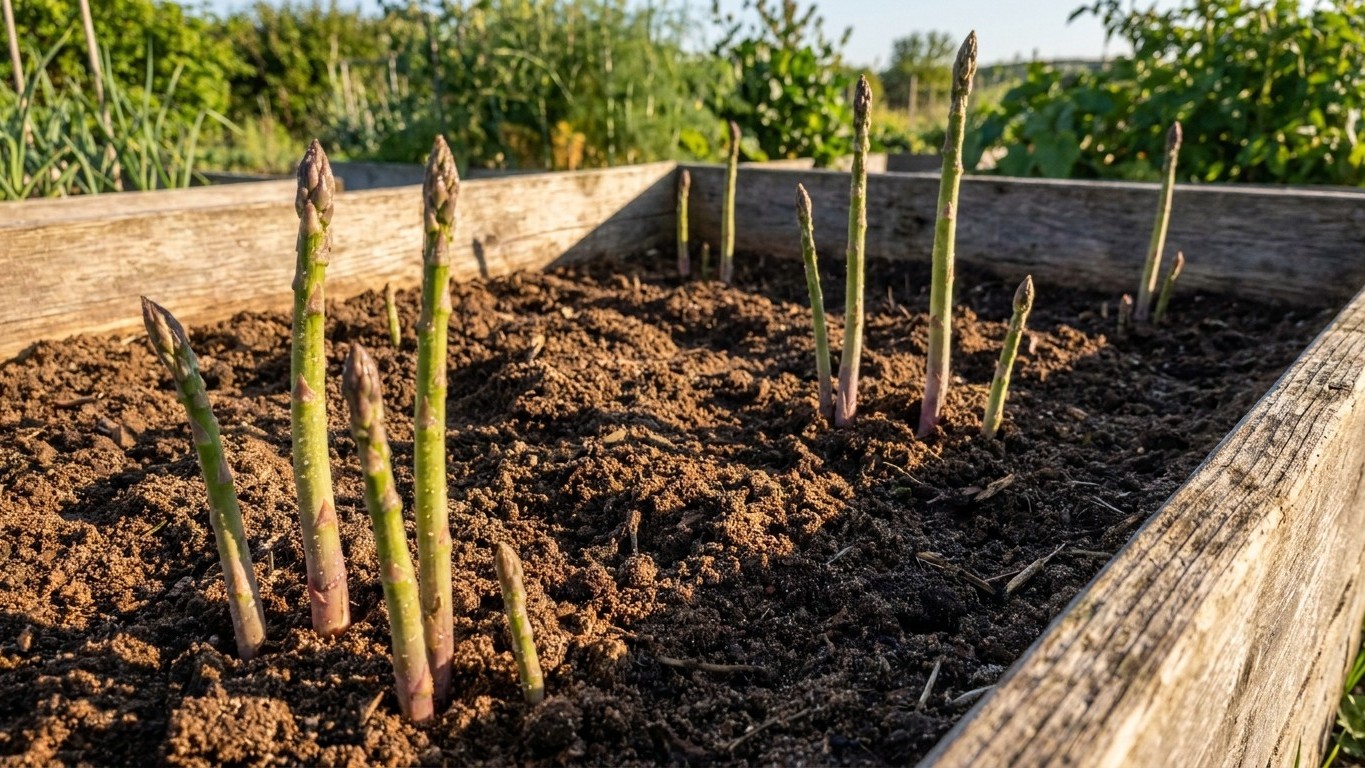

Yes, for most of the state, a well-sited asparagus bed can outlast a car loan and two kitchen remodels. Michigan’s official soil, the sandy Kalkaska series, sheds water fast enough to satisfy the one rule asparagus crowns actually care about: don’t sit wet. But “the state soil” is a legal designation, not a survey of your backyard, and the ten to fifteen years a bed is expected to keep producing is long enough that getting the site wrong costs real years, not just a season.
The short answer
Start with the numbers, because they explain why drainage carries so much weight here. The Kalkaska series, named Michigan’s state soil by state law, runs 86 percent sand, 5 percent clay and 9 percent silt at the surface, and it’s classified as somewhat excessively drained. Sand that dominant doesn’t hold water long. Rain moves through it fast, air follows right behind, and roots sitting in that profile are rarely waterlogged for more than a few hours after a storm.
That matters because the only site requirement Utah State University Extension attaches to asparagus is drainage. Not pH, not fertility, not a particular texture. Most soils will grow a productive bed, provided they drain. A Kalkaska-type sandy soil clears that bar easily, which is one reason asparagus has a long history as a dependable crop across sandy stretches of the Lower Peninsula.
The surface pH recorded for the Kalkaska series sits at about 4.7, which is strongly acid. That number describes the mapped soil series, not your garden bed, and asparagus’s own pH preference isn’t published in the source used for this page, so don’t treat 4.7 as a target or a warning either way. A soil test on your own plot is the only way to know where you actually stand, and it costs far less than replanting a bed in year six.
What the organic-matter figure actually means
The Kalkaska series also shows organic matter near 75 percent at the surface, a number that looks almost impossibly rich. It isn’t describing fertile topsoil. A figure that high means the mapped surface layer is a natural organic layer, forest litter or duff sitting over sand, not the worked, cultivated soil in a dug garden bed. Don’t read it as a promise of rich ground; a tilled bed on the same series won’t carry anything close to that organic-matter reading.
If your ground doesn’t drain
Plenty of Michigan gardens sit on soils nothing like Kalkaska: heavier clay pockets, filled lots, low ground that stays soggy after spring rain. On that kind of site, the fix isn’t to skip asparagus, it’s to change the bed itself. Raised beds or mounded rows lift the crowns above standing water. Working in coarse organic matter loosens a tight soil over time. What you shouldn’t do is plant crowns into ground that puddles after rain and hope fifteen years of that goes well.
Will the summer here water it for you?
an Asparagus Bed has a specific thirst, and it changes with age. In the first two years it wants 1 to 2 inches of water every other week. Once established, that eases to roughly the same amount every three weeks. Set that against what summer actually delivers here, and the shortfall becomes a matter of arithmetic.
- What the crop asks for: 1-2 inches every other week for the first two seasons works out to somewhere around half an inch to a full inch per week on average, tapering to a lighter, less frequent need once the bed matures.
- What summer brings: the region’s June-through-August rainfall averages about 10.0 inches total, spread across June at 3.26 inches, July at 3.51 inches, and August, the driest of the three, at 3.26 inches. Averaged out, that’s roughly three-quarters of an inch a week, arriving unevenly rather than on a schedule.
- Where the gap shows up: August is the tightest month, tying with June for the lowest total. A bed in its first two summers, needing water every other week without fail, can’t count on August’s rainfall pattern to cover it on its own, especially on a fast-draining sandy soil that lets moisture pass through within a day.
- What a sandy, well-drained soil changes: the same rain that lingers for a week on clay is gone within hours on Kalkaska-type sand. That’s good news for root rot, bad news for a gardener assuming the ground stays moist between storms.
- The practical move: a rain gauge on the actual bed, not a regional average, is what tells you whether a given week met the 1-2 inch mark. On sandy ground especially, plan to supplement during dry stretches rather than trust the calendar-month total.
None of this is a forecast. These are 1991-2020 normals from a single reference station, and a slope, a windbreak, or a different corner of the state shifts the real number. Treat the 10.0 inches as what the region can usually expect over a summer, and let your own gauge settle the rest.
When to put the crowns in
Asparagus crowns go into the ground in early spring, planted into furrows about 8 inches deep. In this part of the country, “early spring” lines up with the tail end of frost season rather than the calm weeks after it. Around the Detroit area, the mean last spring frost lands around April 30; across most of the rest of the Lower Peninsula, it runs a bit later, early to mid May. Both are averages, not guarantees, and a cold snap after that date isn’t unusual enough to ignore.
The furrow itself isn’t filled in all at once. As the crowns send up growth, soil gets pulled back in gradually, about 2 inches every other month across the season, until the furrow is level with the surrounding bed. That slow backfill gives the developing roots room without burying new shoots too fast.
Crowns aren’t the only route in. Starting from seed is the alternative, though the source used for this page focuses on crown planting and doesn’t lay out seed-starting specifics here. Either way, patience is the real requirement: there’s no harvest at all in the first two years, and the first cutting doesn’t come until year three, and even then it’s short, about four weeks, before spears are left to grow into ferns. The harvest window lengthens in later years, but the stopping point is always the same signal rather than a date on the calendar: when most of the spears coming up are thinner than a pencil, harvest stops for the season.
On variety, the published record is thin by design. Utah State University Extension names four: Jersey Giant and Jersey Knight, both all-male hybrids, and UC 157 F1 and Purple Passion, both male-and-female types. That source doesn’t rank them by flavor, yield, or garden performance, and no nursery is named here either. The sex of the plant is the one attribute on record; anything beyond that is outside what’s published.
Common questions
Does asparagus need acidic soil to grow well in Michigan?
Not according to the source behind this page. Utah State University Extension’s only stated requirement is drainage; it doesn’t set a pH target. The Kalkaska series’ surface pH of about 4.7 describes that particular soil series, not a requirement for the crop, and it isn’t a stand-in for your own garden’s number.
Can I plant asparagus in clay soil?
Most soils will grow asparagus as long as they drain, but standing water is the one condition to avoid over a 10-to-15-year bed. On heavier, slower-draining ground, raising the bed or working in organic matter to improve drainage is the more reliable path than planting directly into soil that stays wet after rain.
How long before I get my first asparagus harvest?
There’s no harvest in the first two years after planting. The first cutting comes in year three, and it’s brief, about four weeks, before the plants are left alone to grow into ferns and build up the root system for the years ahead.
How do I know when to stop harvesting each season?
Not by counting weeks. The signal is the spears themselves: once most of what’s coming up is thinner than a pencil, harvest ends for the season regardless of the date, letting the remaining growth feed the crown for next year.