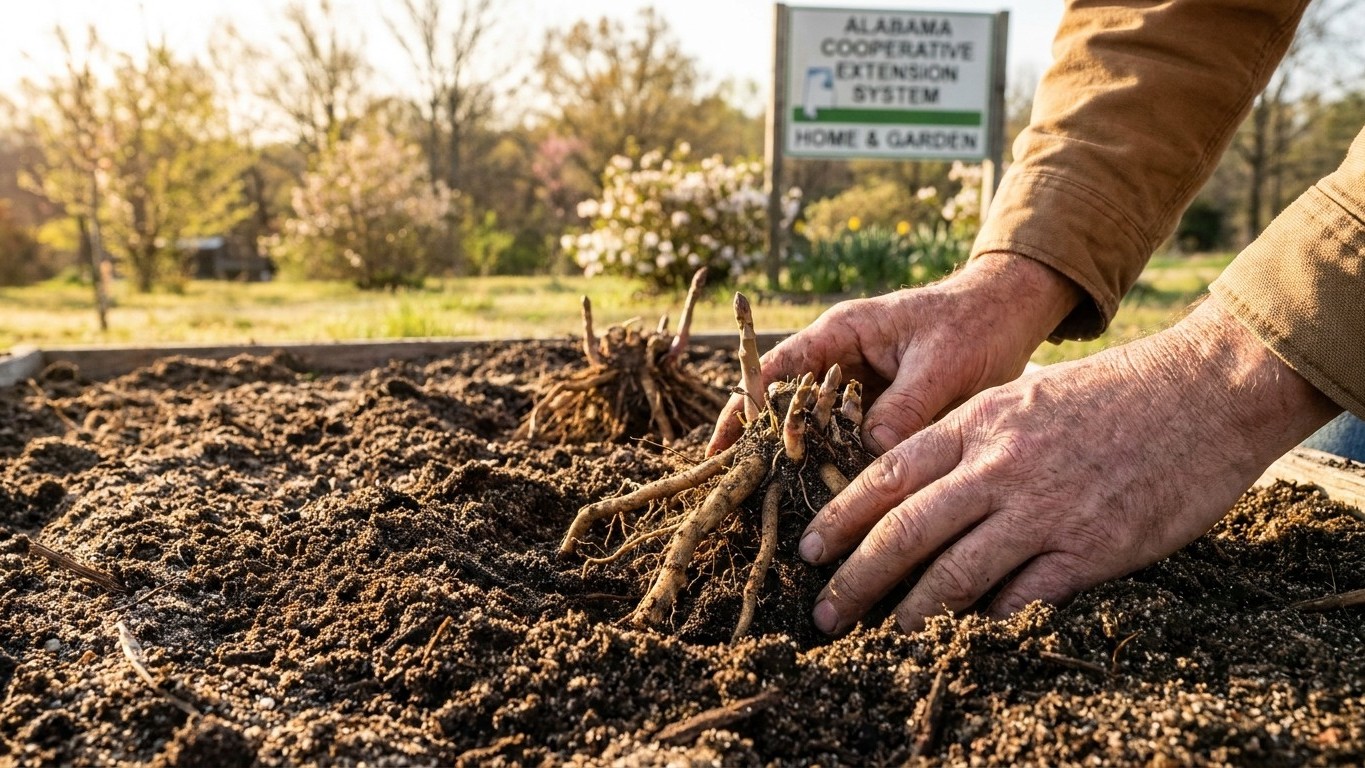

Plant Asparagus Crowns in Michigan in early spring, once the soil has thawed and dried enough to work, roughly the window that opens after the region’s last frost date has passed. In the Detroit area that mean date lands around April 30; across most of the Lower Peninsula it runs early to mid May. The bed you dig will still be producing spears a decade and a half from now, so the planting date matters less than the ground it goes into.
The short answer
Asparagus is the rare vegetable where the planting decision outlives most other choices a gardener makes. Utah State University Extension puts it plainly: crowns go into 8-inch furrows in early spring, the bed gives nothing back in its first two years, and then it produces for 10 to 15 years running. That’s not a season’s commitment. It’s closer to the length of time a family keeps a car, or the years a kid spends from kindergarten through high school. The site you pick has to keep working for all of that, which is why the source’s only real requirement for soil isn’t texture or fertility. It’s drainage. Asparagus crowns sitting in standing water rot. A bed that puddles after a spring rain is a bed that will thin out and fail long before its fifteenth year.
Michigan’s official state soil, the Kalkaska series, gives a useful starting picture of what the region’s ground tends to do. It’s a sandy Spodosol, 86 percent sand against just 5 percent clay and 9 percent silt, and USDA’s surface-horizon data describe it as somewhat excessively drained. Sand that coarse doesn’t hold water long. If your garden sits on something close to Kalkaska soil, or any sandy, glacial-outwash ground common across the state, drainage is likely the one problem you won’t have. Water moves through fast, sometimes too fast for other crops, but exactly what a fifteen-year asparagus bed wants.
That figure is a state average, not a verdict on your yard. Kalkaska soil formed under conifers, and the same USDA data record its surface organic matter at around 75 percent, a number that only makes sense for a natural forest floor, not a tilled vegetable bed. Michigan also holds heavy clay flats, old lakebed soils, and plenty of yards where a builder scraped off the topsoil and compacted what’s left. None of that behaves like Kalkaska sand.
So the state soil is a clue, not a diagnosis. The only way to know your own ground is to watch it after a hard rain. If water stands for more than a few hours, or a shovel comes up heavy and sticky, don’t fight it with the crowns already in the ground. Build a raised bed, or work in coarse organic matter before planting, so the roots sit above the standing water rather than in it. Fifteen years is too long a bet to make on hope.
Will the summer here water it for you?
an Asparagus Bed has a fairly specific thirst: 1 to 2 inches of water every other week for its first two years, tapering to every three weeks once it’s established. NOAA’s 1991-2020 normals for the reference station covering this data put summer rainfall at about 10.0 inches across June, July and August combined, roughly 3.26 inches in June, 3.51 in July, and 3.26 in the driest month, August. Laid side by side with the bed’s needs, here’s what that means in practice:
- Weeks with no dry stretch: if a June or July rain delivers close to an inch in a single event, that week may need little or no supplemental watering, especially in the bed’s second year and beyond.
- Weeks that fall short: averaged out, the summer normals work out to under an inch a week overall, below the every-other-week target of 1 to 2 inches for a first- or second-year bed, so most weeks still need the gardener to fill the gap with a hose or drip line.
- August is the tightest month: at 3.26 inches for the whole month, roughly the same total as June despite it usually running hotter, established beds cut back to every three weeks will likely still need a supplemental soak if the rain arrives unevenly.
- Sand changes the math fast: on ground close to the sandy, somewhat excessively drained Kalkaska profile that represents the state, an inch of rain can pass through the root zone within a day, so a gardener on sandy soil should expect to water more often than these monthly averages suggest, even in a summer that looks wet on paper.
- A rain gauge beats a normal: these are 1991-2020 averages for one reference station, not a forecast and not a reading from any single yard. A rain shadow, a slope, or a paved lot nearby can shift what actually reaches the bed, so the only number that really settles the question is one measured on the property itself.
When to put the crowns in
Crowns go into the ground in early spring, and in Michigan that means timing the job around the last frost rather than a fixed calendar date. The mean last spring frost lands around April 30 in the Detroit area, and early to mid May across most of the Lower Peninsula. Those are means, averages built from years of records, not a guarantee for any single spring. A gardener working from that number treats it as a rough center point, not a hard start line, and checks the soil itself before digging: it should be workable, no longer waterlogged from snowmelt, and dry enough that a shovel doesn’t come up as mud.
Once the ground is ready, the crowns go into 8-inch furrows. The trench isn’t filled in all at once. It gets backfilled gradually across the season, about two inches of soil added every other month, so the developing shoots are never buried too deep too fast while they’re still finding their way to the surface. That gradual fill is part of why the early-spring window matters: rushing the planting date doesn’t rush the harvest. The bed still won’t give up a single spear worth cutting until its third year in the ground.
Crowns aren’t the only route in. Utah State University Extension also lists starting asparagus from seed as an alternative, though it’s the slower path, since seed-grown plants need an extra season of growth before they reach crown size and go into the permanent bed. For most home gardeners working around Michigan’s spring frost dates, crowns are the faster and more direct route to a producing bed, but seed remains an option for anyone starting further ahead of the planting window.
On variety, the published information is limited to sex, not performance. Utah State University Extension names four: Jersey Giant and Jersey Knight as all-male varieties, and UC 157 F1 and Purple Passion as male and female. No flavor comparison, yield figure, or preference between them is published by that source, and none should be invented here. All-male varieties are generally chosen because they don’t put energy into seed production, but that reasoning isn’t part of the cited source and shouldn’t be presented as fact from it.
Winter chilling and soil pH are two questions gardeners often ask about asparagus, and neither is addressed by the source behind these facts. Michigan’s hardiness zones aren’t a substitute for a published chilling requirement, and no pH target should be assumed from the state soil’s acidity. Both remain open questions this source simply doesn’t answer.
Common questions
How long until an Asparagus Bed in Michigan actually produces spears?
Not until the third year after planting. The first two seasons are for root establishment only; cutting spears earlier weakens the crown and shortens the bed’s productive life.
Does Michigan’s sandy soil mean I never have to worry about drainage?
No. The Kalkaska series that represents the state runs somewhat excessively drained, but that’s a statewide reference point, not a reading of your own yard. Clay flats, old lakebeds, and disturbed building sites all exist within the state and can hold water. Check your own ground after a rain before assuming sand will save you.
Can I plant asparagus crowns before the last frost date to get a head start?
The last frost dates cited here, around April 30 in the Detroit area and early to mid May across the Lower Peninsula, are averages, not guarantees. Working the soil before it’s dried out and thawed properly risks compaction and rot rather than saving time.
Is one asparagus variety better than another for Michigan gardens?
That isn’t published in the source behind these facts. Jersey Giant and Jersey Knight are identified as all-male, and UC 157 F1 and Purple Passion as male and female, with no flavor, yield, or regional performance comparison attached to any of them.