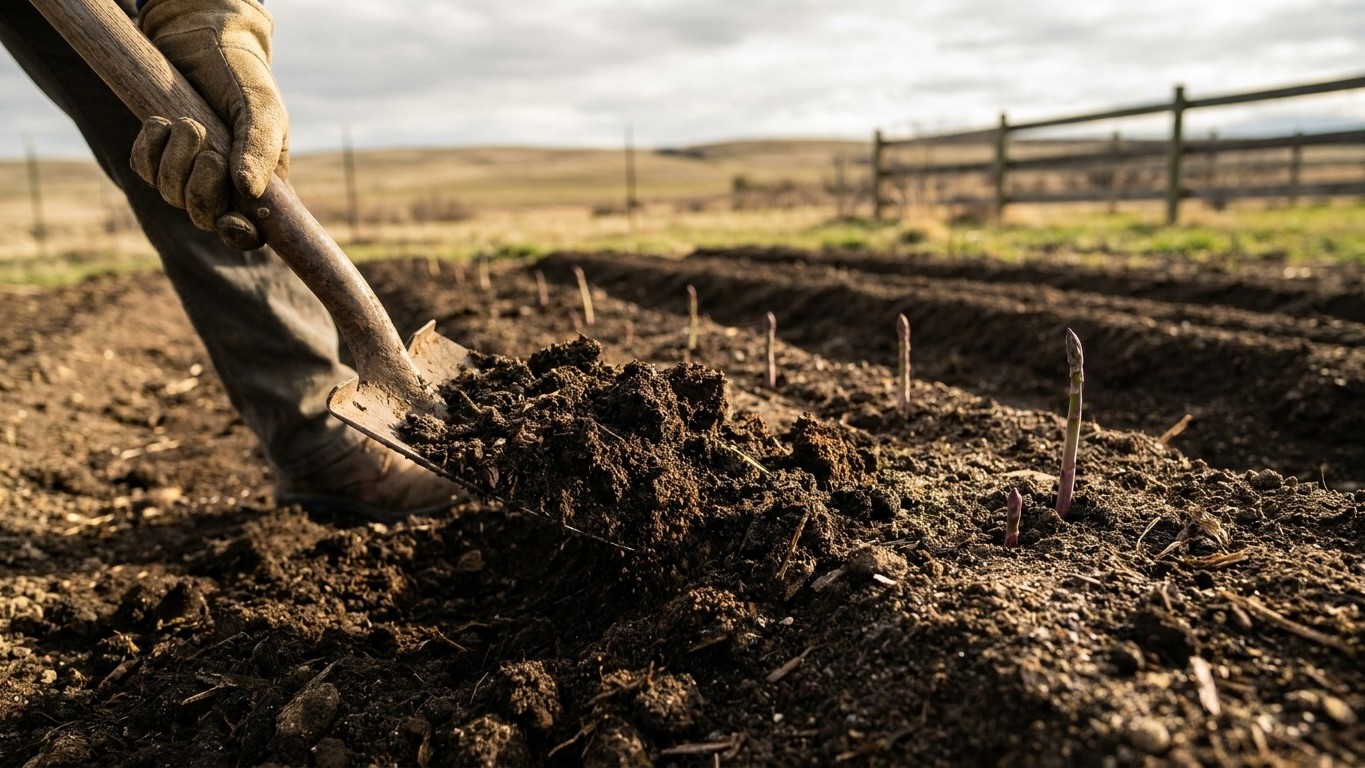

Fifteen years is a long time to bet on one patch of ground, but that’s the deal with asparagus, and the question of Will Michigan Soil Hold an Asparagus Bed for Fifteen Years? comes down almost entirely to drainage. Michigan gardeners can absolutely make that bet work, provided the bed sits somewhere that drains well and the crowns go in during that narrow early-spring window before the plant’s first real growth, a timing question covered in detail in this guide on When to Plant Asparagus Crowns in Michigan. The soil test, not the calendar, is what makes or breaks this crop.
The short answer
An asparagus bed, once established, produces for 10 to 15 years. Nothing about that timeline hinges on Michigan’s winters specifically. It hinges on drainage, because a crown sitting in wet feet for a decade and a half will rot long before it ever exhausts its natural lifespan. Utah State University Extension puts it plainly: most soils will grow asparagus fine, as long as they’re well drained. That’s the entire soil requirement published for this crop, and it’s worth sitting with, because it means the gardener’s job isn’t finding perfect dirt. It’s ruling out bad drainage.
Michigan’s own representative ground, the Kalkaska series, was named the state soil by state law and gives a useful reference point. It runs 86 percent sand, 5 percent clay, 9 percent silt, with a surface pH around 4.7, strongly acid, and it’s classified as somewhat excessively drained. Read that last phrase again: excessively drained, not poorly drained. A sandy soil like this one sheds water fast, which for most crops is a liability but for a plant that hates wet roots for fifteen straight years is closer to an advantage. The organic matter figure recorded for this series, about 75.0 percent, sounds startling, but that number describes a natural forest floor layer under conifers, not a tilled garden bed. No cultivated plot will carry organic matter anywhere near that; strip it away and till the ground, and what’s left is the sandy mineral soil underneath, which is the part that actually governs drainage.
None of this diagnoses any one backyard. Kalkaska is the soil chosen to represent the state, not a survey of every garden in it. A property on river-bottom clay, or ground a builder filled and compacted, will behave nothing like it. The fix, if a bed test shows standing water an hour after a hard rain, isn’t to abandon asparagus. It’s to raise the bed, mound it eight to twelve inches above grade, or move the planting to higher ground before crowns go in, because this is the one decision on the whole property that isn’t easy to undo once fifteen years of roots are established.
The harvest side of the bargain asks for patience most vegetables never demand. There’s no cutting spears at all in the first two years. Year 3 brings the first harvest, and even then it’s limited: about four weeks of cutting, extending to six weeks the following year, then eight weeks once the bed is fully mature. The rule for when to stop each season isn’t a date on a calendar. It’s a look at the spears themselves: once most of them are running thinner than a pencil, cutting stops for the year and the remaining growth is left to feed the roots for next season.
Will the summer here water it for you?
An established asparagus bed wants 1 to 2 inches of water every other week through its first two years, then eases to about the same amount every three weeks once it’s settled in. Michigan’s summer rainfall normal, measured at a reference station over the 1991-2020 period, runs about 10.0 inches across June, July and August combined, with June at 3.26 inches, July at 3.51 inches, and August, the driest of the three, back down to 3.26 inches. Here’s how that stacks up against the bed’s actual needs.
- Do the math on frequency first. Ten inches spread across roughly thirteen summer weeks averages out to a little over half an inch a week, which lands close to the low end of the 1-2 inch, every-other-week target a young bed needs. On paper, an average summer nearly covers it.
- Averages hide the gaps. Rain rarely falls in tidy weekly installments. It arrives as a thunderstorm that dumps an inch in twenty minutes and runs off a sandy surface before it soaks in, followed by a stretch of nothing. A bed can go through a two-week dry spell in a summer that still hits its seasonal average.
- Watch August specifically. It’s the driest of the three summer months in this normal, and it’s also when a young bed is still building the root system that has to carry it for the next thirteen years. This is the month most likely to need supplemental watering even in an otherwise wet year.
- Match the watering schedule to the bed’s age. New plantings in their first two seasons need that closer, every-other-week check. Once the crowns are established, the every-three-week rhythm gives more room to skip a watering after a good rain.
- Put a rain gauge on the actual bed. The 1991-2020 normal describes a reference station, not a specific yard. A slope, a nearby structure, or simple local variation can push a given property well above or below that average, and a gauge settles the question a normal never can.
When to put the crowns in
Crowns go into the ground in early spring, planted in furrows about 8 inches deep. That furrow doesn’t get filled in all at once. Instead, soil is backfilled gradually over the course of the year, adding roughly two inches every other month as the young shoots emerge and grow taller, rather than burying the crown under a full 8 inches on planting day.
Timing that first planting against Michigan’s frost calendar means working with an average, not a guarantee. The last spring frost lands around April 30 in the Detroit area, and runs early to mid-May across most of the Lower Peninsula. That word “around” matters: a mean frost date is built from years of records averaged together, and any single spring can arrive earlier or later than the mean suggests. Crowns tolerate a bit more cold than tender seedlings, but planting still generally waits until that frost risk has passed for the area, rather than being pushed ahead of it.
Seed is the alternative route to crowns, and it exists for gardeners who’d rather start from scratch than buy nursery stock. It’s the slower path. Rather than setting an already-growing crown directly into its permanent furrow, seed-grown plants need to be raised to a usable size first, which pushes the whole timeline back before the plant is even at the crown stage most gardeners start with. For most home gardens, crowns remain the more direct route into that first, patient two-year wait before any harvest at all.
On variety, the published record is narrow. Utah State University Extension names four: Jersey Giant and Jersey Knight, both all-male varieties, and UC 157 F1 and Purple Passion, both male-and-female types. That’s the extent of what’s documented there, no flavor comparison, no yield figures, no stated reason to prefer one over another. A gardener choosing between them is choosing based on sex type alone, at least as far as this source goes.
Checking this against your own county
Everything above describes Michigan in general terms: a representative soil series, a statewide summer rainfall normal, a mean frost date drawn from Detroit and the Lower Peninsula broadly. None of it substitutes for what’s actually true on one specific piece of ground. A county extension office can run an actual soil test on a specific bed site, confirm local frost timing that may run earlier or later than the statewide figures, and flag drainage issues particular to that area’s terrain.
Michigan State University Extension is the land-grant service for the state, and its outreach programs are listed at canr.msu.edu/outreach. Before committing a bed to Fifteen Years in One Spot, a call or visit there is the step that turns a statewide average into an answer for one particular yard.
Common questions
How long before an asparagus bed produces anything at all?
Nothing is harvested in the first two years. The first cutting comes in year 3, and even then it’s limited to about four weeks before the plants are left alone to keep building their root systems for the following seasons.
Does Michigan’s acidic sandy soil rule out asparagus?
Not by itself. The published requirement is drainage, not pH or acidity, and the state’s representative Kalkaska soil, despite its low surface pH, is actually well suited on the drainage front. A soil test on the actual planting site is still the only way to know what’s really there.
Which asparagus variety should I plant?
The documented options are Jersey Giant and Jersey Knight, both all-male, and UC 157 F1 and Purple Passion, both male-and-female. No source here publishes a flavor, yield, or performance comparison between them, so the choice comes down to sex type rather than any documented preference.
What if my yard doesn’t drain well?
Raising the bed above grade, by mounding soil eight to twelve inches or building a raised frame, is the standard workaround when a planting site holds water. Given that a bed is meant to stay in place for a decade or more, this is worth settling before crowns go in the ground, not after.