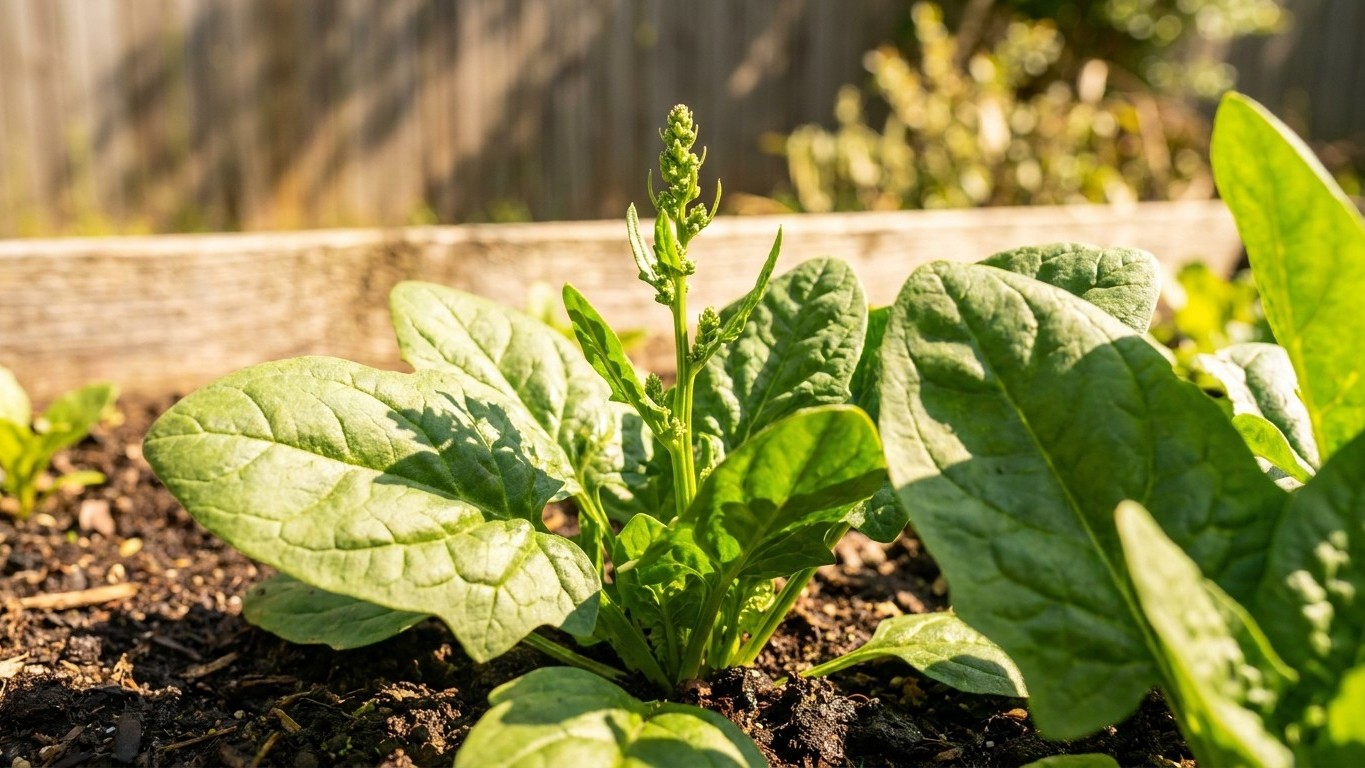

Spinach will almost certainly bolt early in Michigan, and the biggest reason isn’t the state’s heat, it’s the length of the day. Detroit clocks 15 hours and 5 minutes of daylight on the longest day of the year, and that alone pushes spinach toward flowering. Add in the roughly 10 days a year that hit 90 F, and the growing window narrows from both directions at once.
The short answer
Fifteen hours and five minutes of daylight on the summer solstice. That’s what a Detroit-area garden gets at its longest, and it’s the number that matters most for spinach. Spinach bolts on long days and on warm temperatures together, and Michigan’s summer day length crosses well past whatever threshold keeps this crop leafy and productive. A cool, cloudy Michigan summer doesn’t change that math. The plant isn’t counting degrees alone, it’s reading how many hours of light hit its leaves, and once the calendar tips toward June, those hours pile up fast regardless of what the thermometer says.
That’s the part gardeners moving here from warmer states tend to misjudge. A mild Michigan July feels like it should be spinach-friendly, and in terms of raw heat, it often is, with only about 10.3 days a year reaching 90 F at the Detroit reference station. But the day length keeps climbing toward the solstice no matter how mild the air feels, and spinach responds to both signals at once. So the honest answer to “Will Spinach Bolt Early here” is yes, and the mechanism is dual: long days trigger the shift toward flowering, and any stretch above roughly 75 F pushes it along even faster while also turning the leaves bitter.
Put another way, Michigan doesn’t give spinach a pass just because it isn’t Georgia or Texas. The state sits far enough north that its summer daylight hours run long, and that’s precisely the condition spinach reacts to worst. Growers in the Upper Midwest sometimes assume northern latitudes buy them a longer cool-season window for every crop. It works that way for some vegetables. It does not work that way for spinach, because the trigger here isn’t a temperature ceiling by itself, it’s the combination of long light exposure and rising heat arribing together in late spring.
So the limiting factor in Michigan is both day length and heat, working in the same direction at the same time. The 75 F growth ceiling from Utah State University Extension applies here just as it would anywhere else, but Michigan’s long summer daylight hours mean that ceiling gets reached, and then compounded by day length, earlier in the season than gardeners might expect from the state’s reputation for mild summers. Understanding that combination is the key to planning both a spring crop and a fall one, which is exactly what the next two sections work through.
How long the spring window really is
- Start with the frost date. The last spring frost lands around April 30 in the Detroit area, and early to mid May across most of the Lower Peninsula, according to MSU Extension. That date anchors everything else that follows.
- Move the sowing date earlier. Spinach seed goes in the ground 2 to 3 weeks before that last frost, since the crop tolerates cold soil far better than heat. For the Detroit area, that puts realistic sowing somewhere in the second week of April.
- Count forward to the heat and light trigger. Growth stops being good once temperatures climb above 75 F, and that ceiling doesn’t act alone in Michigan, it’s reinforced by the lengthening days that build toward the June solstice and its 15 hours and 5 minutes of daylight.
- Add up the usable stretch. From a mid-April sowing to the point where long days and rising heat start pushing plants toward bolting, most Michigan gardens get somewhere in the range of six to eight usable weeks before the spring crop turns bitter and starts sending up flower stalks.
- Plan the harvest inside that window, not at the edges. Because the closing trigger is a combination of day length and heat rather than a single hard date, the safest approach is to sow as early as soil conditions allow and harvest continuously rather than waiting for full-size leaves late in the window.
That six-to-eight-week stretch is shorter than most warm-season vegetables get, and it’s exactly why spring Spinach in Michigan is treated as a fast, early crop rather than something to plant once and harvest all summer. Four named varieties commonly discussed for home gardens, Bloomsdale, Melody, Teton, and Olympia, all face the same day-length and heat pressures described here; no maturity-date data for any of them is published in the source used for this page.
The autumn crop, and when the soil lets you sow
Soil still too warm to germinate
Spinach seed germination drops off once soil temperatures climb above 80 F, according to Utah State University Extension. That’s the opposite problem from spring, when cold soil is the concern. In Michigan, soil doesn’t cool down quickly just because the calendar turns to August. With an average of 10.3 days a year reaching 90 F at the Detroit reference station, most of that heat load lands in July and into August, and soil holds warmth well after the air itself starts to feel like fall is coming. Practically, that means an early-August sowing attempt often lands on soil that’s still too warm for reliable germination, and the safer play is to wait until the heat load has clearly tapered before putting fall seed in the ground.
The frost that ends the season
The other boundary is the first fall frost, which arrives between October 6 and October 21 in Michigan’s zone 6a areas, per MSU Extension’s Garden Calendar. Utah State University Extension’s guidance for a fall crop is to sow 50 to 75 days before the date you want to harvest, and no maturity-date figure beyond that range is published. Counting back from an October 6 frost, 50 to 75 days lands sowing somewhere between mid-July and mid-August. Counting back from the later end of the frost range, October 21, that same 50-to-75-day math pushes sowing into early September at the outside edge. Put those two constraints together, warm soil on one side and frost on the other, and the realistic fall sowing window across most of the Lower Peninsula sits in a band from late July through late August, narrower than it looks on paper once the germination limit is factored in.
That narrow band is worth planning around deliberately rather than guessing at. A grower who sows in early August, right in the middle of the state’s hottest stretch, risks poor germination from soil still running hot. Waiting until soil has clearly cooled, even if that pushes sowing toward late August, tends to produce a more even stand, and the crop still has enough runway before the October frost dates to reach a usable fall harvest.
Common questions
Does a cloudy Michigan summer slow down bolting?
Not reliably. The trigger for bolting includes day length, and cloud cover doesn’t change how many hours of daylight the plant is exposed to. A cool, overcast stretch can soften the heat side of the equation, but the long-day signal keeps building toward the solstice regardless of cloud cover.
Can I just plant later in spring to dodge the heat?
That trades one problem for another. Sowing later in spring means the plant hits both the 75 F ceiling and the season’s longest days at roughly the same calendar point, which tends to shorten the usable harvest window rather than extend it. Earlier sowing, right at the 2-to-3-week-before-frost mark, gives the crop the most runway before that combination kicks in.
Is fall spinach easier than spring spinach in Michigan?
The obstacles are different, not necessarily lighter. Spring spinach fights a closing window driven by long days and heat. Fall spinach fights a germination barrier from soil that’s still too warm in late summer, then a hard stop at the first frost. Both require timing sowing to a specific band rather than planting on a fixed date.
What does the 75 F ceiling actually affect besides growth?
It’s the same number for two separate effects. Above 75 F, leaf growth slows, and the leaves that do form tend to turn bitter. It isn’t tied to a specific calendar date in Michigan, since it’s reached at different points depending on that year’s weather pattern layered on top of the state’s fixed day-length schedule.