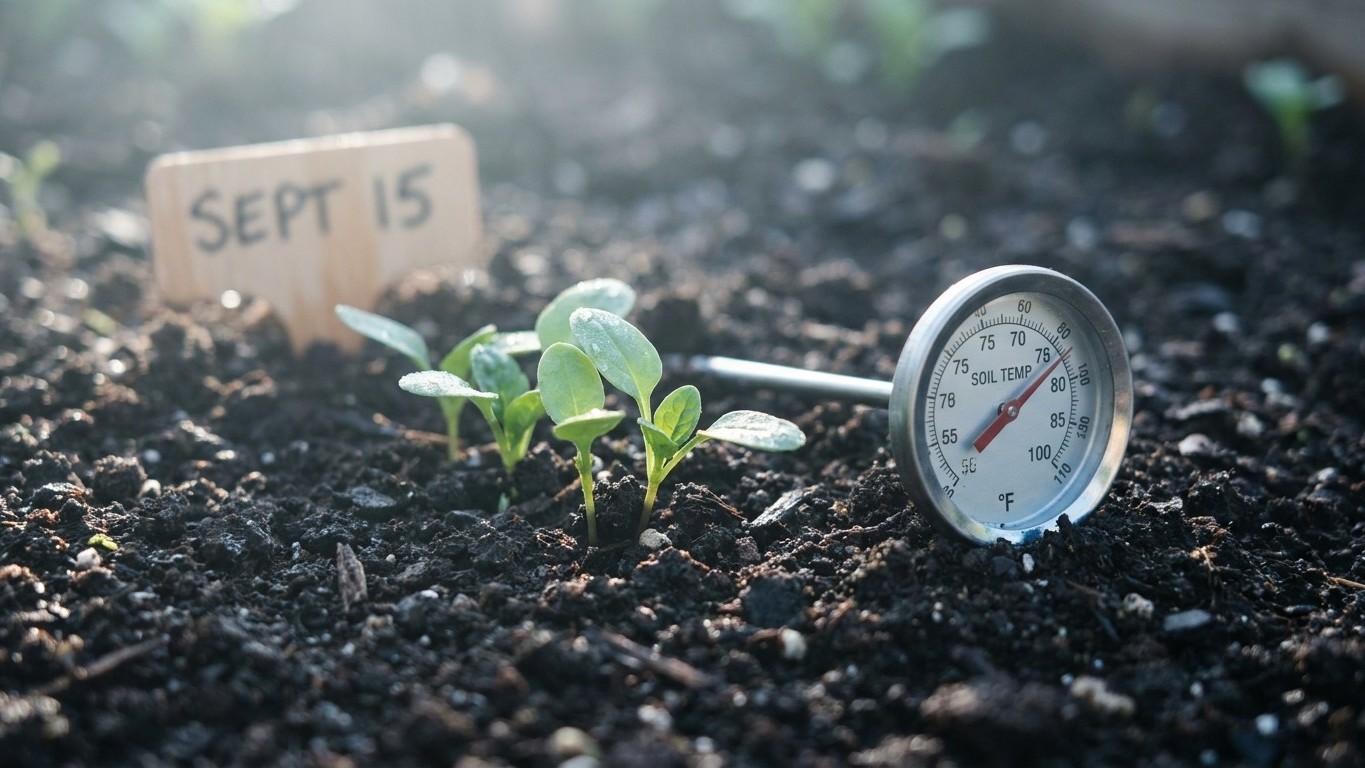

In Minnesota, autumn spinach goes into the ground anywhere from late July to early September, timed 50 to 75 days before the first fall frost (October 11 to 23 at the reference station). The exact week depends on where in the state you garden and how quickly late-summer soil cools enough for seeds to sprout. Northern growers should lean toward the earlier end of that stretch; the Twin Cities and points south can push closer to early September.
The short answer
Minneapolis logs 15 hours and 25 minutes of daylight on the summer solstice, the longest day of the year at the reference station behind these normals. That number matters more than most gardeners assume, because spinach doesn’t need brutal heat to shut down leaf production. Long days by themselves are enough to flip the plant into flowering mode. A mild Minnesota summer buys nothing back once daylight stretches that far past 14 hours; the plant is reading the calendar through its leaves, not through a thermometer.
That’s the part that trips up gardeners who assume a cooler northern summer means a longer harvest window. It doesn’t work that way for a leaf crop. Heat still plays a role, just a smaller one than people expect. The state averages only 10.6 days a year at 90 F or hotter, a modest heat load by national standards. But spinach starts losing quality and turning bitter well before that mark, once daytime highs push past 75 F. That threshold gets crossed routinely in a Minnesota summer, long before the mercury ever touches 90.
So for the spring crop, both mechanisms are working against spinach at the same time, and day length usually gets there first. The solstice’s long days arrive on schedule every year regardless of how hot or cool the summer turns out to be, which means bolting pressure builds even in a year with almost no 90-degree afternoons. Heat then piles on top of that, pushing past the 75 F growth ceiling and turning any surviving leaves bitter.
Autumn flips the equation. Shortening days actually work in spinach’s favor once the calendar turns past midsummer, so day length stops being the obstacle. The gatekeeper becomes something else entirely: soil that’s still holding onto summer heat, plus a fall frost date that puts a hard stop on however many weeks of growth remain. Those two obstacles, warm soil and the incoming frost, are what actually set the autumn sowing window in this state, and they’re worth walking through separately.
How long the spring window really is
- Find the earliest possible sowing date. Spinach goes in 2 to 3 weeks before the last spring frost. With last frost falling between April 17 and April 30 at the reference station, that puts the earliest sowing somewhere between late March and mid-April, depending on exactly where the last-frost date lands that year.
- Adjust for location within the state. The Twin Cities represent the mild southern edge of Minnesota. Northern Minnesota runs two to three weeks tighter at both ends of the season, which pushes the earliest safe sowing date later in spring and pulls the closing date earlier as well.
- Track when the window starts closing. Daylight climbs toward that 15 hour 25 minute solstice peak through May and into June, and daytime highs start crossing the 75 F growth ceiling around the same stretch. Both pressures build at once, so there isn’t a single clean cutoff date, just a rising risk of bolting and bitter leaves as the calendar moves toward early summer.
- Add it up. From an earliest sowing in late March or early April to a closing window sometime before the days get too long and too warm, most of Minnesota gets somewhere in the neighborhood of six to eight usable weeks of spring spinach. That’s a real crop, but it’s a narrow one, and it closes well before the actual heat of summer arrives.
- Plan around the narrowness. Because the spring run is short and ends on two different clocks at once, many Minnesota gardeners treat it as a single fast cutting rather than a season-long harvest, and lean on the autumn sowing for the fuller run of usable weeks.
The autumn crop, and when the soil lets you sow
Autumn Spinach in Minnesota is set by counting backward from a realistic harvest date. Using the first fall frost window of October 11 to 23, and the 50 to 75 day range for a fall planting, the math lands sowing dates between late July and early September. Sow too early and warm soil works against germination; sow too late and there isn’t enough runway before frost. Two separate obstacles set those edges.
Waiting for the soil to cool
Spinach seed germination drops once soil temperature climbs above 80 F. Minnesota’s heat load is moderate, averaging only 10.6 days a year at 90 F air temperature or higher, so soil here doesn’t sit in that danger zone for weeks the way it might in a hotter state. Still, a stretch of hot, sunny days in late July or August can push bare, uncovered topsoil past 80 F even in a state with a relatively mild summer overall. A few practical adjustments help: water the bed the evening before sowing to bring soil temperature down, sow in late afternoon rather than midday, and use a light mulch or shade cloth over the row until germination shows. If a heat spell is running through the forecast, waiting a few extra days for it to break usually beats fighting it with irrigation alone.
The frost that ends the season
The first fall frost lands between October 11 and October 23 at the reference station, and that 32 F freeze-probability window is the practical end point for this calculation. Northern Minnesota runs two to three weeks tighter than that at both ends of the season, so a grower up there needs to shift every date in this window earlier, both the sowing start and the harvest target. Counting 50 to 75 days back from the earliest end of the frost range (October 11) pushes the earliest sowing to late July; counting from the later end (October 23) with the shorter 50-day minimum stretches the latest sowing to early September. That’s the real width of the autumn window for most of the state.
Utah State University Extension names four spinach varieties commonly grown for home gardens: Bloomsdale, Melody, Teton, and Olympia. That source doesn’t publish days-to-maturity or other performance data for any of the four, so any specific timeline attached to a variety name on a seed packet is coming from the seed source, not from that extension office.
Common questions
Can I still get a harvest sowing in early September?
In the milder southern half of the state, possibly, if harvest can wait until close to the late end of the frost window (October 23) and the 50-day minimum applies. That leaves almost no margin, though. Anyone in northern Minnesota should plan on finishing sowing two to three weeks earlier than that to stay inside a safe window.
Does fall spinach need frost protection?
The data available here covers only the 32 F freeze-probability date, not a separate light-frost or hard-freeze threshold, so there’s no published basis for assuming extra weeks of harvest past that date. Treat the first fall frost window as the practical end of the season rather than counting on it.
Which spinach varieties are recommended for Minnesota?
Bloomsdale, Melody, Teton, and Olympia are the four named by Utah State University Extension, though that source doesn’t publish performance data distinguishing one from another for this or any other region.
Why doesn’t a cool Minnesota summer stretch the spring harvest?
Because spinach bolts in response to long days as well as heat. Minneapolis reaches 15 hours 25 minutes of daylight on the summer solstice regardless of how hot or mild the season turns out, so that day-length trigger arrives on schedule every year and closes the spring window whether or not the thermometer cooperates.