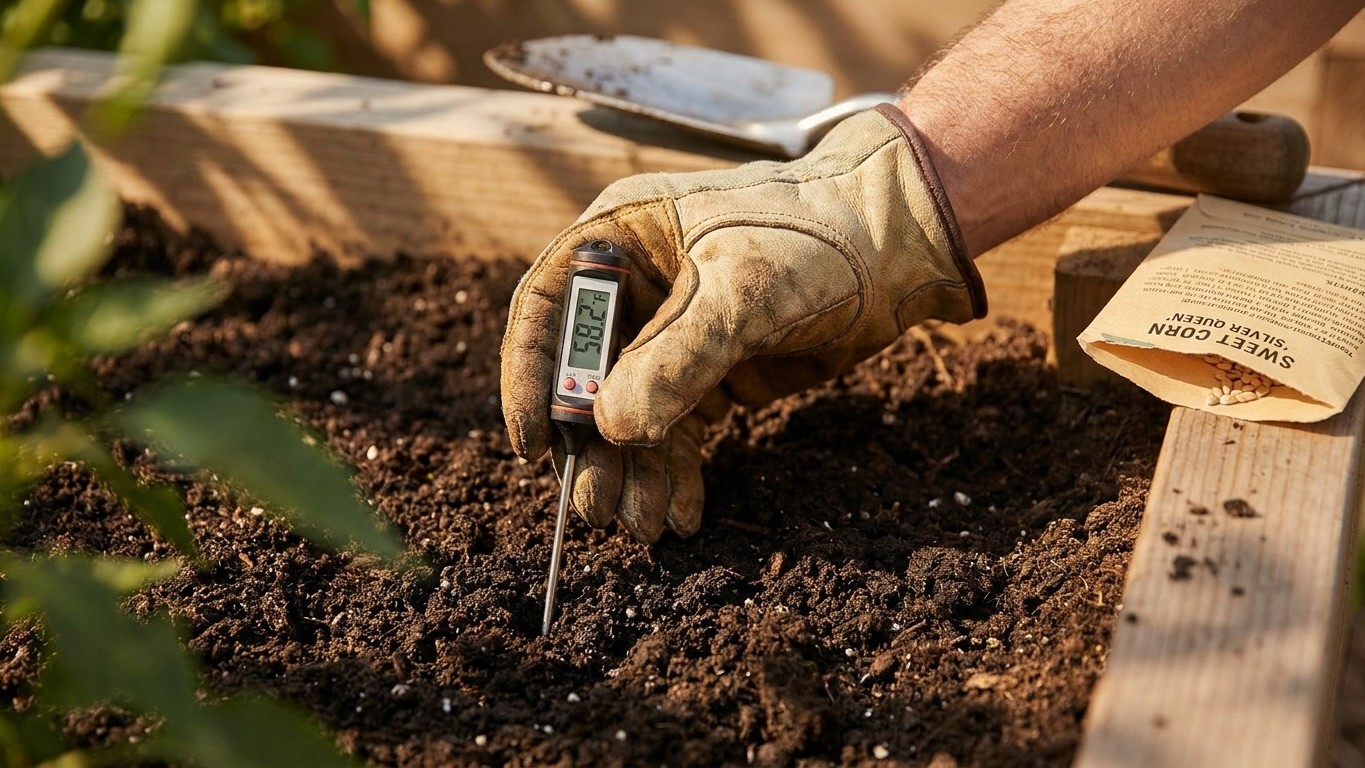

Sweet corn goes into Missouri ground once the soil holds steady at 60°F or warmer, not on the calendar date of the last frost. That threshold typically arrives after Missouri’s last spring frost window of April 6 to April 20, and it leaves a wide season before the first fall frost, October 18 to October 29. A 60-to-90 day maturity range fits inside that stretch, though the exact planting date shifts by region, since southern Missouri warms earlier and the reference station used here sits well north of Kansas City.
The short answer
Soil doesn’t warm at the same pace as air, and that gap is the whole story here. The last spring frost, according to NOAA’s 1991-2020 Climate Normals for the reference station, falls somewhere between April 6 and April 20. But the 60°F soil mark sweet corn actually needs comes later than that date, sometimes by several weeks, because bare ground releases the cold it stored over winter slowly, even after the air stops freezing at night. A gardener who drops seed the day frost risk clears is very likely planting into soil still too cold for sweet corn to germinate cleanly.
That lag matters less than it sounds, because Missouri’s frost-free stretch is long. Counting from the earliest last frost (April 6) to the latest first fall frost (October 29) gives roughly 206 days without freezing weather. Even using the tighter combination, a late last frost (April 20) paired with an early first fall frost (October 18), the frost-free window still runs about 181 days. Either way, once soil finally crosses 60°F, whether that happens in the first half of the frost-free season or later, there’s still comfortably more than the 60 to 90 days sweet corn needs to mature before autumn cold returns.
This is the piece that trips people up: a warm afternoon in early spring can fool a gardener into thinking the ground is ready. It isn’t, until it consistently reads 60°F or higher, which is a soil thermometer question, not a weather-app question. Air temperature swings fast; soil temperature moves slowly and evenly, and that’s exactly why it’s the more reliable signal for a crop that rots in cold, wet ground before it ever sprouts.
The practical takeaway is straightforward. Watch the soil, not the frost date. Once it holds at 60°F for a few consecutive days, and given how much frost-free time follows in a typical Missouri season, there’s room for a full 60-to-90 day corn crop, and often room for more than one planting spaced a couple of weeks apart to spread out the harvest.
Does a late variety fit here?
Maturity length is the number printed on the seed packet, counted from planting to harvest. In Missouri’s case, the question isn’t whether the season is long enough on paper, it’s whether soil timing and summer heat change how comfortably a given maturity length actually plays out.
A 60-day variety
A fast type built around 60 days from planting to harvest is the easiest fit for this territory. Even with soil reaching 60°F well after the April frost window closes, a 60-day corn planted at that point still finishes with a wide cushion before the October 18 to 29 fall frost arrives. This is also the safer choice for anyone forced into a later start, whether from a wet spring, a delayed soil test, or a first planting that failed and needs replacing. A short-season type absorbs that lost time without pushing harvest anywhere near the first fall frost.
A 90-day variety
A slower type, closer to 90 days, asks more of the calendar but still fits, given how long Missouri’s frost-free stretch runs. Even a planting delayed until soil is thoroughly warm should mature well ahead of the earliest fall frost date, provided it goes in without unnecessary delay once the soil test clears. Where the 90-day type loses its margin is timing risk stacked on timing risk: a late spring, a slow-to-warm soil profile, and a stretch of days above 90°F, which happens an average of 32.7 times a year here, can all land during the pollination window at once. That heat load doesn’t stop a 90-day variety from maturing, but it can stress pollination if it hits during tasseling and silking. The late type isn’t wrong for Missouri, it just leaves less room for a second attempt if the first planting fails, and it pays to get it in the ground as soon as soil conditions allow rather than treating the long season as a safety net.
What goes wrong here
- Soil sown too cold. Planting on the last-frost date instead of the soil-temperature date is the most common mistake in this climate. Seed sitting in ground below 60°F germinates poorly or rots outright before it sprouts. The fix is simple: check soil with a thermometer a few inches down over several consecutive days, and wait for a steady 60°F reading rather than trusting the calendar or a warm afternoon.
- A variety too late for the season. Missouri’s frost-free window is generous, but a 90-day type planted after repeated delays, a cold spring, a failed first attempt, a slow-draining garden bed, has far less cushion than a 60-day type planted under the same late conditions. When a planting gets pushed back, switching to a shorter-maturity type protects the harvest better than sticking with a longer one and hoping the fall frost arrives late.
- Sweetness lost because two types tasselled together. This failure has nothing to do with Missouri’s weather and everything to do with garden layout. Standard (su), sugary-enhanced (se), and supersweet (sh2) types cross-pollinate freely, and if their tassels shed pollen at the same time, the resulting kernels turn starchy instead of sweet, even though the corn looks fine on the stalk. The fix is timing, not distance: stagger planting dates so the different types don’t tassel in the same window, or grow only one type per season, and always plant sweet corn in blocks of three or more rows rather than a single line, since block planting is what gives each variety reliable pollination from its own kind.
Common questions
Can I plant sweet corn right after the last frost date in Missouri?
Not reliably. The last frost date (April 6 to April 20 here) only tells you when freezing air becomes unlikely. Soil needs its own separate check, since it typically reaches the 60°F sweet corn requires later than that frost date, and planting into cold soil risks seed rot before germination.
How many days does Missouri’s growing season actually give sweet corn?
Counting from the last spring frost window (April 6 to April 20) to the first fall frost window (October 18 to October 29) gives a frost-free stretch of roughly 181 to 206 days, depending on where those dates fall in a given year. That comfortably covers the 60 to 90 days sweet corn needs from planting to harvest, even accounting for soil warming later than the frost date.
Does planting two sweet corn varieties ruin the harvest?
Only if they tassel at the same time. Standard, sugary-enhanced, and supersweet types cross-pollinate and lose sweetness if pollen sheds simultaneously between them. Staggering planting dates so tasseling windows don’t overlap avoids the problem; there’s no published isolation distance to rely on instead, timing is what matters.
Is Missouri’s summer heat a problem for sweet corn?
It can be during pollination specifically. The reference station averages 32.7 days a year at 90°F or above, and heat during tasseling and silking can stress pollination even though it doesn’t prevent the crop from maturing. Timing planting so pollination lands outside the hottest stretch of summer reduces that risk.