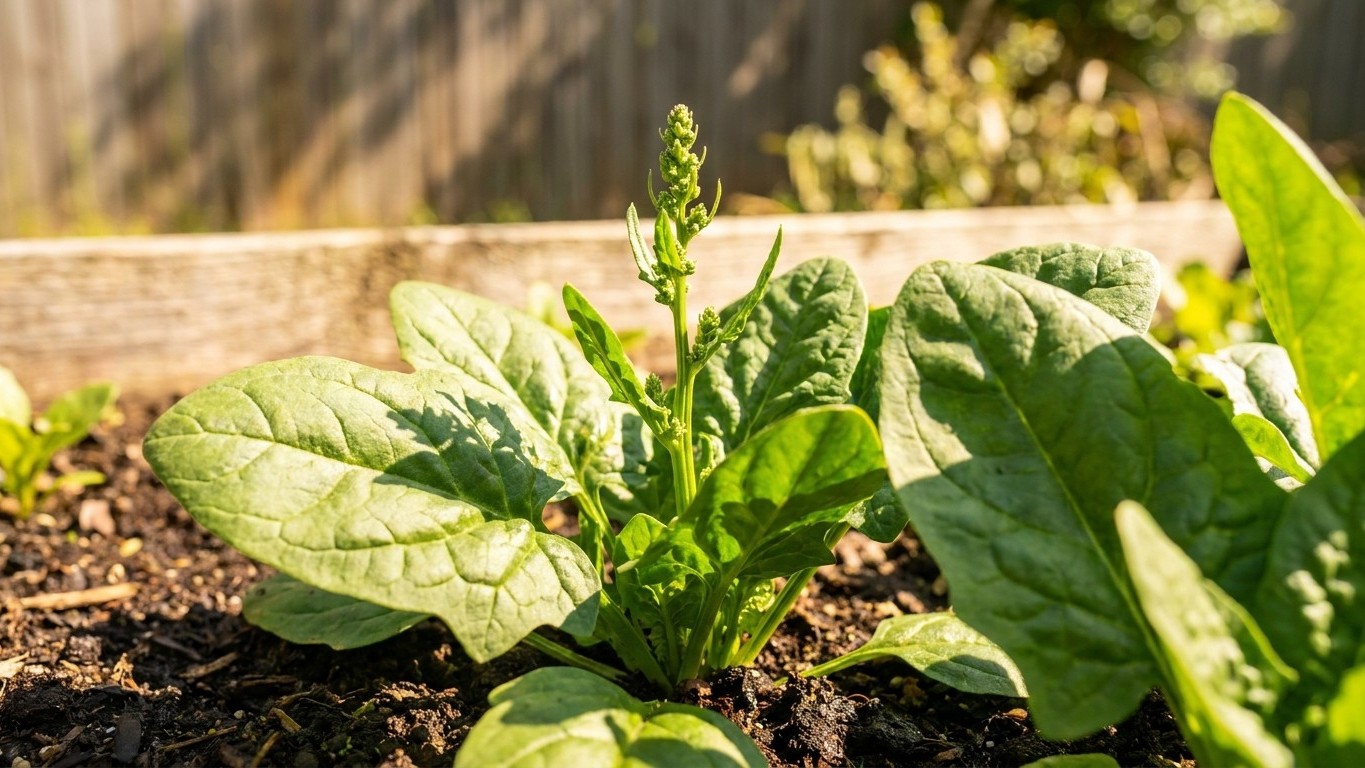

Yes, Spinach in New Hampshire bolts fast, and the real cause isn’t heat. It’s daylight. At Manchester, the reference city for this region’s climate normals, the longest day of the year holds 15 hours and 10 minutes of daylight, well past the point where spinach shifts from growing leaves to sending up a flower stalk. A mild, cool summer doesn’t change that. Between the long days centered on June and the short frost-free stretch on either side of it, New Hampshire’s spinach seasons are two brief windows, not one long summer planting.
The short answer
Manchester’s 15 hours and 10 minutes of daylight on the summer solstice isn’t just a fact about when the sun sets. For spinach, day length is the trigger that flips the plant from leafy growth into flowering, a process gardeners call bolting. Once days stretch past a certain length, the plant starts that process no matter what the thermometer reads. New Hampshire’s summer days run long enough, for weeks on either side of the solstice, to keep that switch on.
That’s the part that trips up gardeners who assume a cooler climate buys them time. It doesn’t. Day length works the same in a mild summer as in a hot one, because the signal comes from light, not warmth.
Heat adds a second push on top of that. Utah State University Extension notes spinach grows best where temperatures stay under 75 F, and that same figure marks the point where leaves start turning bitter. Manchester doesn’t run brutally hot by Northeast standards, averaging 10.9 days a year at 90 F or hotter, but spinach’s ceiling sits so far below what counts as a hot day here that any real warm spell pushes an already day-length-primed plant into bolting sooner.
So which is the limiting factor, day length or heat? Both, and they land in the same stretch of the calendar. New Hampshire’s frost-free season falls squarely across the months when daylight runs longest, so the biological signal for bolting and the year’s warmest stretch hit spinach at the same time. A cool June doesn’t buy extra weeks, because the days are already long enough on their own to end the leafy stage.
Utah State University Extension names four spinach varieties, Bloomsdale, Melody, Teton, and Olympia, without publishing bolt-resistance or maturity data for any of them, so there’s no verified way to say one holds up longer than another under New Hampshire’s day length. None of this means spinach can’t be grown well here. It means treating the crop as two short, separate seasons rather than one long summer planting.
How long the spring window really is
Working out the usable spring window for spinach in New Hampshire means stacking three figures together: the last frost date, the point where lengthening days start working against the crop, and the point where heat does the same.
- Start with the last frost. At Manchester, the reference station for this region, the last spring freeze typically falls between April 16 and April 27. Suburban and rural gardens, especially inland or at elevation, often see frost linger one to two weeks longer, so check your own county’s frost history before setting a date.
- Count back for sowing. Spinach seed goes in two to three weeks before that last frost date, which lands sowing near the end of March into the first week of April for most of the state, earlier in milder pockets, later at elevation.
- Track how fast the days lengthen. From early April to the June solstice, day length in New Hampshire climbs steadily toward that 15-hour, 10-minute peak. Spinach doesn’t wait for the solstice itself, long days accumulate their effect over weeks, so a plant sown in late March is already working against a lengthening clock from the moment it germinates.
- Track the heat separately. Growth stays good only below 75 F. Late March and April run cool enough that heat isn’t yet the limiting factor, but as May moves toward June, warmer afternoons start stacking on top of the day-length effect.
- Add it up. A sowing in late March to early April gives roughly eight to ten weeks of good growth before the combined push of long days and rising heat ends the leafy stage, typically somewhere in the first half of June. That’s the entire spring spinach season in one stretch, not a harvest that keeps rolling into summer.
The autumn crop, and when the soil lets you sow
The fall spinach crop in New Hampshire isn’t blocked by cold at planting time. It’s blocked by heat still sitting in the ground, and then squeezed by the frost that follows a few weeks later.
Soil that’s still too warm to germinate
Utah State University Extension notes that spinach seed germination drops once soil temperatures climb above 80 F. Working backward from a realistic fall harvest date around mid-October, and using the Extension’s guidance to sow 50 to 75 days before the date you want to pick, puts the sowing window somewhere between roughly August 1 and August 26. That’s exactly when New Hampshire soil is least ready for spinach seed. The state averages 10.9 days a year at 90 F or hotter, and most of them land in July into August, keeping topsoil warm well past the point spinach seed prefers. In practice, the workable sowing date tends to sit toward the back half of that August range, once the hottest run of summer has broken and soil has had time to cool.
The frost that closes the door
At Manchester, the first fall freeze typically arrives between October 13 and October 26, and that date is doing double duty. It marks the end of the harvest window, and it’s the reason sowing can’t slip much later while waiting for soil to cool further. A sowing pushed into early September, chasing cooler ground, leaves less than the 50-day minimum before that frost window opens. Suburban and rural gardens away from the reference station, particularly inland and at higher elevation, often see frost arrive one to two weeks earlier than Manchester’s figures suggest, narrowing the fall window even more. The realistic target for most of New Hampshire is a mid-to-late August sowing, aimed at a harvest in the first half of October, ahead of the earlier end of that frost range.
Common questions
Can I stop spinach from bolting once the days get long?
Not by anything a home gardener can do outdoors. The trigger is day length, not a stress you can water or shade away. Once New Hampshire’s days climb into the long stretch around the solstice, bolting proceeds regardless of how well the plant is cared for.
Does shade slow bolting down in New Hampshire’s summer?
Shade can lower leaf temperature and may buy a little time against the 75 F growth ceiling, but it does nothing about day length, which is the primary trigger here. It’s a minor delay, not a fix.
Why does the fall sowing date matter more than the spring one?
Because it’s boxed in on both sides. Sow too early and the soil is still above 80 F, working against germination. Sow too late and there isn’t enough time before the first fall freeze, which arrives between October 13 and October 26 at the reference station.
Should I trust Manchester’s frost dates for my own yard?
Use them as a starting point, not a guarantee. Suburban and rural gardens, especially inland or at higher elevation, commonly see the last spring frost come later and the first fall frost come earlier than the reference station shows, sometimes by one to two weeks. Check your own county’s frost records before locking in a sowing date.