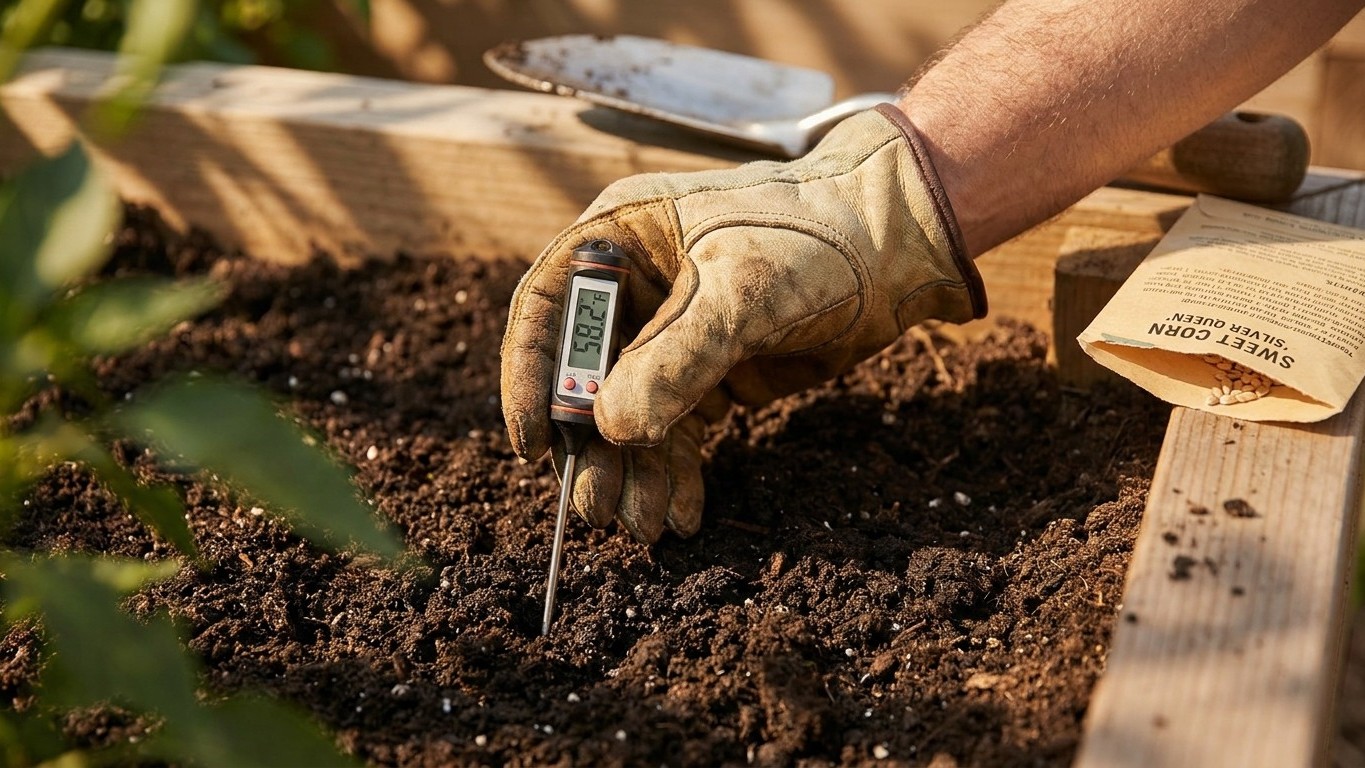

Soil in most New Mexico gardens needs to hold steady above 60°F before sweet corn seed will sprout reliably, and that threshold arrives well after the last spring frost, not alongside it. At the reference weather station, that frost risk clears between March 31 and April 12, but the ground itself takes longer to catch up. Once soil is warm enough, the 60- to 90-day window from planting to harvest fits comfortably before the first fall frost.
The short answer
Air temperature and soil temperature don’t move together. A calm, sunny afternoon can push the thermometer into the 70s while six inches of ground underneath is still cold from months of winter. That’s the trap a lot of New Mexico gardeners fall into: they see the last-frost date pass (March 31 to April 12 at the reference station, per NOAA’s 1991-2020 Climate Normals) and assume the soil is ready too. It usually isn’t yet. Sweet corn seed sitting in ground below 60°F doesn’t germinate, it rots, and a gardener who plants on the frost date alone often ends up reseeding a few weeks later anyway.
The good news is that New Mexico’s growing season has plenty of slack built in. The first fall frost at the same reference station lands between October 29 and November 9. Counting from the latest possible last-frost date (April 12) to the earliest possible first-frost date (October 29) still leaves roughly 200 days of frost-free growing time. Sweet corn only needs 60 to 90 days from the day it goes in the ground to the day it’s ready to pick. Even after waiting for soil to climb past 60°F, which can easily eat up several extra weeks beyond the frost date, there’s still a wide margin left for the crop to mature before autumn cold returns.
That margin matters more in New Mexico than in a lot of places, because summer heat here is a real factor in how the crop performs. The reference station averages 42.5 days a year at 90°F or hotter, a heat load that drives up water demand and can stress pollination if tasseling happens during the peak of that stretch. It’s not a reason to delay planting past the point soil is ready, since the season buffer already covers that. It is a reason to keep an eye on the calendar once corn is in the ground, because irrigation needs will spike right alongside those 90-degree afternoons.
One more caution worth repeating: these frost dates come from a single airport weather station. Suburban and rural gardens, especially at higher elevation, typically see the last frost arrive later and the first frost arrive earlier than the station shows, sometimes by one to two weeks or more. New Mexico’s elevation swings are large enough that a garden thirty miles from the reference station could be running on a noticeably different clock. Check local county extension guidance or your own frost history before locking in a date.
Does a late variety fit here?
A 60-day variety
A fast 60-day sweet corn fits New Mexico’s season with room to spare. Even in the tightest scenario, a late last frost paired with an early first frost, the roughly 200-day frost-free stretch leaves well over 100 days of unused season after a 60-day crop finishes. That surplus opens the door to succession planting: a second sowing three or four weeks after the first can extend the fresh-corn harvest deep into summer without any risk of running out of season. Gardeners who want to spread pollination away from the hottest weeks of the year, when the 42.5-day average of 90°F-plus afternoons peaks, can use that flexibility to stagger tasseling times across two or three plantings.
A 90-day variety
A slower 90-day sweet corn also fits, and comfortably, once soil has actually reached 60°F. Subtract even a generous few weeks of soil warm-up delay from the roughly 200-day frost-free window, and there’s still far more than the 90 days the crop needs to mature. The one thing worth planning around is heat timing rather than season length: since the growing window here isn’t the limiting factor, there’s no upside to delaying planting past the point soil is reliably warm just to “play it safe.” Getting the crop in the ground as soon as soil conditions allow gives it the best shot at tasseling before the hottest stretch of summer sets in, which tends to produce more reliable ears than a later start.
Two separate clocks matter here, and they answer different questions. The 60- to 90-day figure counts from planting to harvest and tells you whether the variety fits the season at all, which in New Mexico it clearly does. A second figure, 17 to 24 days from silk emergence, tells you which week to start checking ears for ripeness once tasseling has already happened. Don’t merge the two: one is a season-length question, the other is a picking-week question.
What goes wrong here
- Soil sown too cold. Planting right on the last-frost date, before soil has climbed past 60°F, leads to poor germination or seed that simply rots in the ground. The fix is patience: wait for soil, not air, to confirm readiness, and check it with a simple soil thermometer a few inches down rather than trusting the calendar alone.
- A variety too late for the season. This isn’t a common failure in New Mexico given how much frost-free time the reference station’s dates suggest, but at higher elevations where frost lingers later and returns earlier than the reference numbers show, a slow variety can run short on time. The remedy is checking local frost history rather than relying only on station-based averages, especially in mountain valleys and higher-elevation counties.
- Sweetness lost to cross-pollination timing. This one has nothing to do with soil or frost. Standard (su), sugary-enhanced (se), and supersweet (sh2) types lose their intended flavor and texture if they tassel at the same time nearby, because their pollen mixes. The published guidance gives no isolation distance to rely on, so the fix is timing and layout: stagger planting dates so different types don’t tassel together, and grow each type in its own block of three or more rows rather than thin single rows, which also improves pollination reliability within each block.
Common questions
Can I plant sweet corn in New Mexico as soon as the last frost passes?
Not reliably. The last-frost date only marks when freeze risk drops off. Soil usually needs several more weeks of warming before it holds steady above 60°F, and seed planted in colder ground tends to rot rather than sprout.
How long is New Mexico’s sweet corn growing season?
Using the reference station’s dates, the frost-free stretch runs roughly 200 days even in the tightest case (last frost April 12, first frost October 29). That comfortably covers the 60- to 90-day window sweet corn needs from planting to harvest.
Do different types of sweet corn need to be kept apart?
Yes, but by timing rather than distance. No isolation distance is published in the source guidance for this. What matters is that standard, sugary-enhanced, and supersweet types must not tassel at the same time, or their sweetness and texture suffer.
How do I know when the corn is actually ready to pick?
Look for three signs together, not just one: silks that have turned dry and brown, husks that are still moist and green, and milky (not clear or thick) juice from a punctured kernel. This ripeness check happens roughly 17 to 24 days after silk emergence, a separate clock from the 60- to 90-day planting-to-harvest window.