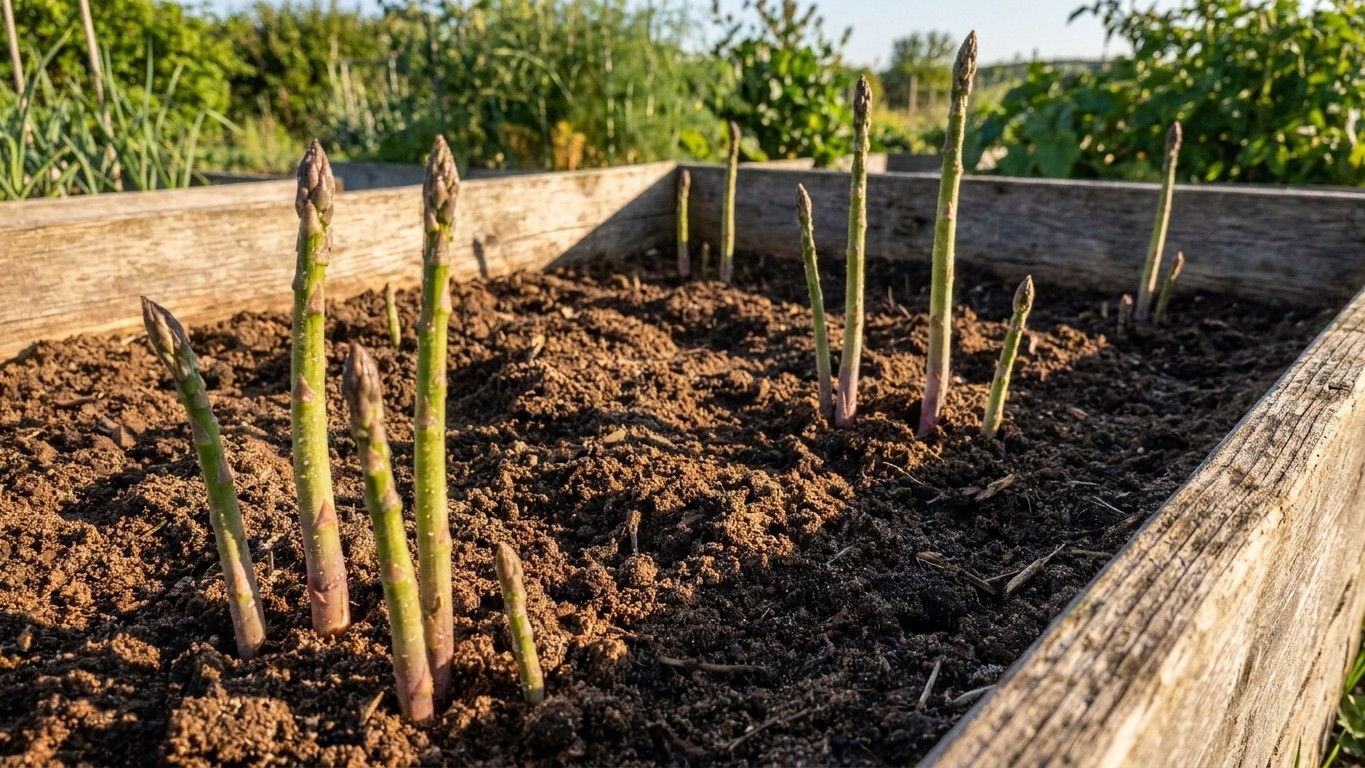

Yes, in most cases. The Honeoye series, the soil USDA lists as representative of New York, is classified well drained, and drainage is the one soil requirement Utah State University Extension attaches to an asparagus planting that’s expected to produce for 10 to 15 years. That’s the short version. What decides whether it holds true on your own plot is a longer story.
The short answer
Start with what the Honeoye series actually is: an Alfisol, a forest soil of moderate fertility that holds onto nutrients reasonably well. Its surface horizon runs 26 percent sand, 19 percent clay and 55 percent silt, a loam-to-silt texture with a surface pH around 6.3, slightly acid. Organic matter sits around 3.0 percent, a number typical of a mineral surface that’s been under vegetation or cultivation rather than a peat or muck layer. USDA NRCS records this soil as well drained, and that single word is the whole reason it can support an Asparagus Bed for a decade and a half without the gardener having to rethink the site.
Asparagus doesn’t ask for a rich soil, a particular pH, or any specific fertility program in the source cited here. It asks for drainage, full stop. That’s a strange demand to build a fifteen-year commitment around, but it makes sense once you consider what asparagus actually is: a perennial crown that sits in the ground, roots spreading outward, through every wet spring and every winter thaw the site will see for the life of the bed. A soil that sheds water rots those crowns eventually. A soil that drains keeps them alive long enough to reach year three, when harvest finally starts, and long past it.
New York’s representative soil clears that bar. But the Honeoye series is a starting point, not a diagnosis of any one backyard. A state spans hundreds of soil series, and the ground under a particular house may sit nowhere near a Honeoye map unit. River bottoms tend to hold water longer than upland loams. Hill country sheds it faster. Any lot a builder has cut, filled, or compacted during construction can behave nothing like the natural profile USDA mapped. The pH figure above, 6.3, is a representative reading for this series as surveyed, not a number to copy onto your own garden.
The practical move, before committing a corner of the yard to fifteen years of asparagus, is a simple field check: dig a hole about a foot deep, fill it with water, and see how long it takes to drain. If water is still standing after several hours, the site isn’t ready as-is. The fix isn’t complicated, raised beds or mounded rows lift the crowns above the standing water table, and working in compost improves structure in a heavy spot. What doesn’t work is planting anyway and hoping. A soil test through a local extension office will also confirm where your own plot’s pH and texture actually land, since the Honeoye figures describe the state’s benchmark soil, not yours.
Will the summer here water it for you?
Asparagus has a two-stage thirst. For the first two years, while the crown is establishing its root system, it wants 1 to 2 inches of water every other week. After that, once the bed is mature and producing, the interval stretches to every three weeks. New York’s summer rainfall, measured at a reference station over the 1991-2020 period, averages about 13.7 inches across June, July and August, with June the driest month at 4.54 inches, July at 4.6, and August at 4.56. Spread evenly, that’s a bit more than an inch a week, which sounds close to what a young bed needs. Rain rarely spreads evenly.
- Check the calendar against the crown’s age. Years one and two need 1-2 inches every other week; a mature bed past year two needs 1-2 inches roughly every three weeks. The rainfall averages above cover both stages reasonably well on paper, but only on paper.
- Account for how the rain actually arrives. Summer rainfall in this region tends to come as thunderstorms rather than steady soaking rain. A single downpour that dumps an inch in twenty minutes runs off a well-drained loam faster than it soaks in, which is exactly the soil this state is built on.
- Factor in the soil’s own drainage rate. The same well-drained texture that keeps asparagus crowns from rotting also means water passes through the root zone quickly rather than lingering. That’s good for winter survival and bad for stretching out a summer rain event.
- Watch for heat spikes. Days that push into the 90s drive evaporation up sharply, pulling moisture out of the top few inches of soil faster than a monthly rainfall average would suggest.
- Put a rain gauge on the actual bed. Averages describe a reference station, not a backyard. A rain shadow, a slope, or nearby pavement can shift what a given plot receives well above or below the regional number.
The honest takeaway is that New York’s summer rainfall gets a young or mature bed most of the way there, but it isn’t a substitute for watching the soil itself. A gardener who waits for the sky to deliver exactly 1 to 2 inches every other week, in tidy installments, will often come up short during a dry stretch in a hot July, and will need to run a hose to close the gap.
When to put the crowns in
Crowns go into the ground in early spring, set into furrows about 8 inches deep. In New York, that window sits around the last spring frost, which the historical record for a New York City reference station places around March 23 to April 3. That’s an average, not a promise, so treat it as a rough target rather than a fixed date on the calendar. Upstate counties and the Adirondacks run on their own clock entirely, with frost lingering noticeably later into spring than the city figure suggests, so a gardener in those regions should lean later rather than earlier when deciding it’s safe to open the furrow.
Once the crown is set in its furrow, the backfilling isn’t a one-time job. Soil goes back in gradually across the season, about 2 inches every other month, rather than filling the trench flat on planting day. That staged approach lets the emerging shoots keep growing toward light as the furrow slowly fills, rather than burying them under the full depth at once.
Growers who’d rather start from seed instead of crowns can, though the crown method is what the source used for this piece actually details step by step, and starting from seed is a slower road to that first real harvest in year three regardless of which starting point a gardener chooses.
Variety choice is available, but published information is limited strictly to which varieties are all-male and which are a male/female mix, nothing about flavor, yield, or which performs better in any particular region.
| Variety | Sex type |
|---|---|
| Jersey Giant | All-male |
| Jersey Knight | All-male |
| UC 157 F1 | Male/female |
| Purple Passion | Male/female |
All-male varieties are often chosen because they don’t put energy into producing seed, which in theory leaves more for spear production, but that’s a general gardening rationale, not a claim made by the source above. No winter chilling requirement is published for asparagus in this material, and no target soil pH is specified either, so don’t treat a state’s hardiness zone as a stand-in for either figure.
Common questions
Can I harvest the first spring the crowns come up?
No. Harvest doesn’t begin until year three, regardless of how vigorous the first-year growth looks. Cutting spears earlier weakens the crown before it’s established enough to support repeat production for the next decade.
How long can I keep cutting spears once harvest starts?
Stop cutting for the season once most of the spears coming up are thinner than a pencil. That’s a sign the crown’s energy reserves are running low for the year, not a fixed week count on a calendar.
What if my soil test comes back heavier than the state’s representative soil?
Raised or mounded beds are the standard fix for a spot that holds water longer than asparagus can tolerate. Working compost into the planting area also helps a heavy soil drain and warm faster in spring.
Does the reference frost date apply to my exact town?
Only loosely. The March 23 to April 3 window is drawn from a New York City station; the further upstate or into higher elevation you garden, the later that window tends to shift, sometimes by weeks rather than days.