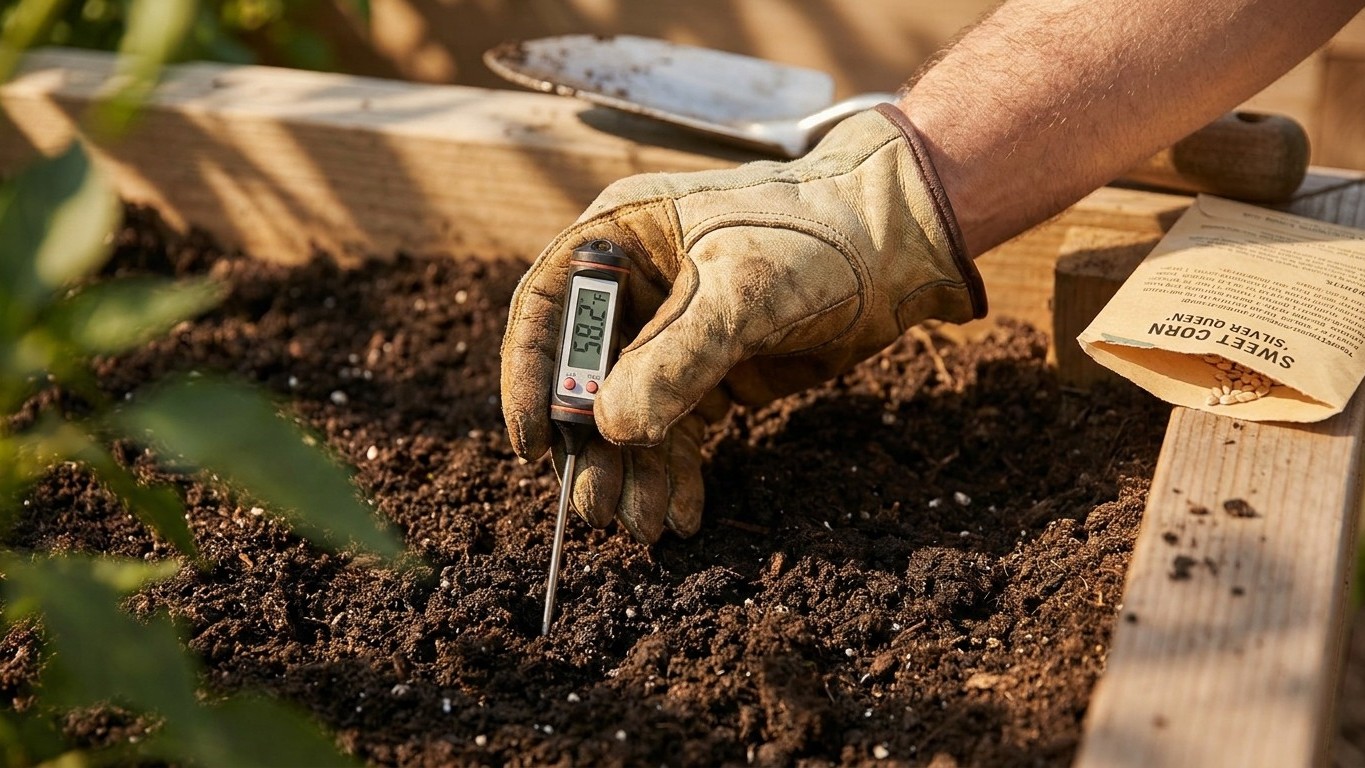

Soil here needs to cross 60°F before sweet corn seed will sprout instead of rot in the ground, and that threshold lands well after the region’s average May 7 last frost, often not for several weeks after. Once the ground finally catches up, a 60- to 90-day variety still has room to mature before the average October 18 first fall frost, but that room shrinks fast for the slower varieties, and this province’s cool summers rarely help make up lost time.
The short answer
Air warms faster than soil, which is the whole problem with using a frost date as a planting cue. Environment and Climate Change Canada’s 1981-2010 normals put the average last spring frost at Halifax Stanfield at May 7, but that figure describes when the air stops freezing, not when the ground underneath is warm enough for a corn seed to germinate reliably. Sweet corn asks for soil above 60°F, and that mark typically arrives noticeably later than the frost date itself, sometimes by several weeks, depending on soil type, drainage, and how much sun a given plot gets in spring.
Treat May 7 with some caution too. It’s a mean date, which means in roughly half of all years the last frost actually falls after it. A grower who plants the moment that date appears on the calendar is gambling on the better half of the odds, not on a guarantee. The same caution applies at the other end of the season: the average first fall frost at the same station is October 18, but again, that’s a midpoint, not a safe deadline. Some years push colder weather in earlier.
Between those two average dates sits a frost-free stretch of roughly 164 days. That sounds generous for a crop that needs 60 to 90 days to mature. But the usable window is shorter than the raw frost-to-frost span suggests, because nothing can go in the ground until that soil temperature clears 60°F, and that doesn’t happen the same week the air stops frosting. Whatever weeks are lost waiting for the soil to catch up come straight out of the growing season available to the plant.
There’s another factor working against speed here. Nova Scotia averages zero days a year above 90°F at the Halifax reference station. That’s the measure of summer heat load, the kind of warmth that pushes corn through its growth stages quickly. Without it, a planted crop tends to mature toward the slower end of whatever days-to-maturity figure is printed on the seed packet rather than the faster end. A variety rated for 70 days in a hot Midwestern summer may take noticeably longer to reach the same stage here, simply because the heat units aren’t accumulating at the same pace.
Put together, the honest short answer is this: wait for soil, not air, to hit 60°F, expect that to land later in the season than the frost date implies, and lean toward the shorter end of the 60-to-90-day range if the growing window is going to close comfortably before that average October 18 frost.
Does a late variety fit here?
A 60-day variety
A variety rated near 60 days from planting has the easiest path in this climate. Once soil clears 60°F, even allowing for a delayed start well after the average May 7 frost date, there’s still ample calendar left before the average October 18 frost. Two months of growing time, plus a buffer of several additional weeks, gives this kind of variety room to finish even in a cooler-than-average summer, and room to recover if a cold snap slows things down for a stretch. This is the type that fits the province’s actual growing conditions rather than the theoretical frost-to-frost window.
A 90-day variety
A 90-day variety asks for nearly the full three months, and that’s where the math gets tight. Because planting can’t start until soil is warm, and because this region records zero days a year above 90°F, meaning the heat that speeds up maturity simply isn’t there in any reliable quantity, a 90-day type is likely to run at the slow end of its own rated window rather than the fast end. Add in that October 18 is only a mean frost date, with roughly half of all years bringing frost sooner, and the margin left for a full-season variety gets thin fast. Said plainly: a 90-day sweet corn variety does not comfortably fit most Nova Scotia gardens. It might work in an unusually early, unusually warm year, or in a garden with an exceptional south-facing microclimate, but it’s not a safe bet as a rule, and gardeners planning around the province’s actual averages are better served sticking closer to the shorter end of the maturity range.
What goes wrong here
- Soil sown too cold. The most common mistake is treating the last frost date as the green light to plant. Seed put into soil that hasn’t yet reached 60°F tends to rot or germinate unevenly, leaving gaps in the row. The fix is simple: check the soil itself, not the calendar, before sowing, and accept that the safe planting date in this province usually falls later than the average frost date implies.
- A variety too late for the season. Choosing a 90-day type banks on a long, warm stretch that a province averaging zero days above 90°F rarely delivers with consistency. When the season runs short or cool, a late variety can still be standing in the garden, unfinished, when the first fall frost shows up. The remedy is choosing a variety closer to the 60-day end unless there’s real, local evidence the site runs warmer than average.
- Sweetness lost because two types tasselled together. This one has nothing to do with frost dates or soil temperature. Standard (su), sugary-enhanced (se), and supersweet (sh2) sweet corn types cross-pollinate if their tassels shed pollen at the same time, and the result is starchy, disappointing kernels even in a garden that did everything else right. The fix isn’t a measured distance, it’s timing: stagger plantings, or grow only one type per season, so different sweet corn types are never tasselling at the same time. Planting in blocks of three or more rows, rather than one or two long rows, still matters for good pollination within a single type or planting.
Common questions
Can I just plant sweet corn as soon as the last frost passes in Nova Scotia?
Not reliably. The average last frost date describes air temperature, and sweet corn needs soil above 60°F to germinate well. Soil typically takes longer to warm than the air does, so the safer cue is a soil check, not the frost date itself.
What happens if sweet corn goes into cold soil?
Seed sown before the ground reaches 60°F tends to rot or come up thin and uneven, since the seed sits in cold, damp soil longer than it can tolerate before it starts to break down.
How many rows of sweet corn should I plant?
Utah State University Extension recommends blocks of three or more rows rather than one or two long rows. That’s about the shape of the planting for good pollination, not a planting date.
Does Nova Scotia get hot enough to ripen sweet corn quickly?
Rarely. The province averages zero days a year above 90°F, so there’s little of the intense heat that speeds up maturity elsewhere. Expect a given variety to mature toward the slower end of its rated days-to-maturity range rather than the faster end.