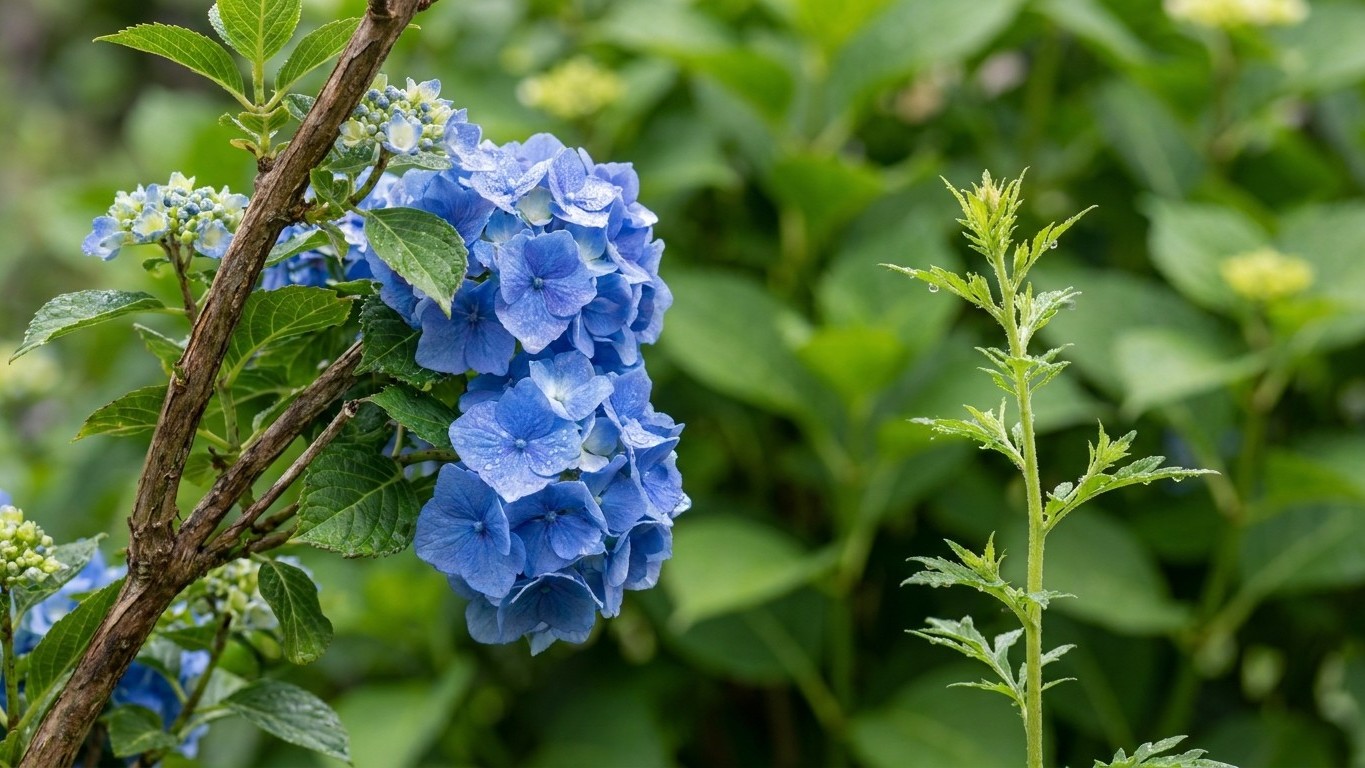

Most hydrangeas in Nova Scotia get through winter on their own roots and a thick blanket of mulch. The ones that need more are bigleaf and oakleaf types, which carry next summer’s flower buds on last year’s stems. Pile leaves or bark over the base once the ground cools, shield exposed shrubs from wind, and keep the pruners in the shed until spring. Panicle and smooth hydrangeas bloom on new growth, so they can lose every stem to cold and still flower.
What this comes down to in Nova Scotia

Hydrangeas are exposed to winter damage from about the first fall frost, on average around October 18 at Halifax Stanfield, until the last spring frost, on average around May 7. Those dates are approximate and are based on Environment and Climate Change Canada’s climate normals for Halifax, whose published figures differ by a few days depending on the reference period; they are midpoints. In one year out of two the first frost arrives earlier than October 18, and in one year out of two the last frost falls later than May 7. The two dates are about 164 days apart, so the exposed season, from mid-October to early May, covers a little over half of the calendar.
Halifax sits in Canadian hardiness zone 6b, according to Natural Resources Canada’s plant hardiness site. That system is built on seven climate variables and does not convert to a USDA zone, so a nursery tag written for the US scale cannot be read straight across.
The zone number says little about what actually kills hydrangeas here. Deep midwinter cold is rarely the culprit. Maritime winters swing between thaw and freeze, and a mild week in February or April can wake the buds just before a hard night. Frost in October can catch stems that have not finished hardening off. Wind and bright sun also dry out canes while the frozen ground cannot send up any water to replace it.
Which hydrangeas need winter protection in Nova Scotia?
It depends on where the plant sets its flower buds. A shrub that blooms on old wood has everything to lose over winter. One that blooms on new wood only needs its roots to survive.
| Type | Blooms on | Winter risk | What to do |
|---|---|---|---|
| Panicle | New wood | Low; stems may die back but flowers return | Mulch the base |
| Smooth | New wood | Low; may die to the ground and regrow | Mulch the base |
| Bigleaf | Old wood (reblooming types on old and new) | High; buds die in cold or freeze-thaw | Mulch, cage with leaves, add a windbreak |
| Oakleaf | Old wood | Moderate; buds can fail in exposed spots | Mulch and shelter from wind |
Reblooming bigleaf hydrangeas soften the blow, since a lost set of buds costs the first flush but not the whole summer.
Working it out for your own garden
Start from the two means and work outward. The first fall frost is around October 18 in Halifax, and in a cold year it comes sooner. Have your mulch, wire, burlap and stakes in hand by early October, roughly two weeks ahead of that mean. Nothing has to go on yet. The point is that you are never hunting for a roll of burlap on the night the forecast turns.
The protection itself goes on later. Wait for several hard freezes, usually well into November, so the ground has started to chill. Mulch laid over warm soil invites voles to nest and keeps stems soft when they should be hardening. In spring, count forward from the May 7 mean. Pull the heavy covering off in stages through late April and early May, and keep burlap close until mid-May, since half of all years have a frost after the mean date.
Take a bigleaf that blooms on old wood as a worked example. Its buds were set the previous late summer, so everything depends on them surviving until June or July. Stop feeding by midsummer, skip fall pruning, and water deeply in late October if the weather has been dry. Once the freezes arrive in November, ring the plant with a wire cage and fill it with shredded leaves. Uncover gradually in spring and watch for green buds swelling on the stems.
A panicle hydrangea runs the same calendar with half the work. A layer of mulch around the base is enough, because it will bloom on whatever new growth it makes. If a hard late frost kills the tips in May, the plant flowers a little later and a little smaller. A non-reblooming bigleaf in the same frost can lose the whole season.
How can you tell what winter did to your hydrangea?
Do not prune in April, because bigleaf hydrangeas leaf out late and dead-looking canes are often alive. Scratch a bit of bark with a thumbnail. Green underneath means the stem is alive, and brown and dry means it is dead. Then look for a pattern:
- Healthy leaves but no flowers on bigleaf points to buds killed by cold or a thaw-freeze swing.
- Stems dead to the snow line, with strong new shoots from the base, points to cold or a lack of snow cover.
- Gnawed bark near the ground points to voles under the mulch or snow.
- Brown, crisp leaf edges and shriveled tips on the windward side point to wind and salt.
What changes across the province
Halifax is one reference point on the Atlantic coast, and a province is not one climate. The ocean softens the extremes near the shore, which delays the first fall frost and takes some of the bite out of midwinter. It also brings fog, wind and salt spray, which scorch evergreen foliage and dry out exposed stems. A bigleaf at a seaside house may avoid the worst cold but still need a windbreak of burlap on stakes.
Inland and upland districts run colder. Frost comes earlier in fall and lingers later in spring, by weeks rather than days, and the protection season stretches at both ends. Higher ground and the interior of Cape Breton are the obvious examples, as are the hills along the northern side of the mainland. Anyone gardening there should treat the October 18 and May 7 means as a best case and have your materials ready earlier and plan to uncover later.
Snow changes the picture again. A deep, steady snowpack insulates the base of a shrub as well as or better than most mulches, and areas that get reliable snow often fare better than milder places where snow melts and refreezes. Wind-scoured open ground loses its cover first. Cold air also pools in hollows and low pockets, which can be several degrees colder than the slope above, while a south-facing wall gives a little extra warmth. Placing a tender hydrangea against a sheltered wall can help as much as a wrap.
The mistakes this province punishes
Mulching too early is a common error. A warm October tempts people to tuck the shrubs in right after the first frost, but mulch over warm ground holds heat, keeps growth soft, and gives voles a cozy home. Wait for the ground to chill and a run of freezing nights, then mulch.
Late feeding is another. Nitrogen after midsummer pushes tender new shoots that will not harden before frost, and a mean frost date of October 18 leaves little margin. Switch to no fertilizer by midsummer. The same logic applies to planting. A hydrangea set out in late October has no time to root before the ground freezes, so plant by early fall or hold the shrub in its pot until spring.
Fall pruning takes a toll as well. Cutting back a bigleaf or oakleaf in autumn removes next year’s flowers. Leave the canes alone until you can see which ones leaf out. Wrapping the shrub tightly in plastic is another trap, because it traps moisture, heats up in winter sun, and encourages rot and early bud break. Burlap or a cage of leaves breathes. Lifting the cover too soon is a mistake too. A warm spell in April feels like spring, but frost can still follow in May, so keep the cover on until the weather steadies and keep burlap ready.
Finally, watch road salt. Shrubs near driveways or the coast take salt through the soil and in spray. Plant them farther from the road and rinse the soil in spring if the plants look scorched.
Checking this against your county
A frost window from one station is a starting point. Your own garden may be warmer or colder, and lower or higher, than Halifax. Ask the Nova Scotia Department of Agriculture how your county compares, and keep a notebook of when frost first shows up in your own yard. For the basics of siting and care, see the guide to growing hydrangeas in Nova Scotia.
Common questions
When should I put winter protection on hydrangeas in Nova Scotia?
Have materials ready by early October, but wait to apply them until several hard freezes have chilled the ground, usually in November. The mean first frost at Halifax is around October 18, and it comes earlier inland and upland.
Do panicle hydrangeas need winter protection?
Rarely beyond a layer of mulch over the roots. Panicle hydrangeas bloom on new wood, so stems killed by cold still regrow and flower. Young plants and exposed sites benefit from extra mulch.
Should I prune hydrangeas before winter?
Leave bigleaf and oakleaf hydrangeas unpruned, since the buds for next summer are already on the canes. Panicle and smooth types can be cut back in late winter or early spring before growth starts. Faded flower heads left on over winter offer a little extra cover for the buds below.
Why did my bigleaf hydrangea leaf out but not bloom?
The flower buds were most likely killed by cold or by a thaw followed by a freeze, while the leaf buds survived. A cage filled with leaves, a windbreak, and uncovering in stages through the weeks around the mean last frost of May 7 help protect the buds. A reblooming type will still flower later in the summer on new growth.