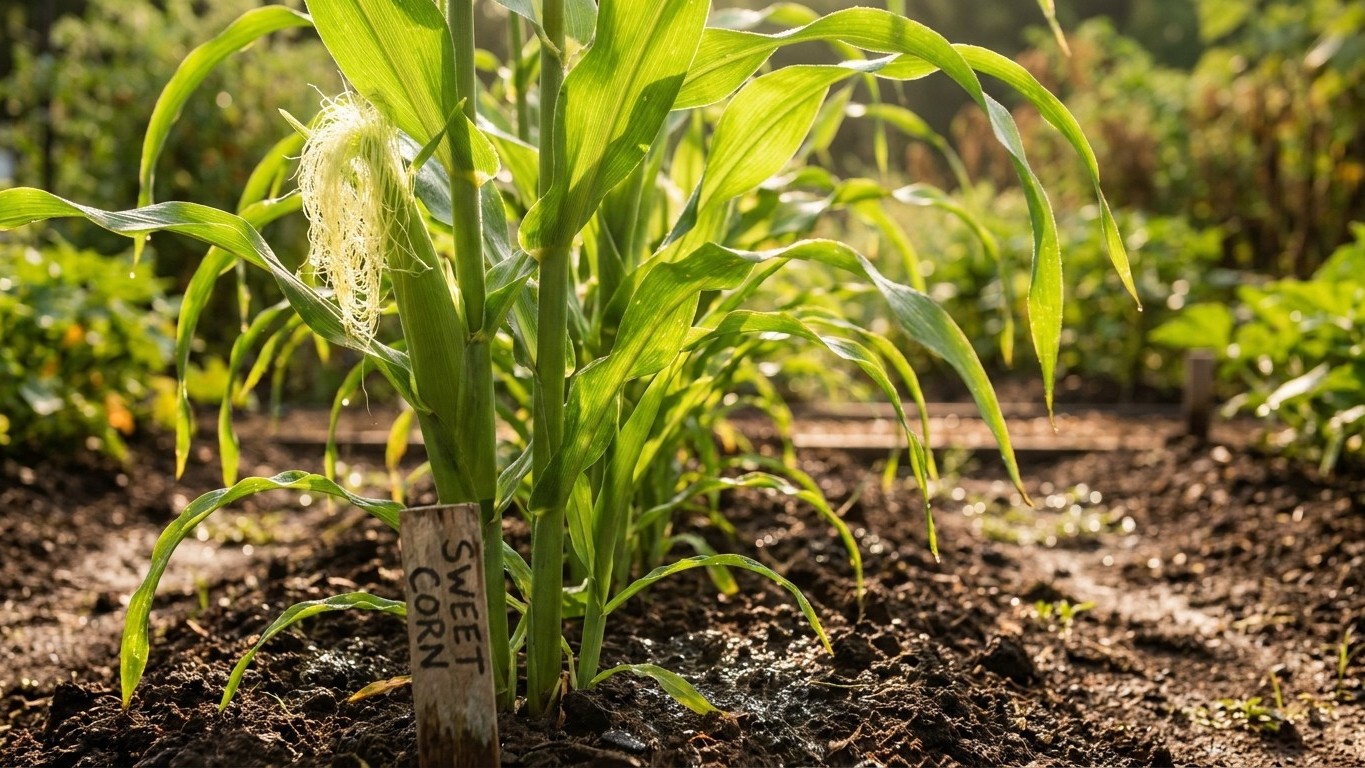

Yes, sweet corn can ripen in Nova Scotia, but the margin is narrower than most gardeners assume. The frost-free calendar looks generous on paper, yet the soil itself takes its time catching up to the air, and that lag is what actually decides whether a given variety has enough runway before fall.
The short answer
Sweet corn seed will not germinate reliably until the soil holds steady above 60 F. That threshold arrives well after the last spring frost, not on the same date. In this part of Nova Scotia, the average last spring frost falls around May 7, according to Environment and Climate Change Canada’s climate normals for Halifax Stanfield International Airport. Soil doesn’t jump to planting temperature the moment frost risk clears; it warms gradually over the following weeks as the sun climbs higher and the ground itself sheds its winter cold. So the real planting window opens later than a quick glance at the frost date would suggest.
That May 7 figure is also an average, not a guarantee. Environment and Climate Change Canada draws it from three decades of records, and by definition, half of those years saw frost arrive later. Treat it as the midpoint of a range, not a line you can plant right up against.
On the other end of the season, the average first fall frost lands around October 18, again from the Halifax Stanfield station. Between May 7 and October 18 sits roughly 164 days, frost to frost. Sweet corn needs 60 to 90 days from planting to maturity, so on paper there’s plenty of calendar left even after subtracting the weeks it takes soil to warm. That’s the reassuring part of the math.
The catch is heat, not just days. The same climate normals show an average of 0.0 days per year reaching 90 F at this reference station. That number matters more than it looks. Sweet corn’s days-to-maturity count assumes a reasonably warm growing season pushing the plant along; without real heat load, growth slows, and a variety rated for 75 days on a seed packet can easily stretch past that in a cooler-than-usual stretch. So while the calendar window is real, it’s a window that rewards shorter varieties and punishes anyone counting on a hot summer to bail out a late planting.
Put together, the short answer holds: sweet corn ripens in Nova Scotia most years, provided the variety is matched to a season that is long on daylight but short on real heat, and provided the grower doesn’t plant the moment frost clears rather than waiting for the soil itself to catch up.
Does a late variety fit here?
Whether a specific variety fits depends on stacking two things against each other: how many days it needs, and how many usable days actually exist once soil warmth, not frost date, sets the start line. Here’s how that plays out at the two ends of the typical range.
A 60-day variety
A variety rated near 60 days has the easiest path through this climate. Even accounting for soil needing several extra weeks past the average frost date to hold above 60 F, a 60-day type planted once conditions allow still finishes with a wide cushion before the October 18 average fall frost. That cushion matters because it absorbs the year-to-year swing in both frost dates and the slower growth that comes with Nova Scotia’s lack of true summer heat, given the 0.0 average days above 90 F. A short variety is the forgiving choice here, and it’s the one that leaves room for a late spring without the whole crop being pushed past its limit.
A 90-day variety
A 90-day type is a much tighter fit, and honestly it doesn’t fit comfortably. Stack the same soil-warming delay onto a longer maturity requirement, and the harvest date creeps close to that October 18 average frost, a date that itself is only a midpoint, meaning frost arrives earlier than that in roughly half of all years. Add in the heat deficit, zero days a year averaging 90 F, and a 90-day count on the packet can realistically run longer in practice, since that figure assumes warmer conditions than this coastal climate typically delivers. Between a possibly early frost, a possibly late spring, and slower-than-rated growth, a full-season 90-day variety carries real risk of not finishing before the cold arrives. Growers who want a longer-season type should treat it as a gamble rather than a plan, and lean toward the shorter end of the range instead.
What goes wrong here
- Soil sown too cold. Planting right at the average frost date, rather than once the ground itself holds above 60 F, is one of the most common failures. Cold, wet soil rots the seed before it ever germinates. The remedy is patience: check the soil directly, with a thermometer if possible, rather than trusting the frost date alone, and accept that the safe planting window opens weeks after that date, not on it.
- A variety too late for the season. Choosing a 90-day type because it sounded like a bigger harvest is a common mistake in a climate with almost no days above 90 F to push growth along. The remedy is to favor shorter-season varieties that finish with margin, rather than counting on a hot stretch that this climate rarely delivers.
- Sweetness lost to timing, not weather. This one has nothing to do with soil or frost. Standard (su), sugary-enhanced (se), and supersweet (sh2) types cross-pollinate if they tassel at the same time, and the result is starchy, disappointing ears even in a perfect growing season. The remedy is to keep different sugar types from tasseling together, staggering plantings or choosing only one type per garden, and to plant sweet corn in blocks of three or more rows rather than a single thin row, since that layout is what allows reliable pollination in the first place.
Common questions
When should I actually plant sweet corn in Nova Scotia?
Once the soil holds steady above 60 F, not on the average last frost date of May 7. That date marks when frost risk eases, but soil temperature lags behind it, so plan for planting to happen later in spring than the frost date alone would suggest.
Can I treat the average frost dates as safe planting and harvest deadlines?
No. Both the May 7 last-frost average and the October 18 first-frost average are means drawn from three decades of records at Halifax Stanfield. In one year out of two, frost arrives later than May 7 or earlier than October 18. Use them as the midpoint of a range, and build in a cushion on both ends.
How do I know when an ear is actually ripe?
Look for three signs together, not just one: silks that have turned dry and brown, husks that are still moist and green, and juice from a punctured kernel that runs milky rather than clear or thick. All three should line up before you pick.
Why did my corn end up starchy instead of sweet, even though the season went fine?
This is almost always a pollination issue rather than a weather one. If a standard (su), sugary-enhanced (se), or supersweet (sh2) variety tassels at the same time as another type nearby, the ears lose their sweetness. Keep sugar types from tasseling together and plant in blocks of three or more rows for reliable pollination within a single type.