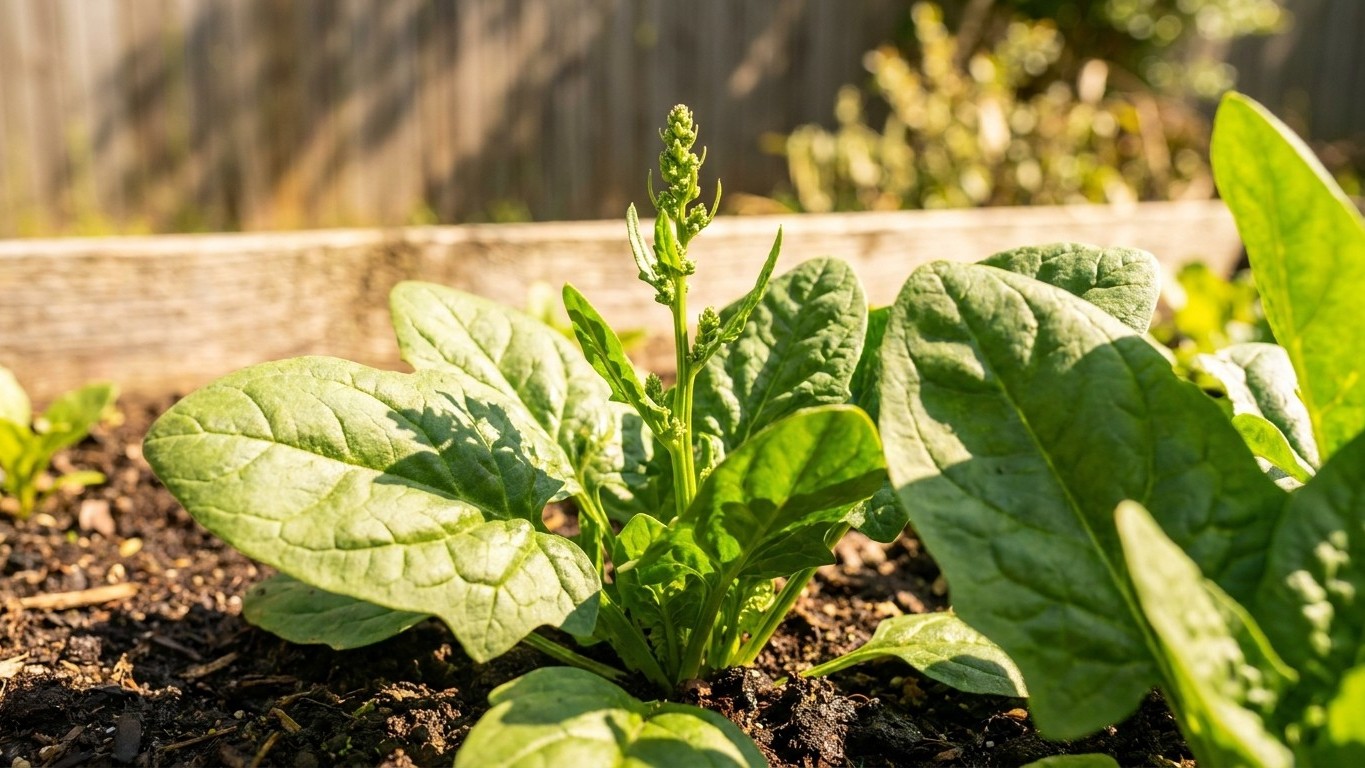

Spinach in Ontario is far more likely to bolt from the calendar than from a heat wave. The reference station near Toronto sees essentially no days at 90 F or hotter, yet the sun sits above the horizon for over fifteen hours at the summer solstice. That combination of long daylight and mild-to-cool temperatures still pushes spinach toward flowering, because day length, not heat, is the trigger this crop responds to first.
The short answer
At the reference city near Toronto, the longest day of the year holds 15 hours and 17 minutes of daylight. That number matters more for spinach than almost anything else in this discussion, because spinach shifts from leaf production to flowering once days stretch long, regardless of whether the air feels cool or hot. A gardener who assumes that Ontario’s mild summers will stretch the harvest season is working from the wrong variable. The day length does the damage on its own.
This is where Ontario’s climate gets interesting. The same station records an average of 0.0 days per year at 90 F or above. That is not a typo or an approximation, it is the long-term mean: essentially zero days of serious heat stress in a normal summer. In a lot of the United States, spinach fails in early summer because 90-degree afternoons scorch the leaves and force the plant into survival mode. That is not what happens here. Ontario’s summer air rarely gets hot enough to be the primary stress on its own.
So which factor is actually limiting the crop? The honest answer is day length, working mostly on its own, with heat playing a distinctly secondary role. Spinach bolts during long days and warm temperatures, and it grows best where temperatures stay under 75 F. Ontario keeps that heat ceiling in check almost by default, given how rare 90-degree days are here. But nothing in the local climate slows down the sun’s arc. The days get long in May and June whether or not the thermometer cooperates, and that alone is often enough to send spinach into flower.
The practical takeaway is that a cool Ontario summer will not buy extra weeks the way it might for a heat-sensitive crop like lettuce grown in a hotter state. Spinach growers here are working against the calendar first, and against temperature only as a secondary pressure once early summer heat starts to build on top of the long days. Understanding that order of operations changes how the spring and fall windows should be planned.
How long the spring window really is
- Frost timing sets the start. The average last spring frost at the reference station is April 30. That is a mean date from the 1981-2010 climate normals, not a guarantee, so in roughly half of all years frost arrives later than that. Treat it as the middle of a range, not a safe line to plant against.
- Sowing happens before the frost date, not after. Spinach seed goes into the ground 2 to 3 weeks before the last expected frost, which puts a realistic Ontario sowing window somewhere from early to mid April, assuming the soil is workable that early in a given year.
- Growth stays strong while temperatures stay moderate. Spinach performs best below 75 F, and Ontario’s near-zero count of 90-degree days means air temperature is unlikely to shut the crop down outright during this stretch. Soil and air conditions in April and May typically sit comfortably under that ceiling.
- Day length becomes the limiting factor as the calendar moves toward June. Daylight climbs steadily after the equinox and approaches the 15-hour-17-minute peak by the summer solstice. That lengthening day, not a heat spike, is what eventually pushes spinach toward flowering.
- The usable window adds up to roughly eight or nine weeks. From an early-to-mid-April sowing to the point in June when day length alone starts driving plants toward bolting, Ontario gardeners get a workable but genuinely limited spring harvest period before the crop needs to be pulled or replaced.
The autumn crop, and when the soil lets you sow
Fall spinach in Ontario has to be timed backward from harvest, and it runs into two separate obstacles that have nothing to do with each other: soil that is still too warm to germinate seed reliably, and a frost date that eventually ends the season outright.
Soil too warm for germination
Spinach seed germination drops off once soil temperature climbs above 80 F. Ontario’s air rarely reaches 90 F, but that does not mean garden soil stays cool through late July and early August. Bare, sun-exposed beds can still run hot enough at the surface to slow or block germination, even in a region with almost no extreme-heat days in the official record. This is a soil problem, not an air-temperature problem, and it means the fall sowing date is set by when the ground cools down, not by any date on a calendar.
The frost that ends the season
The average first fall frost at the reference station is October 16, again a mean figure from the 1981-2010 normals rather than a fixed cutoff. In roughly half of all years, the first real frost lands later than that date, and in the other half it arrives sooner. Utah State University Extension’s guidance for a fall crop is to plant 50 to 75 days before the date a gardener wants to harvest. Counting back from October 16 puts the sowing window somewhere between early August and late August, depending on how much frost risk a gardener is willing to accept and how quickly the soil has cooled by that point in the season. No days-to-maturity figure is published for spinach in this source, so that 50-to-75-day planting-to-harvest span is the only timing guidance available, and it should be treated as an estimate rather than a fixed schedule.
Four spinach varieties come up in the extension literature: Bloomsdale, Melody, Teton, and Olympia. No performance data, days-to-maturity figures, or bolt-resistance ratings are published for any of them in this source, so nothing more specific can be said here without guessing.
Common questions
Does Ontario’s cool summer mean spinach won’t bolt at all?
No. Bolting is triggered by long days as well as by warm temperatures, and Ontario’s summer daylight still reaches over 15 hours at the solstice. A mild summer reduces the heat-related pressure to bolt, but it does not cancel the day-length trigger.
Is 90 F the number to watch for when planning around heat?
Not directly. The 90 F figure describes how rare extreme heat days are at the reference station (0.0 per year on average), which shows why heat stress is a minor factor here. The number that actually matters for growth quality is the 75 F ceiling above which spinach stops performing well and can turn bitter.
Can I just sow spinach earlier to dodge the long-day trigger?
Earlier sowing, done 2 to 3 weeks before the average April 30 last frost, is the standard recommendation and it does give the plant more growing time before days lengthen toward the solstice. It does not change when the days themselves get long, so an earlier start still runs into the same eventual trigger, just with a bigger head start.
Why does fall sowing depend on soil temperature instead of air temperature?
Germination specifically responds to soil conditions, and Utah State University Extension notes that germination drops once soil temperature rises above 80 F. Garden soil can hold heat from summer sun well after the air itself has cooled, which is why the fall sowing date is tied to soil cooling rather than to any single air-temperature reading.