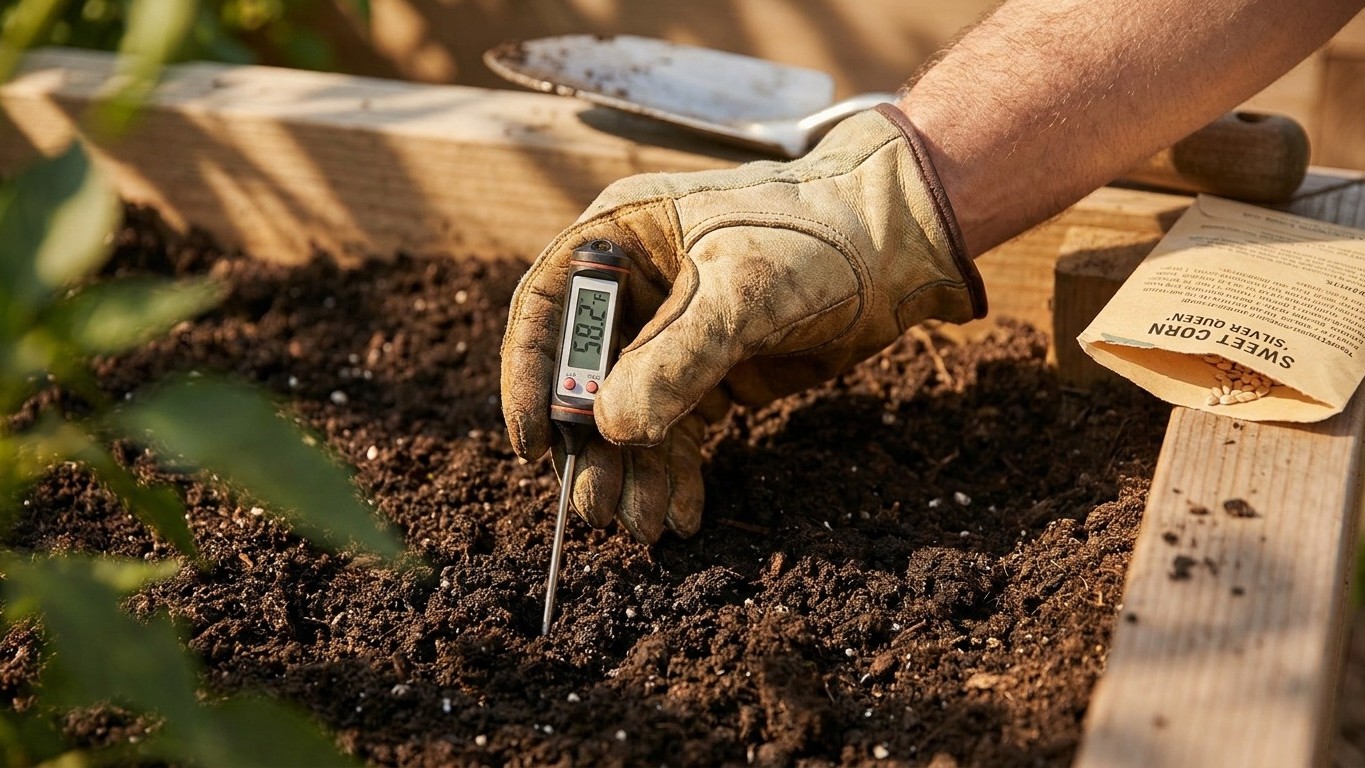

In Prince Edward Island, sweet corn goes in the ground once soil temperature holds at 60 F or above, which happens well after the average last spring frost of May 16. That timing typically lands in late May to mid-June depending on the season, leaving a window that runs to the average first fall frost of October 17. A 60-day variety fits comfortably inside that stretch; a 90-day variety leaves far less room for error.
The short answer
The date on the calendar that matters for sweet corn isn’t the frost date. It’s the soil temperature date, and in Prince Edward Island those two numbers don’t line up the way a lot of gardeners assume. The average last spring frost at the Charlottetown reference station falls on May 16. Corn seed sitting in soil that cold simply won’t sprout, and if it does, it rots or produces a stunted, uneven stand. Soil needs to hold at 60 F before sweet corn seed goes in, and that threshold arrives measurably later than the frost date, often by two to four weeks depending on how the spring unfolds and how exposed or sheltered the plot is.
That gap matters because it shrinks the season from both ends. Sweet corn needs 60 to 90 days from planting to harvest, and the other bookend on the calendar is the average first fall frost on October 17. Count backward from that date and the arithmetic gets tight fast. If soil doesn’t reach 60 F until early June, a 90-day variety is asking to mature right around the average frost date, with zero cushion for a cool August or a slow, wet spring that pushed planting back further than usual.
There’s a second factor working against long-season varieties here, and it’s easy to miss if you’re only watching the calendar. Prince Edward Island averages 0.0 days a year above 90 F. That figure isn’t a summary of how warm the summer feels; it’s a direct measure of heat load, and sweet corn is a heat-loving crop that accumulates growth through warm days, not just elapsed calendar time. A variety rated at, say, 75 days in a hot Midwestern summer can take longer than that here, because the days themselves aren’t delivering the same heat units. The number on the seed packet assumes a certain pace of warmth that this island’s maritime climate doesn’t reliably provide.
Put together, the practical answer is this: test the soil before you trust the calendar, expect that test to come back warm enough sometime after the last frost rather than on it, and pick a maturity length that leaves slack rather than one that uses up every day of the average window. A gardener who waits for 60 F soil and picks a shorter-season variety is working with the climate instead of racing it.
Does a late variety fit here?
Whether a given maturity length works comes down to a straightforward subtraction: the date soil reaches 60 F, plus the days to maturity, has to land before October 17 with room to spare for a cooler-than-average summer. Prince Edward Island’s cool summers, reflected in that 0.0 days above 90 F figure, mean the crop grows on the slower end of what any given variety is capable of, so the safe move is to lean toward the shorter number rather than the longer one.
A 60-day variety
A variety at the 60-day end of the range has the best shot at fitting this territory’s window comfortably. If soil hits 60 F even as late as mid-June, a 60-day crop still points to a harvest around mid-August, roughly two months before the average first fall frost. That cushion matters because it absorbs the unpredictability baked into these averages: a cool stretch in July, a slow-to-warm patch of soil, a planting delayed by a wet spring. Short-season corn is the forgiving choice in a climate where the growing season itself is the limiting factor, not pest pressure or soil fertility.
A 90-day variety
A 90-day variety is a much tighter fit, and depending on how late the soil warms in a given year, it may not fit at all. Push planting to early June, which is realistic if the soil test comes back cold that spring, and a 90-day maturity length points to a harvest window sitting right on top of the average October 17 frost date. Since that frost date is a mean, not a guarantee, there’s roughly a coin-flip chance the actual frost arrives even earlier than average in any given year. Add in the cool-summer effect on growth pace, and a 90-day variety in Prince Edward Island is working against the season rather than within it. The honest answer for anyone planting on this island is that the long-season end of the sweet corn range is a poor match, and gardeners chasing that maturity length should expect a real risk of an unfinished crop.
What goes wrong here
- Seed sown into soil that hasn’t reached 60 F. This is the most common misstep because it’s driven by the frost date rather than the soil itself. A gardener plants right after May 16 assuming the danger has passed, but the soil is still too cold for sweet corn seed to germinate reliably. The seed either fails to sprout, rots in place, or comes up weeks late and uneven. The remedy is simple and doesn’t require a fancy tool: check the soil temperature directly before planting, and wait until it holds at 60 F rather than counting days since the last frost.
- Choosing a variety too late for the season. A 90-day maturity length assumes a growing season with enough heat and enough calendar room to finish, and this territory’s cool summers plus its October 17 average first frost don’t reliably provide either. The fix is to plant toward the shorter end of the 60-to-90-day range and treat any longer-season variety as a gamble rather than a default choice.
- Sweetness lost because different types tasselled together. This one has nothing to do with the climate at all. Sweet corn comes in different genetic types, and when two of those types release pollen, or tassel, at the same time nearby, the kernels can cross-pollinate and lose the sweetness the variety was bred for. The remedy is timing and planning rather than any specific distance, since no isolation figure is published for this: stagger plantings so different types don’t tassel in the same window, or plant only one type in a given season if the garden is small. Sweet corn should also go in as a block of three or more rows rather than a single long row, since that shape improves pollination within the block itself.
Common questions
Is May 16 a safe date to plant sweet corn in Prince Edward Island?
No. That date is the average last spring frost, which means frost arrives later than that in roughly half of all years. It also isn’t the relevant threshold for sweet corn anyway, since the crop needs soil at 60 F, a condition that shows up later than the frost date, not on it.
How do I know when soil has actually reached 60 F?
The only reliable way is to measure it directly in the planting bed rather than guessing from air temperature or the calendar. Soil warms more slowly than air, especially in a maritime climate, so relying on a frost date or a general sense that “it feels warm enough” leads to planting too early.
Does Prince Edward Island’s cool summer really affect corn that much?
Yes. With an average of 0.0 days a year reaching 90 F, the island simply doesn’t deliver the heat load that sweet corn varieties are often rated under. That means a variety’s stated maturity length can run longer in practice here than it would in a hotter climate, which is part of why long-season varieties are riskier on this island.
What’s the difference between the 60-to-90-day figure and the 17-to-24-day figure sometimes mentioned for corn?
They answer completely different questions. The 60-to-90-day range is counted from planting and tells you whether the crop can fit inside the season at all. A separate figure, roughly 17 to 24 days, is counted from when the silks first emerge and tells you which week to check for harvest. Confusing the two leads to picking too early or missing the harvest window entirely. Readiness itself is confirmed by three signs together: dry, browned silks, husks that are still moist and green, and milky juice from a punctured kernel, never by just one of those signs alone.