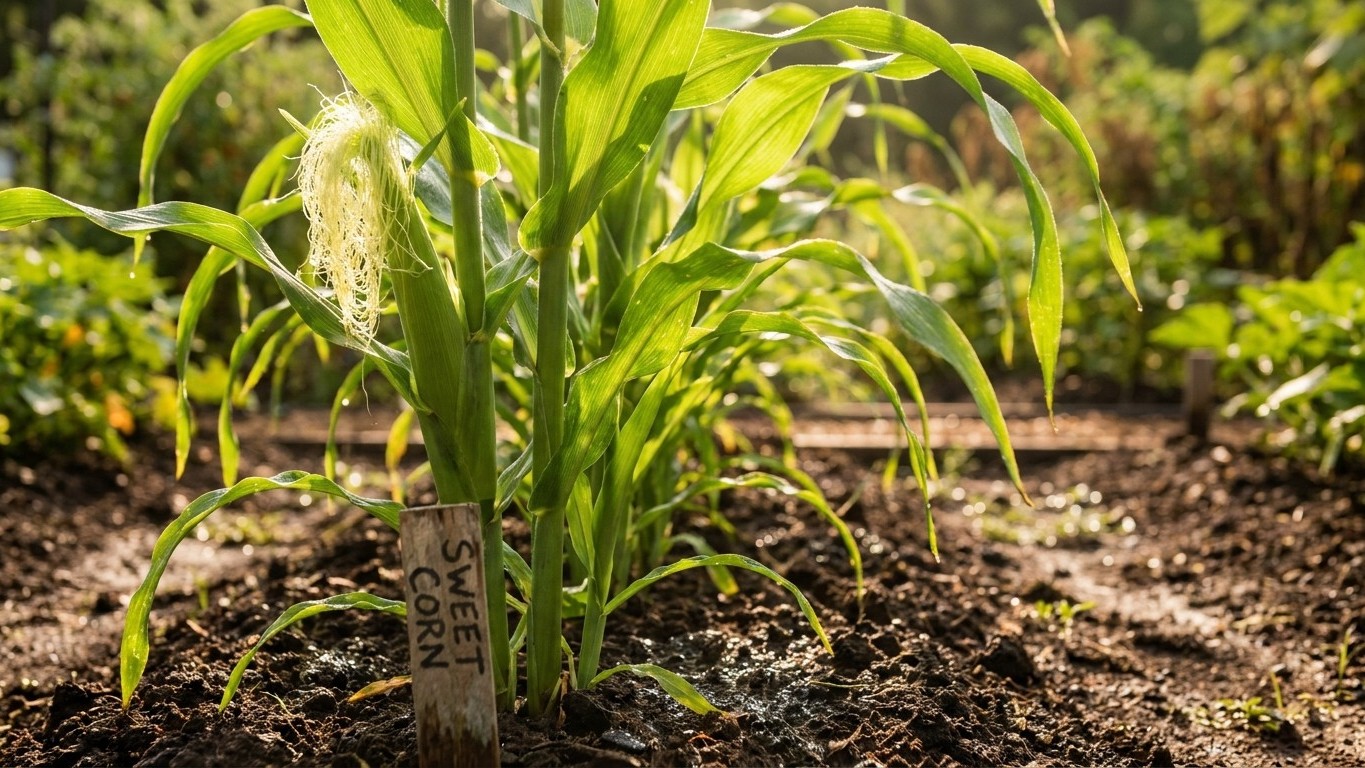

Sweet corn can ripen in Quebec, but the calendar is tighter than gardeners expect. The soil needs to hold above 60°F before seed even goes in the ground, and that threshold arrives well after the last spring frost. Once planted, sweet corn needs 60 to 90 days to mature, and squeezing that window between a cold, slow spring and an early fall frost is the real challenge here, not the growing itself.
The short answer
Start with the frost math, because it sets everything else. At the reference station near Montreal, the last spring frost falls on average around May 6, and the first fall frost arrives on average around October 5. That’s roughly 152 days of frost-free ground on paper. Sounds generous for a crop that needs 60 to 90 days. But sweet corn doesn’t care about air temperature at frost time. It cares about soil temperature, and soil above 60°F is a different, later milestone than the last frost.
Soil warms slower than air, and it lags the frost date by a real stretch, not a few days. That mean May 6 frost date is also just a midpoint: in one year out of two, the actual last frost lands later than that, sometimes considerably later. A cool, wet spring can push soil warmup back further still. So the honest planting window doesn’t open on May 6, or even shortly after. It opens whenever the soil itself crosses 60°F, which in a cooler northern climate can easily land in late May or into the first half of June, depending on the year and the site.
That delay eats directly into the days available before the October 5 mean fall frost, which carries the same caution in reverse: it’s an average, not a guarantee, and some years bring frost earlier than that date. Add in the region’s heat profile, essentially zero days a year reaching 90°F at the reference station, and you get a growing season that’s cool overall, not just short at the edges. Corn doesn’t stall from a lack of frost-free days here so much as from a lack of driving heat once it’s up and growing.
Put those pieces together and the short answer holds: sweet corn will ripen in Quebec in most years, but only if the grower plants after the soil, not the calendar, says it’s ready, and only if the variety’s maturity length leaves real margin before the mean fall frost rather than running right up against it.
Does a late variety fit here?
Maturity length is the lever a gardener actually controls, since the frost dates and soil warmup are fixed by climate. The question is whether the two ends of the maturity range, a fast 60-day type and a long 90-day type, both fit inside the real window once soil-warming delay is accounted for.
A 60-day variety
Suppose the soil doesn’t cross 60°F until sometime in the first half of June, which is a realistic lag behind a May 6 mean frost date in this climate. Planting then, a 60-day maturity crop would be ready roughly in early-to-mid August. Measured against a mean fall frost of October 5, that leaves close to two months of open margin. Even in a year where soil warms later than usual, or the fall frost arrives ahead of the mean, a 60-day variety has enough buffer on both ends to absorb the swing. This is the safer end of the maturity range for this territory.
A 90-day variety
Run the same planting date through a 90-day maturity length and harvest lands around mid-September, still ahead of the October 5 mean fall frost, but by only two to three weeks rather than two months. That margin isn’t nothing, but it isn’t much either, once you remember the fall frost date is a mean, not a floor: in some years frost arrives earlier than October 5, and in a cool year the soil may not have crossed 60°F until even later than assumed here, pushing the whole schedule further right. Stack a slow spring and an early fall together, which does happen, and a 90-day variety can run out of season before it finishes. The late end of the maturity range does not fit this climate with any real safety margin, and gardeners leaning that direction should treat it as the riskier choice, not the default one.
What goes wrong here
- Soil sown too cold. Seed goes in as soon as the last frost passes, before soil has actually crossed 60°F. The seed sits, rots, or emerges weak and stunted. The fix is patience: check soil temperature directly rather than working off the frost date, and wait for 60°F to hold, not just touch, before planting.
- A variety too late for the season. A 90-day type gets planted on a normal schedule and simply runs out of warm days before the ear matures, especially in a year where spring soil warmup lags or fall frost lands early. The fix is choosing shorter maturity length for the bulk of the planting, and treating longer maturity types as a smaller, secondary planting rather than the main crop.
- Sweetness lost with no climate cause at all. This one has nothing to do with frost or soil temperature. Sweet corn types (su, se, and sh2) cross-pollinate freely, and if two different types tassel at the same time nearby, the sweeter type’s kernels turn starchy and disappointing, even though the plant grew perfectly well. The fix is timing and separation of plantings so different types don’t tassel together, and keeping each type planted in blocks of three or more rows rather than thin single rows, which also improves pollination generally.
Common questions
Can sweet corn be planted right after the last spring frost in Quebec?
Not reliably. The last frost date and the soil reaching 60°F are two different milestones, and the second one comes later. Planting on frost date alone risks cold, wet seed that fails to come up well.
How do I know when sweet corn is actually ripe?
Look for all three signs together, not just one: silks that have dried and turned brown, husks that are still moist and green, and milky juice from a punctured kernel. Any single sign alone is not enough to confirm ripeness.
Is 17 to 24 days after silk emergence the same as the 60-to-90-day maturity number?
No, and mixing them up causes confusion. The 60-to-90-day figure counts from planting and tells you whether the variety fits the season at all. The 17-to-24-day figure counts from silk emergence and tells you which week to actually pick, once the crop is already growing well.
Do I need to keep sweet corn a set distance from field corn or other sweet corn types?
The published guidance from Utah State University Extension does not give a distance in feet or rows. What it does say is that su, se, and sh2 types must not tassel at the same time, since that’s what causes the loss of sweetness, not proximity by itself. Stagger planting dates or choose compatible types instead of relying on a spacing rule that isn’t published.