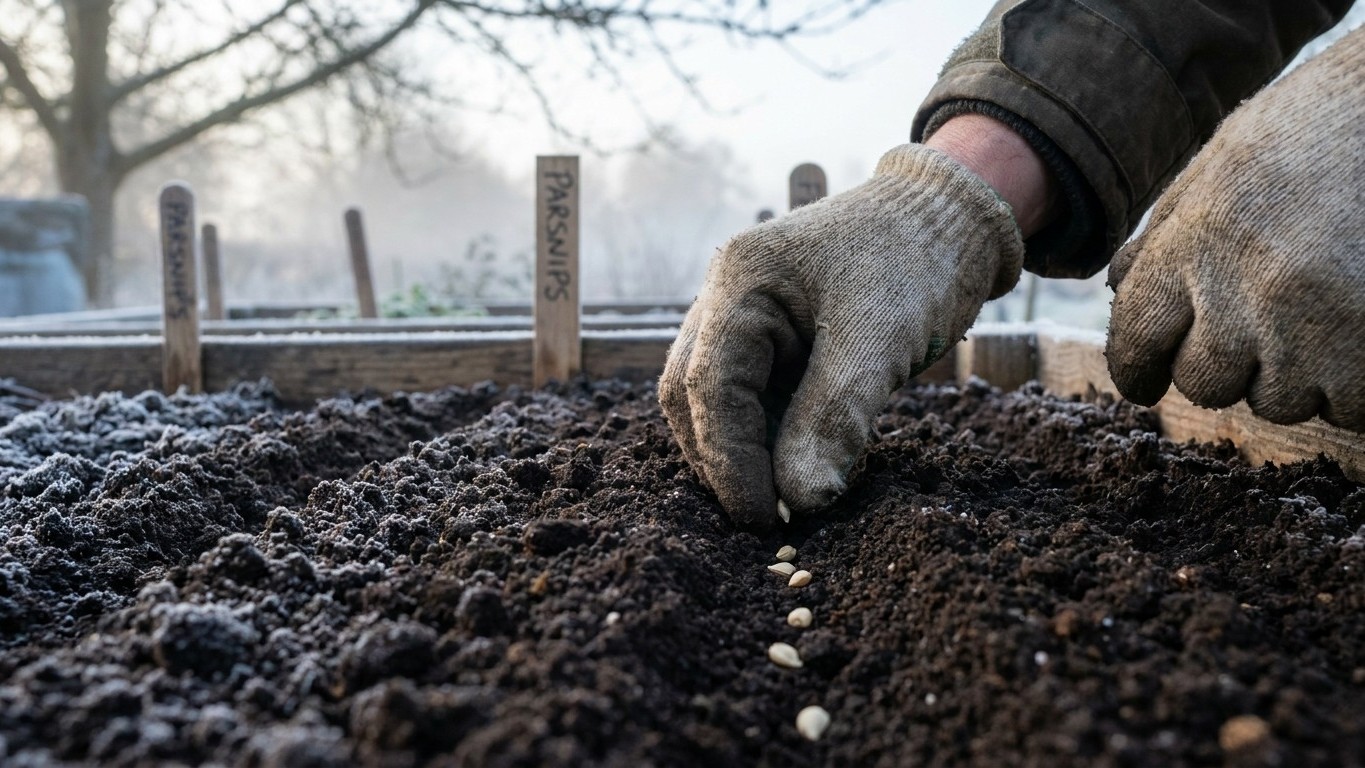

Houston-area gardeners can sow parsnips roughly mid-January to mid-February, two to three weeks ahead of the last spring freeze. The bigger question isn’t whether the seeds will sprout here (they will), it’s whether the winters ever get cold enough, for long enough, to turn that root sweet instead of just starchy and bland.
The short answer
Does Houston deliver several frosty weeks in a row, the kind that actually converts stored starch into sugar inside a parsnip root? The mean daily minimum for the coldest month here, based on NOAA NCEI Climate Normals (1991-2020) for the Houston reference station, sits at 43.7°F. That’s not a hard freeze. That’s a mild night, the kind where a jacket helps but the ground rarely locks up. Most nights in the coldest month of the year stay above freezing on average, even though a scattering of colder snaps does slip through.
What this means for flavor
Parsnips need real exposure to frost, not just cool weather, to develop the sweetness gardeners grow them for. A soil temperature that dips below freezing for stretches at a time triggers the starch-to-sugar conversion inside the root. A mean minimum of 43.7°F in the coldest month tells a different story: this is a climate that will happily grow a parsnip root, but it won’t reliably deliver the sustained frosty weeks that a colder inland or northern climate provides as a matter of course. You’ll get a usable root here. Whether it gets genuinely sweet depends on catching one of those colder snaps at the right moment, not on the climate doing the work for you every winter.
This distinction matters because it’s tempting to look at a hardiness zone map and assume mild equals fine, or cold equals better. Neither shortcut works. A hardiness zone tells you whether a perennial plant survives winter here at all. It says nothing about whether a biennial root vegetable, left in the ground on purpose, gets the frost exposure it needs to sweeten. Houston’s mild coldest-month average is exactly why growers in this part of Texas often report parsnips that are perfectly edible but never taste like the ones grown a few states north.
One more caution worth repeating: Texas spans four separate USDA hardiness zones, and this 43.7°F figure comes from a single reference station near Houston, on the mild Gulf end of the state. The Panhandle sees its first freeze months earlier and its last freeze months later. Hill Country and North Texas run their own separate calendars. None of those figures are captured here, so treat this answer as a Houston-area answer, not a statewide one.
Does the season fit?
Parsnips are sown directly in place, never transplanted, and the 100 to 120 days to maturity run from the day the seed goes in the ground, not from germination. Germination itself is slow, typically 14 to 21 days before you’ll see the first thread-like leaves, so patience matters before you assume a bad batch of seed. Here’s how the arithmetic plays out for the Houston reference station.
- Pick a sowing date. Two to three weeks before the last spring freeze (Feb 4 to March 1, per NOAA NCEI 1991-2020 Climate Normals for station USW00012960) puts sowing somewhere between mid-January and roughly mid-February.
- Add the germination lag. Seedlings won’t emerge for 14 to 21 days, so don’t judge the bed as empty before early-to-mid February at the earliest.
- Count 100 to 120 days from seeding to maturity. A mid-January sowing reaches maturity around late April; a mid-February sowing reaches maturity closer to mid-June.
- Compare that harvest window against the first fall freeze. The first fall frost here runs December 1 to December 19, also from the same NOAA NCEI dataset.
- Read the gap. An April-to-June harvest lands roughly five to seven months before the first fall frost even arrives. The season fits comfortably in terms of raw days, with room to spare.
That comfortable margin comes with a catch, though. A crop sown to fit neatly inside the spring frost window and harvested by early summer never sees a single frost while it’s still in the ground. Sweetening depends on frost exposure, and if the roots are out of the ground before December, they never get it. Growers chasing flavor, not just a harvestable root, sometimes push sowing later and let the crop mature into the December frost window instead of pulling it in late spring.
What goes wrong here
- Forked roots from heavy or stony ground. Gulf Coast soils around Houston lean toward dense clay, and a parsnip taproot forking around an obstruction is one of the most common complaints growers report. Utah State University Extension recommends deep, sandy soil for this crop, and says heavy soil needs to be double dug before sowing, loosening the ground well past the depth a mature root will reach.
- Forked roots from overwatering. This is a separate cause from soil texture, not the same problem in disguise. Consistently soggy soil encourages the root to split and branch even in a bed that was properly loosened. Even, moderate moisture rather than frequent heavy watering keeps the taproot growing straight down.
- A season that runs out before the root sweetens. The 100 to 120 day window fits inside Houston’s frost-free stretch with months to spare, so running out of growing days isn’t the risk here. The risk runs the other direction: pulling the crop too early, before it’s had any real cold exposure, trades flavor for convenience.
- A winter too mild to finish the job. With a coldest-month mean minimum of 43.7°F, some winters simply won’t deliver enough sustained frost for full sweetening no matter how well the crop was grown. Leaving mature roots in the ground through December, rather than harvesting in late spring, gives them the best shot at catching whatever cold does arrive.
Common questions
What’s the best month to sow parsnips near Houston?
Mid-January through mid-February gives roughly two to three weeks of lead time before the last spring freeze window of February 4 to March 1, per NOAA NCEI Climate Normals for the Houston reference station.
Can parsnips stay in the ground through a Houston winter?
Yes, and leaving them there through the first fall frost window (December 1 to December 19) is the only real chance this climate offers for frost-driven sweetening, given how mild the coldest month typically runs.
Does Gulf Coast clay soil need special prep for parsnips?
Heavy soil should be double dug before sowing, per Utah State University Extension guidance, since a shallow, compacted bed is one of the two documented causes of forked roots in this crop, the other being overwatering.
How long before parsnip seeds sprout in Texas heat?
Expect 14 to 21 days before seedlings emerge. That’s slower than most garden vegetables, and it’s easy to mistake a slow-germinating bed for a failed one if you don’t account for the lag.