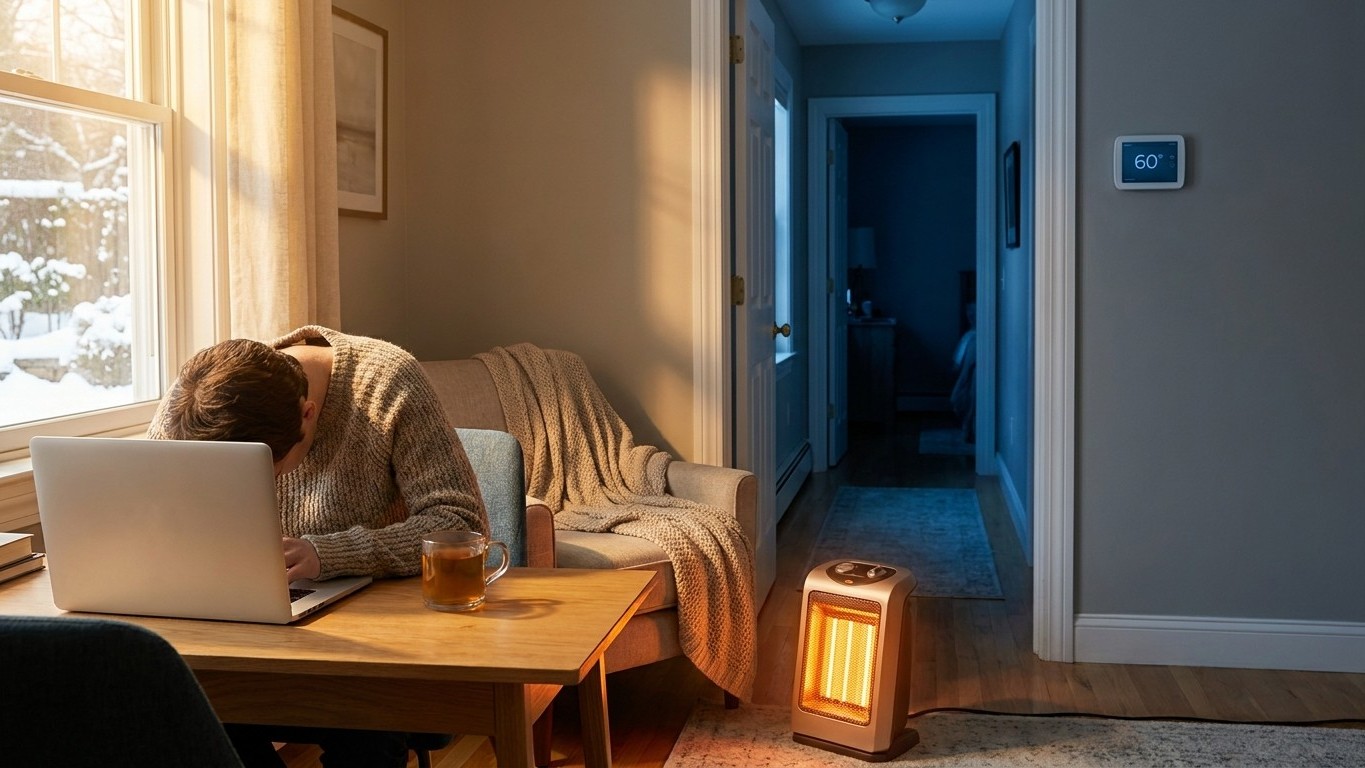

Heating one room instead of the whole house can lower your energy bill, but only under one condition: the central Thermostat has to actually drop, and someone has to actually stay in that room. Skip either part and you’re not saving anything. You’re just adding a second heat source on top of the first one.
The idea, and the condition attached to it

The math behind zone heating is simple in theory. A furnace or heat pump spends energy warming air in rooms nobody is using: guest bedrooms, hallways, a dining room that only sees traffic on holidays. A portable heater aimed at the one room where a person actually sits cuts out that waste. That’s the pitch, and it’s not wrong.
But the pitch only holds if the central system’s setpoint moves down when the space heater turns on. If the furnace keeps chugging along at 70 degrees for the whole house while a space heater runs in the office, you haven’t replaced any of that furnace output. You’ve stacked a second appliance’s electricity or fuel cost on top of the first one, and your bill reflects both. This is the single most common way zone heating fails to deliver, and it happens quietly. Nobody walks over to the Thermostat and turns it up on purpose. It just stays where it’s always been, because turning it down feels like an extra step, or because someone forgets, or because a different family member likes the hallway warm.
There’s no clean percentage to attach to the savings, and any article that gives you one is guessing. Fuel type changes the equation: electric resistance heat in a small room costs differently per hour than a natural gas furnace heating a whole floor. Local utility rates swing by a wide margin state to state. House age, insulation quality, how airtight the room in question is, how many hours a day someone actually occupies it, whether the rest of the house drops five degrees or fifteen, all of it moves the number. What’s fixed is the logic: the central setpoint has to come down, and the room has to be occupied enough hours to justify running a second heater in it. Skip the first part and you’re paying for two heating systems. Skip the second and you’re paying for a space heater that ran for no one.
The rooms where it works
Zone heating earns its keep in specific, predictable situations. The households that actually save money with a space heater tend to fall into one of these patterns:
- A home office occupied all day while the rest of the house sits empty. If everyone else is at work or school, there’s no reason to heat bedrooms and a living room for nobody. The central thermostat can drop several degrees for hours at a stretch.
- A bedroom at night. Most of the house is unoccupied and dark anyway. A space heater warming one bedroom while the furnace backs off elsewhere matches actual use of the house almost exactly.
- A workshop, garage, or sunroom used for an hour or two. Heating that space year-round through the central system, or trying to condition it at all, often costs more than a portable unit run only while someone’s actually out there.
- A room the central system never heated well anyway. Additions, converted porches, and rooms at the end of a long duct run are frequently 5 to 10 degrees colder than the rest of the house no matter what the thermostat says. A space heater there isn’t competing with the furnace so much as filling a gap it never closed.
The flip side matters just as much. Open-concept layouts defeat zone heating almost by design: a space heater in a kitchen that flows straight into a living room and dining area is just heating a third of a large shared volume, and the warm air drifts to the coldest part of that space, which is usually far from the heater. A room with a wide opening onto a stairwell has the same problem in a different shape, since heat rises and a stairwell acts like a chimney pulling warmth up and out of the room you’re trying to heat.
And if several rooms are occupied at once, whether it’s a family spread across a home office, a kid’s bedroom, and a kitchen, zone heating stops being zone heating. At that point you’re running multiple space heaters simultaneously, which is closer to heating the whole house piecemeal, usually at a higher cost per degree than the central system was already achieving.
What you must not let get cold
The savings from zone heating come from turning the rest of the house down, and that’s exactly where the risk shows up. It’s not the air in an unheated bedroom that causes trouble. It’s what’s running through the walls, floors, and crawlspaces of that unheated part of the house.
A pipe doesn’t freeze because a room reads 55 degrees on a thermometer sitting on a dresser. It freezes because the specific cavity it runs through, an exterior wall with poor insulation, a crawlspace with vents open to outside air, the framing under a kitchen sink on an outside wall, drops below freezing for long enough. Central heating, even set to a modest temperature, keeps enough warmth circulating through a house’s structure to keep those cavities above freezing most winters. Turn the thermostat down far enough in pursuit of savings, and in the coldest rooms, especially ones with plumbing on an exterior wall, that buffer can disappear.
This is the part of zone heating that rarely makes it into the pitch. A household running a space heater in an office while letting the rest of the house coast can save real money over a season. But if that “rest of the house” includes a bathroom or laundry room with pipes in an exterior wall, and the setback is aggressive enough during a cold snap, the cost of a burst pipe (drywall repair, water damage, a plumber’s after-hours call) can erase months of savings in a single incident.
The practical response isn’t a specific number to hold the thermostat at. It’s knowing your house. Check which rooms have plumbing on exterior walls. Check whether crawlspace vents are open or closed for the season. Check whether a laundry room or half-bath sits at the end of the house that gets the coldest, and whether that’s also the room you’re planning to stop heating. For a deeper look at how unheated spaces actually cause pipes to freeze and what to check before a cold snap, see the frozen pipes and space heating guide on this site.
One room, all night
The strongest single case for zone heating is a bedroom overnight. The rest of the house is unoccupied for six to eight hours, the central system can back off substantially, and one space heater covers the only room anyone’s actually in. On paper, it’s the cleanest example in this entire topic.
It’s also exactly the scenario fire safety data warns against. The U.S. Fire Administration’s 2017-2019 report on portable heater fires in residential buildings found an estimated annual average of 1,100 fires, 65 deaths, 150 injuries, and $51 million in property loss tied to portable heaters. Portable heaters accounted for about 3% of home heating fires overall, but about 41% of fatal home heating fires. That gap, rare among fires overall, wildly overrepresented among deaths, lines up closely with unattended heaters running through the night in a room where someone’s asleep.
The U.S. Fire Administration’s guidance doesn’t hedge on this: “Turn space heaters off when leaving the room or going to bed.” Both halves of that instruction matter. It’s not just about stepping out for an errand. Falling asleep with a portable heater running in the room is treated the same way as walking out and forgetting it. The agency also advises to “keep anything that can burn at least 3 feet from all heat sources including fireplaces, wood stoves, radiators, space heaters or candles,” a reminder that a space heater carries the same clearance requirements as an open flame, not a lesser one, and to “maintain heating equipment and chimneys by having them cleaned and inspected each year by a professional.”
So the honest answer is that the bedroom-overnight case, the one that makes the most financial sense, is the one the safety guidance most directly cautions against running unattended. There’s no way to soften that into agreement. The alternatives are real, though. A heater hard-wired into the room’s electrical system with a thermostat and safety shutoff, installed by an electrician, removes the “someone forgot to unplug it” failure point entirely. Improving the room’s insulation, weatherstripping a drafty window, adding a door sweep, means less heat output is needed to hold a comfortable temperature in the first place. And heavier bedding or a mattress-level heating pad rated for overnight use lets the room’s air run cooler while the person in the bed stays warm, without a heater running unsupervised for hours. None of these fully replicate a portable space heater left on, and that’s the point.
Common questions
Does Closing Vents in Unused Rooms Save money the way a space heater does?
Closing vents changes airflow within a system that’s still running, and in many forced-air setups it can unbalance pressure without actually reducing the furnace’s workload. It’s a different mechanism from zone heating with a portable unit and doesn’t carry the same clear condition (thermostat down, room occupied) that makes space heating pay off.
Is an electric space heater always cheaper to run than gas central heat?
Not always. It depends on local electricity and gas rates, the heater’s wattage, and how many hours it runs. There’s no fixed answer that applies everywhere, which is why any comparison has to start with your own utility rates rather than a national average.
Can I use my oven to warm a room on a cold day?
No. The U.S. Fire Administration is direct on this: “Never use an oven to heat your home.” Ovens aren’t designed for continuous unattended operation and pose carbon monoxide and fire risks well beyond what they’re built to handle.
Is it safe to run a space heater in a bedroom while I’m awake but not right next to it?
Being awake in the room is the deciding factor the guidance addresses, not proximity to the unit. The instruction covers leaving the room or falling asleep, so a heater running while you’re awake and present in that same space falls outside what the warning is about, provided the 3-foot clearance from anything flammable is maintained.