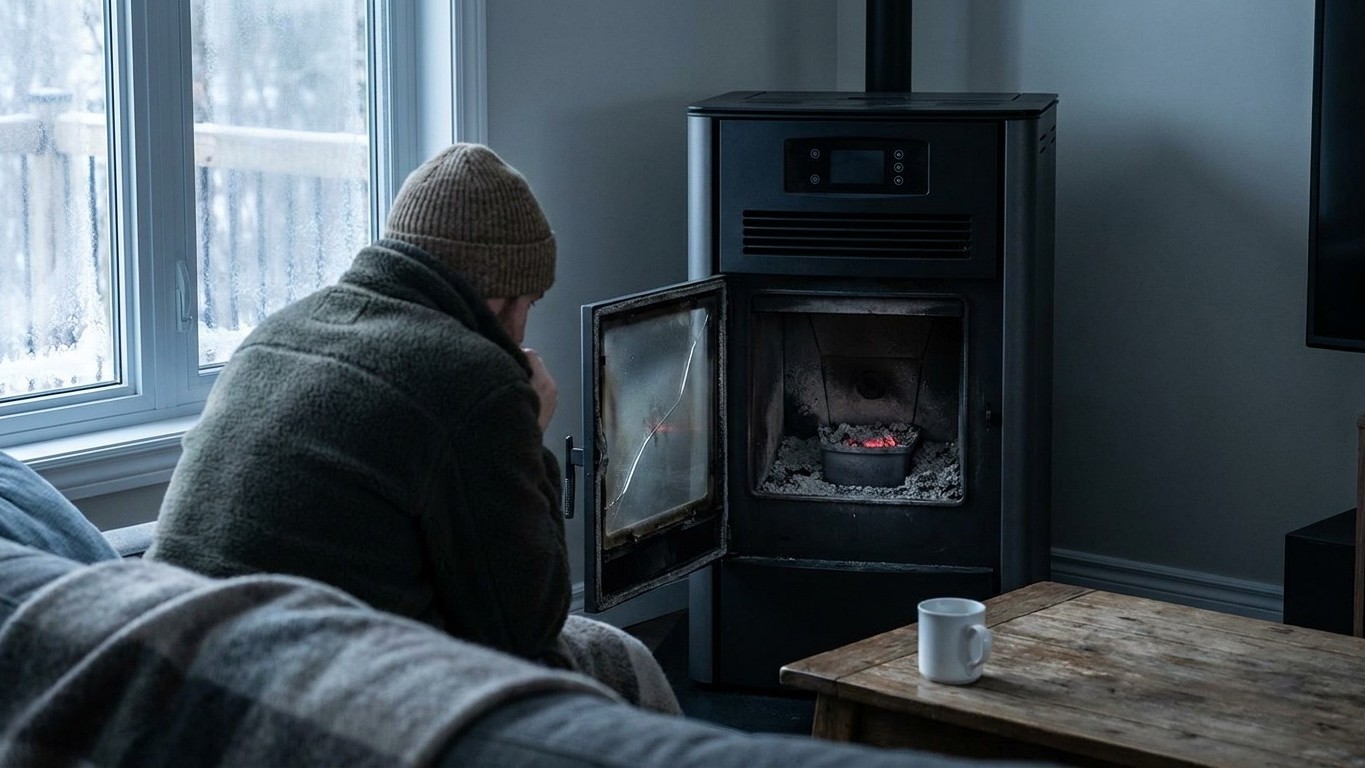

A pellet stove goes cold within minutes of a power outage, and there’s no workaround built into the appliance itself. Unlike a wood stove or a fireplace, a pellet stove depends entirely on electric motors to move fuel and air. When the grid drops, so does your heat, unless you’ve planned for it ahead of time with a battery backup or a separate, non-electric heat source in the house.
What stops, and in what order

The U.S. Environmental Protection Agency puts it plainly: “Pellet stoves need an electrical supply to work because they use motorized components to feed the fire and blow out hot air.” That single sentence explains the entire failure sequence once the power cuts out, and it’s worth walking through step by step because the order matters for what you should, and shouldn’t, do next.
First to go is the auger, the small motorized screw that moves pellets from the hopper into the burn pot. No electricity, no feed. The stove that seconds ago was quietly dropping pellets on schedule now has nothing new reaching the fire. Next, the combustion blower shuts down. This is the fan that pulls outside air in to feed the flame and pushes exhaust out through the vent. Without it, the fire loses its air supply almost immediately. The convection blower, the fan that pushes warm room air out into your living space, stops as well, though this one matters less for the fire itself and more for the fact that whatever heat is left in the stove body won’t be circulated into the room anymore.
The fire doesn’t stay lit on its own
With the auger stopped and the combustion blower dead, the fire in the burn pot starves out. It doesn’t happen instantly, there’s usually a few minutes of dwindling flame as the last pellets in the pot burn down, but there’s no mechanism left to sustain it. This is normal and expected behavior, not a malfunction.
The part that deserves real caution is smoke. A stove that loses its combustion blower mid-burn can, in some conditions, spill smoke back into the room instead of venting it outside, since the draft that was pulling exhaust out is gone. This isn’t something to troubleshoot on the fly. Every pellet stove comes with a manual that spells out exactly what the manufacturer wants you to do when power fails mid-cycle, and that manual is the authority here, not general advice found online. Keep it somewhere you can actually find it during a blackout, not buried in a drawer.
Battery backup, and what it really buys
A battery backup sized specifically for your stove’s motors can keep the auger, combustion blower, and convection blower running through a power cut. It’s a real option, and for households in outage-prone areas it’s often the difference between a cold living room and a functioning stove for the length of a typical outage. But the honest framing matters: this buys you hours, not days. It’s a bridge, not a replacement for the grid.
Sizing one correctly means looking at two different numbers, not one. There’s the stove’s running draw, meaning what the motors pull once everything is up and operating normally, and there’s the ignition draw, the burst of power the igniter needs when it’s lighting the pellets from cold. That ignition spike is meaningfully larger than the running draw, and a backup system sized only for steady-state operation can fail at the one moment you need it most, right at startup after an outage begins.
Where the real numbers live
Neither of those figures is something to guess at or borrow from a general estimate. They’re printed on the appliance’s rating label and detailed in its manual, and they vary by model, hopper size, and blower design. Whoever you’re consulting about sizing a backup system, whether that’s an electrician or the stove manufacturer’s support line, needs the exact figures off your specific unit, not a rule of thumb from a different stove entirely.
It’s also worth remembering that a battery backup doesn’t touch the fuel side of the equation. The EPA notes that “the pellets are poured into a hopper, which automatically feeds into the stove,” and that hopper still needs to be filled by hand regardless of what’s powering the auger. A battery backup solves the electrical dependency during an outage. It does nothing for a hopper that’s already empty when the lights go out, so keeping a reasonable pellet supply on hand matters just as much as the electrical plan.
Heating a house that cannot lose heat
Households that heat exclusively with a pellet stove have, without necessarily thinking of it this way, built an electricity dependency into their primary source of warmth. That’s a different risk profile than a house with a wood stove or a working fireplace, and it changes what a winter power outage actually means for the people living there. A multi-day outage during a cold snap isn’t just an inconvenience when the pellet stove is the only heat source; it’s a real problem that needs a backup plan well before the storm arrives.
The honest counter-argument belongs to wood. A wood stove, or an open fire in a working fireplace, needs no electricity to burn. Feed it logs, manage the draft by hand, and it keeps producing heat straight through a blackout that lasts a day or a week. That’s a meaningful advantage in outage-prone regions, and it’s part of why some households keep a firewood-based heat source as backup even when a pellet stove is their everyday appliance. It’s not a knock on pellet stoves, which the EPA reports it currently certifies “over 90 different” models of, each meeting efficiency and emissions standards a lot of older wood-burning appliances never had to meet. It’s simply a different set of tradeoffs.
Filling the gap without electricity
For households without a wood-burning option, the practical answer during an outage often comes down to a non-electric supplemental heater, layered clothing and blankets concentrated in one room, and a battery backup sized correctly for the stove itself. Some households also keep a battery or generator-powered space heater on hand as a stopgap for exactly this scenario, since it solves a different piece of the same problem: keeping one room livable while the main heat source is down. None of these are permanent fixes. They’re what gets a household through the hours or days until the grid comes back and the pellet stove can restart normally.
Common questions
Can I run a pellet stove on a generator?
A generator sized for the stove’s motors, including that larger ignition draw, can keep it running through an outage in much the same way a battery backup does. The sizing question is identical: check the appliance’s own label and manual for the actual draw figures rather than estimating.
Will pellets left in the hopper go bad during a long outage?
Pellets themselves don’t spoil quickly, but the EPA notes that pellet quality varies: “Lower quality pellets may provide less heat and create a fine dust. Higher quality pellets tend to burn cleaner and produce less ash.” Moisture exposure during a prolonged outage, especially if the stove sits in a damp area, can degrade pellets faster than normal storage conditions would.
Is it safe to keep trying to restart the stove during an outage?
No, since without power the auger, combustion blower, and convection blower can’t function at all. Repeated attempts accomplish nothing and the appliance manual should guide any restart procedure once power actually returns.
Do pellet stoves need extra cleaning after an outage-related shutdown?
An unplanned shutdown doesn’t change the standard maintenance schedule. The EPA is direct on this: “Pellet stoves need to be regularly cleaned to ensure that the stove runs efficiently and safely. Additionally, you should have your stove professionally cleaned at least once a year.” Checking the burn pot and venting after any abnormal shutdown is reasonable, but it doesn’t replace that annual professional visit.