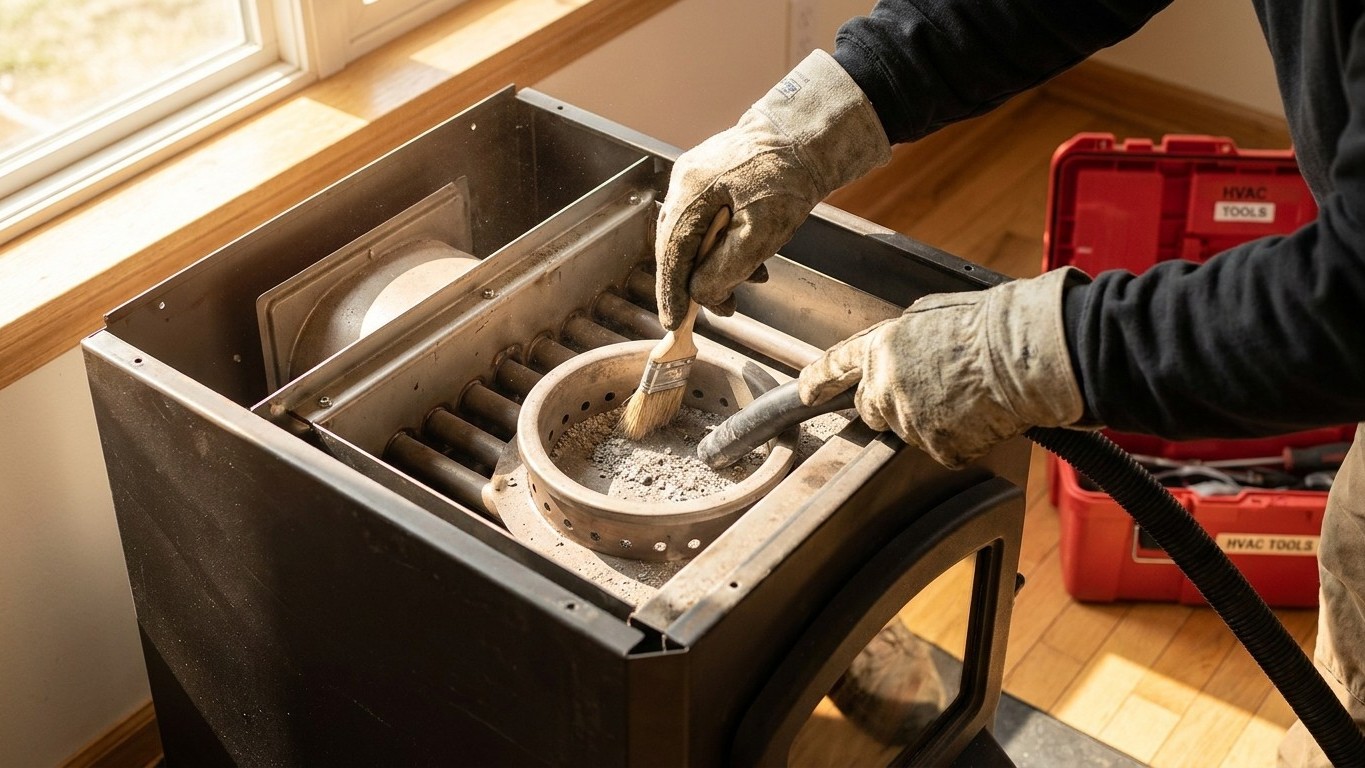

A pellet stove needs two different kinds of cleaning: short, frequent tasks the owner handles based on how much the stove has been running, and one deeper service a technician performs once a year regardless of use. Skip the first and the stove chokes on its own ash. Skip the second and the parts you can’t see, the venting, the blower, the seals, quietly wear out or drift out of safe operating range.
Cleaning is not cosmetic here

The U.S. EPA puts it plainly: “Pellet stoves need to be regularly cleaned to ensure that the stove runs efficiently and safely. Additionally, you should have your stove professionally cleaned at least once a year.” Notice the sentence has two separate instructions bolted together. The first half is about the owner’s ongoing routine. The second is about a scheduled outside visit. They are not the same task done at different frequencies, they are different jobs entirely.
A wood stove that goes a little dirty still burns, just less cleanly and with more visible soot. A pellet stove is a different animal. It’s a metered, motorized appliance, and that changes everything about how dirt affects it. Pellets drop from the hopper on a timed auger, air gets pushed through the burn pot by a combustion blower, and the whole system is tuned to a fairly narrow air-to-fuel ratio. Ash and fine dust don’t just sit there looking bad. They pile up in the burn pot, block the small air holes drilled into it, and throw that ratio off. The flame goes from a clean, active burn to a smothered, lazy one. Efficiency drops. So does heat output.
The stakes here aren’t abstract. The EPA notes that “EPA-certified pellet stoves usually fall into the 70-83% efficiency range, while heating capacities range from 8,000-90,000 Btu per hour.” That’s the factory number, tested clean. A stove clogged with ash and fines doesn’t stay anywhere near the top of that range, no matter how well it was rated when it left the manufacturer. The gap between a well-maintained unit and a neglected one, in terms of actual heat delivered per pound of pellets burned, is bigger than most owners assume.
There’s also the electrical piece, easy to forget because pellet stoves feel like simple fireboxes. They aren’t. As the EPA points out, “Pellet stoves need an electrical supply to work because they use motorized components to feed the fire and blow out hot air.” Every one of those motorized components, the feed auger, the combustion blower, the convection blower, has moving parts that ash and fine dust can bind up over time. A stove that runs on motors is a stove where dirt has more places to cause a real mechanical problem, not just a cosmetic one.
So when a pellet stove starts smelling like it’s straining, or the flame looks duller and more orange than the bright, active flame it had when new, that’s usually not a fuel problem first. It’s usually a cleaning problem that’s been put off a bit too long.
What the owner does, and when
None of this runs on a fixed calendar. It runs on how much the stove has actually burned, and the stove itself gives you the signals. Your owner’s manual sets the specific intervals for your model, but the general order of operations, and what triggers each step, looks like this:
- Burn pot and glass, tied to how the flame looks. If the flame is duller than usual, or the pot has visible clinkers (hardened, fused ash) sitting in the air holes, that’s the trigger, not a date on a calendar. Scrape the pot and wipe or scrape the glass whenever you notice either sign, which for a stove running most days tends to happen fairly often.
- Ash pan, tied to how full it looks. Check it whenever you check the burn pot, and empty it once it’s getting close to full rather than waiting for it to overflow into the burn chamber. How fast it fills depends heavily on the pellets themselves. The EPA notes that “pellets can differ significantly in how well they’re made and how well they burn. Lower quality pellets may provide less heat and create a fine dust. Higher quality pellets tend to burn cleaner and produce less ash.” A bag of poor pellets can mean an ash pan filling noticeably faster than usual, which is itself a signal worth paying attention to.
- Hopper, tied to noticing dust or a rough feed. The EPA describes the basic mechanism this way: “The pellets are poured into a hopper, which automatically feeds into the stove.” Fine sawdust from lower-grade pellets settles at the bottom of the hopper over time and can eventually interfere with the auger feed. Vacuum out the hopper whenever you notice a buildup of that dust, or whenever the feed starts sounding uneven.
- Heat exchanger tubes or fins, tied to declining heat output. If the stove is running as it always has but the room feels cooler than it used to, ash coating the heat exchanger surfaces is a common cause. Running the built-in exchanger rod or brush (most stoves have one) clears this, and it’s worth doing whenever heat output seems to be slipping.
- Exterior surfaces and vents, tied to visible dust. A quick wipe-down keeps air intake and convection vents from pulling in household dust, which is more about long-term motor health than performance you’d notice right away.
The manual is the actual authority on how often each of these should happen for your specific stove. Some manufacturers suggest checking the burn pot daily during heavy use, others build in longer intervals because their burn pot design handles ash differently. What’s consistent across every make is that the trigger is observation, not a set number of days.
What the yearly visit covers
The second half of the EPA’s instruction is the one owners tend to skip, because the stove usually still seems to be working fine. “You should have your stove professionally cleaned at least once a year,” the agency says, and that’s a separate requirement from the routine scraping and emptying described above. The reason is straightforward: a technician reaches parts of the system that the owner’s routine simply doesn’t touch.
The venting is the biggest one. Pellet stoves burn cleaner than wood stoves overall, but they still produce fine ash and creosote-like residue that travels through the flue pipe and can build up at joints, elbows, and the cap. A blocked or partially blocked vent doesn’t just reduce draft, it’s a safety issue, since it affects how combustion byproducts leave the house. This matters more than it might seem given how clean pellet combustion is supposed to be. Even a well-fed, well-maintained fire still needs a clear path out, and that path is exactly the part owners can’t easily inspect themselves.
A yearly service typically also includes a check of the combustion blower and its housing, since ash and dust that make it past the burn pot tend to settle there over a full heating season. Gaskets and door seals get inspected too, because a seal that’s degraded even slightly changes the air the stove pulls in, which throws off the same air-to-fuel balance discussed earlier. And on stoves with electronic sensors, sensors that read airflow or exhaust temperature and adjust the feed rate accordingly, a technician can test and calibrate these in a way that isn’t really possible with a home toolkit.
This yearly service is also tied to how these stoves are regulated. Since 2020, new room heaters have had to meet stricter federal emission limits, a maximum of 2.0 grams per hour when tested with crib wood, or 2.5 grams per hour with cord wood, down from the 4.5 grams per hour standard that applied to appliances certified before that. Pellet stoves are held to the same limits as wood stoves under this rule. Whichever standard your stove was certified under, hitting those numbers in real-world use depends on the appliance running the way it was tested to run, which is exactly what a clogged blower or a degraded gasket undermines over time.
The EPA currently certifies more than 90 different pellet stove models, each with its own hopper size, burn pot design, and blower configuration. That variety is part of why the yearly professional visit matters across the board. Nobody’s owner manual replaces it, and no amount of diligent scraping and emptying at home substitutes for someone opening up the venting and blower housing once a year.
Common questions
Can I clean the venting myself instead of hiring someone?
Some owners do handle basic pipe cleaning, but a full inspection of joints, the cap, and the connection to the stove usually requires tools and experience most households don’t have on hand. Given that blocked venting is a safety issue, not just a performance one, this is the part of the yearly visit worth leaving to a professional.
Does burning higher quality pellets reduce how often I need to clean the burn pot?
It can. Since, as the EPA notes, lower quality pellets “provide less heat and create a fine dust” while higher quality pellets “burn cleaner and produce less ash,” the pellets you burn directly affect how fast ash builds up in the pot and pan. It doesn’t eliminate the need to check, but it can stretch the interval between cleanings.
What happens if I skip the yearly professional cleaning?
Nothing dramatic happens immediately, which is exactly why it’s easy to put off. Over time, ash accumulates in the venting and around the combustion blower, seals degrade further, and the stove drifts away from the efficiency and emissions performance it was certified for. Problems tend to surface gradually as reduced heat output or an odd smell, rather than all at once.
Do pellet stoves need cleaning even during a power outage or when not in use?
Since pellet stoves “need an electrical supply to work because they use motorized components to feed the fire and blow out hot air,” a stove sitting unused for the off-season still benefits from an end-of-season cleaning. Leftover ash left in the pot or hopper over months can absorb moisture and cause corrosion or clumping that makes the next startup harder than it needs to be.