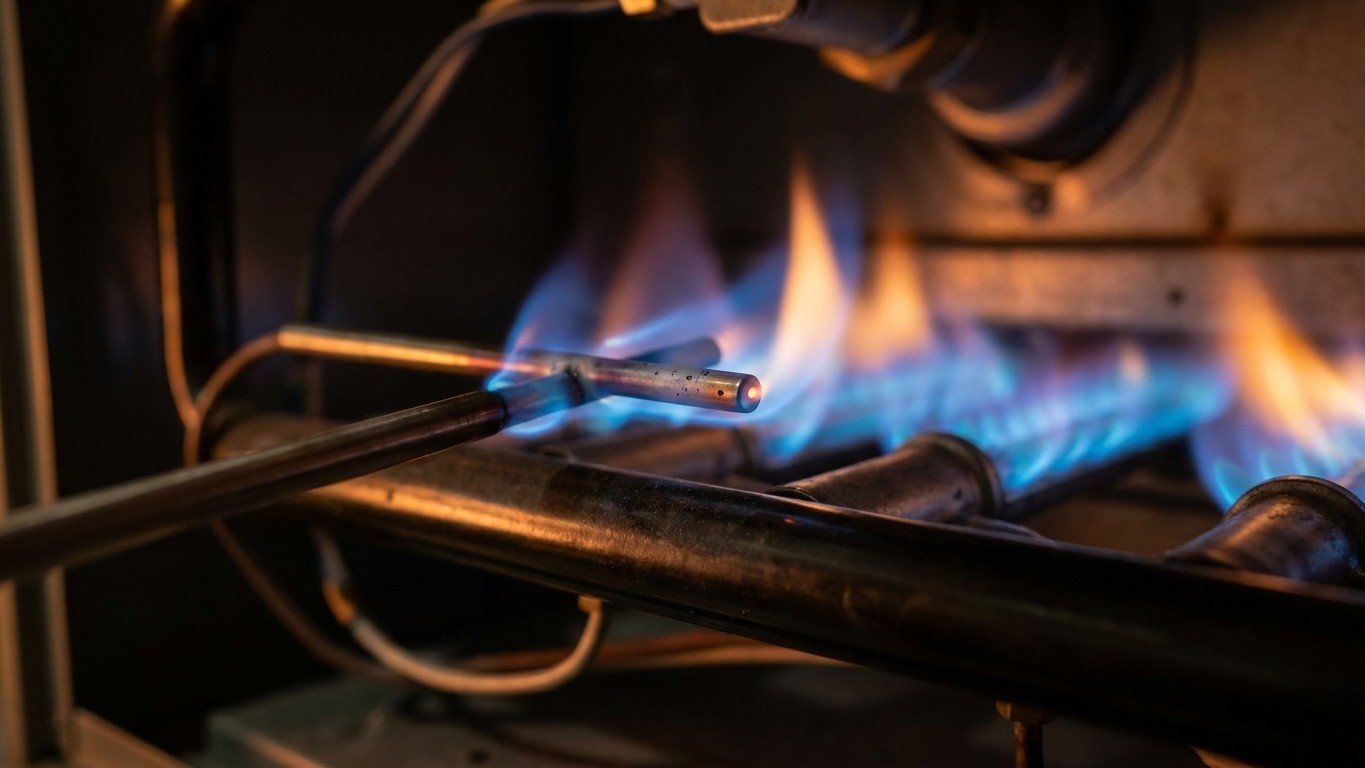

Cleaning a furnace flame sensor is a five-minute job that requires no parts: shut off gas and power, remove the burner access panel, take out the single screw holding the sensor rod, wipe the rod with fine abrasive pad or steel wool, and reinstall it exactly as it sat before. This single step resolves the single most common reason a gas furnace lights and then shuts itself back off within seconds.
A rod that proves the flame exists
The flame sensor is a thin metal rod, usually a few inches long, mounted right next to the burner where the flame wraps around it once ignition happens. It looks almost incidental, like a stray piece of hardware. It is not. That rod is the only thing standing between a normal burner cycle and the furnace’s control board deciding something is wrong.
Here is the mechanism in three sentences, because the explanation is what makes the fix make sense. The rod sits directly in the burner flame. The flame itself, because it is ionized, conducts a very small electrical current through the rod back to the control board. If that current does not register, the control assumes gas is flowing into the burner compartment without actually burning, and it shuts the gas valve within seconds, before that flame does something the flame is not supposed to do.
That fail-safe logic is why the symptom is so specific and so recognizable once you know it. The furnace calls for heat. The igniter glows or sparks. The burner lights, sometimes with a visible whoosh of blue flame. Then, a handful of seconds later, everything shuts off. The blower may still run for a while on residual heat, or it may not run at all. A few minutes pass, the thermostat calls again, and the exact same sequence repeats. Lights, runs briefly, dies. Lights, runs briefly, dies.
Homeowners often describe this as the furnace “trying to start” or “clicking on and off.” Both descriptions are accurate, and both point toward the same rod. It is worth separating this pattern from a furnace that never lights at all, which usually points somewhere else entirely, in the ignition system or the gas valve itself. The flame sensor problem is specifically a furnace that succeeds at lighting and fails at staying lit. That distinction, lights versus stays lit, is the fastest way to know you are looking at a sensing problem rather than an ignition problem before you even open the panel.
Why it stops working without breaking
The counterintuitive part, and the part that explains why this fix is so cheap and so common, is that the rod almost never actually breaks. It does not corrode through, snap, or short out in any dramatic way. What happens instead is slower and less obvious: a fine, almost invisible layer of oxide film builds up on the metal surface after a few thousand hours of sitting inside a flame.
That film is the entire problem. It is not thick enough to see easily, and it does not change the rod’s shape or position. But it is an insulator, and an insulator sitting between the flame and the metal underneath blocks the tiny current the control board is waiting for. The rod is not damaged. It has simply lost the ability to conduct through that coating, the same way a battery terminal with corrosion on it can still be a perfectly good battery, just unable to pass current until someone scrapes the buildup off.
This matters for one practical reason: cleaning restores the part completely. There is no reason to replace a rod that is only coated, and no reason to assume the furnace has a bigger issue the first time this symptom shows up. It also explains something homeowners find frustrating, which is that this same problem tends to return every few heating seasons rather than happening once and being done. The oxide film is a byproduct of normal operation, not a defect, so it rebuilds gradually every time the burner runs. A furnace that gets cleaned this year should be expected to need it again eventually, not because the fix failed, but because the flame is doing the same slow coating job it always does.
Furnaces used in dustier environments, homes with pets shedding heavily near the return, or systems that run long hours through a hard winter tend to need this more often than a furnace in a clean, low-dust mechanical closet running moderate cycles. There is no fixed interval that applies to every furnace, which is exactly why this stays a symptom-driven fix rather than a scheduled one.
Cleaning it
The sequence below assumes basic comfort working near a gas appliance. If shutting off gas at the appliance valve is not something you are confident doing, this is not a job to push through anyway, and there is no shame in leaving it to someone who does this daily. That said, the steps themselves are simple.
- Shut off gas and power, and confirm both. Turn the gas valve at the furnace to the closed position, and cut power at the switch near the unit or at the breaker. Do not skip confirming; a furnace that still has power can attempt to fire while the panel is open, and one that still has gas flowing defeats the entire purpose of the next steps.
- Remove the burner access panel. Most panels lift off or unscrew easily. Set any screws aside where they will not roll under the unit.
- Find the rod and note its orientation. It sits in or near the burner flame path, usually held by a single bracket. Take a mental note, or a phone photo, of exactly how it sits and which way it points before touching it.
- Remove the single mounting screw. Most sensors are held by one screw. Set it aside with the panel screws.
- Clean the film off gently. A fine emery cloth, a light abrasive pad, or even a clean rag with light pressure will remove the oxide coating. Wipe the entire visible surface of the rod, not just the tip.
- Refit it in the same position. Reinstall the screw, replace the panel, and restore gas and power in reverse order.
⚠ Gentle abrasion only. Sandpaper coarse enough to actually scratch the metal underneath changes the rod’s surface and can make future buildup worse, not better. A fine pad or emery cloth removes the film without scoring the base metal; heavy-grit paper or a wire wheel is the wrong tool here.
⚠ Do not bend the rod while cleaning or reinstalling it. Its exact position inside the flame is the entire point of the part. A rod bent even slightly out of the flame’s path can sense poorly even when perfectly clean, which turns a five-minute fix into a confusing callback.
⚠ If shutting off the gas valve confidently is not something you want to do on your own, stop there. This job depends entirely on that first step being done correctly, and there is no version of it worth doing without it.
If cleaning does not fix it
Cleaning solves the majority of these lights-then-dies cycles, but not all of them, and it is worth knowing what else produces the identical symptom before assuming the sensor itself is at fault a second or third time. Four other issues create the same pattern of a burner that lights and then shuts down within seconds.
| Cause | What distinguishes it |
|---|---|
| Cracked porcelain insulator | The rod itself may be clean, but the ceramic base that isolates it from the metal bracket has a hairline crack, letting current leak away instead of reaching the control board. |
| Poor ground at the furnace | The control board relies on a solid electrical ground to read the flame signal accurately; a loose or corroded ground connection anywhere in the furnace wiring can mimic a dirty sensor. |
| Control board fault | The board itself misreads a perfectly good signal, or fails to hold the gas valve open long enough regardless of what the sensor reports. |
| Unstable burner flame | If the flame itself is small, weak, or blowing away from the rod due to a burner or airflow problem, the rod may never sit in enough flame to conduct, no matter how clean it is. |
All four of these sit past the point where a homeowner should keep experimenting. A cracked insulator and a failing control board require replacement parts and diagnostic tools; a poor ground and an unstable flame require testing equipment and knowledge of the furnace’s own wiring and burner assembly, which vary by manufacturer. Reading the furnace’s own control panel, rather than guessing at codes online, is the right next step, since fault indicators differ from one furnace maker to another and there is no universal code list that applies across brands.
⚠ Repeated ignition attempts are not harmless, and this is the one place worth being direct about it. Every lockout-and-retry cycle involves a burner igniting into an unstable, changing environment, and repeated short-cycling like this is a sign the furnace is not completing normal, stable combustion. For fuel-burning furnaces, incomplete or unstable combustion is the condition under which carbon monoxide production rises. The U.S. Environmental Protection Agency’s 1997 consumer guidance on carbon monoxide (EPA 402-K-97-002) describes appliance malfunction as a primary residential source of CO exposure, distinct from properly vented, properly combusting equipment. The Consumer Product Safety Commission separately tracks non-fire carbon monoxide deaths tied to consumer products, a category that groups furnaces together with water heaters, charcoal grills, and portable generators; generators account for the largest share of that total, and the figure is not a furnace-specific death count. None of that means a flame-sensing fault is an emergency by itself. It does mean that a furnace stuck in a repeated lockout cycle for more than a day or two, especially after a cleaning attempt, is a furnace that has earned a professional visit rather than a fourth or fifth retry.
Common questions
How do I know if it’s the flame sensor and not the igniter?
An igniter problem usually means the burner never lights at all, no flame, no whoosh, nothing. A flame sensor problem means the burner lights successfully and then shuts off a few seconds later, repeatedly. That distinction, ignites versus stays lit, separates the two issues before you even open the access panel.
Can I clean the flame sensor without turning off the gas?
No. Shutting off gas at the appliance valve and cutting power at the switch or breaker comes first, every time, and both should be confirmed before the panel comes off.
Will cleaning it stop the problem for good?
It resolves the current cycle, but the oxide film that caused it is a normal byproduct of the rod sitting in a flame, so it rebuilds gradually over time. Expect to repeat this every so often rather than treating it as a one-time repair.
What if I clean it and the furnace still short-cycles?
That points toward a cracked insulator, a poor furnace ground, a control board fault, or an unstable burner flame, all of which involve diagnostic steps and parts specific to the furnace’s own manufacturer. That is the point to bring in someone who works on that equipment directly rather than repeating the cleaning a second or third time.