
Most “furnace won’t turn on” calls trace back to something that costs nothing to check. No parts, no tools beyond a flashlight, no technician yet. The trick is doing the checks in the right order, cheapest and fastest first, so you don’t tear into a panel before ruling out a thermostat setting or a flipped switch. Here’s that order.
Six things that cost nothing

Work down this list in sequence. Each step either fixes the problem or rules it out, and there’s no reason to skip ahead.
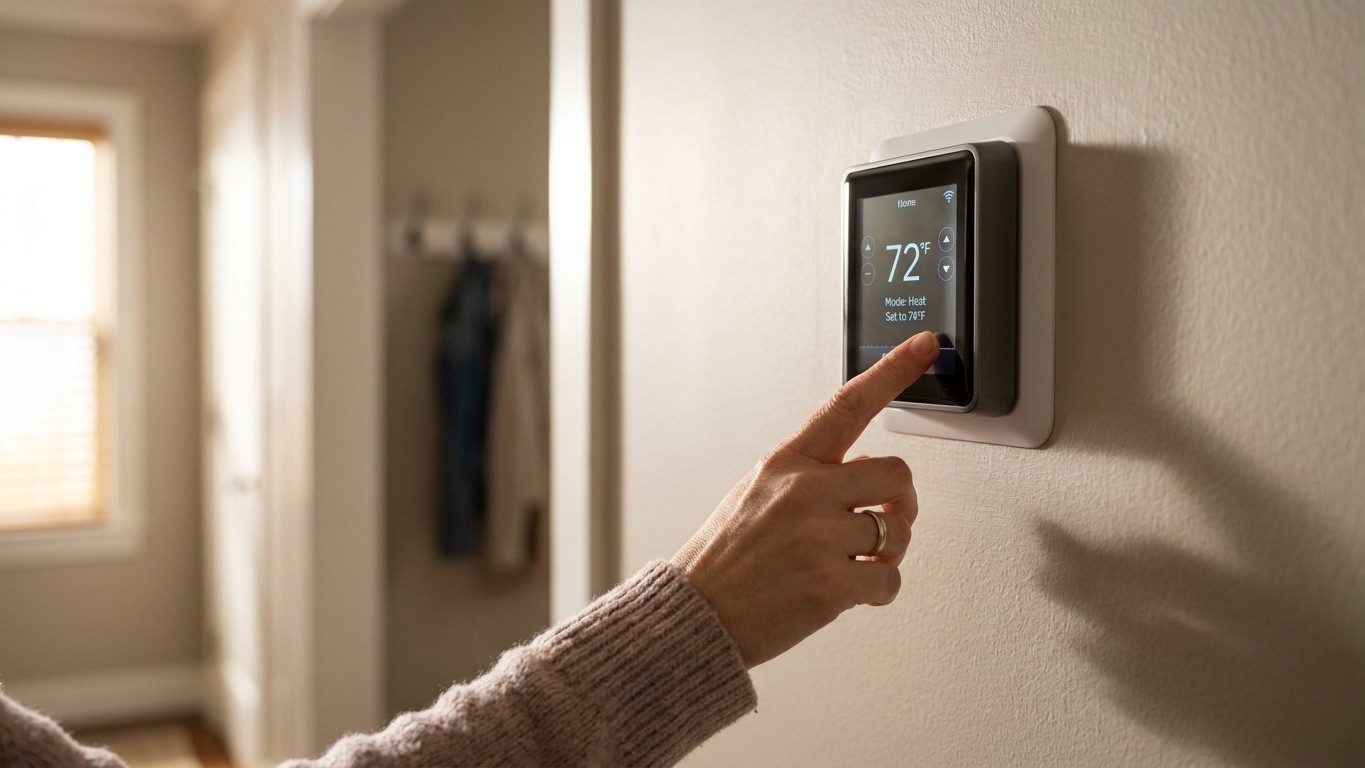
- Thermostat mode and setpoint. Confirm it’s set to “Heat,” not “Cool” or “Off,” and that the target temperature is a few degrees above the room’s current reading. A thermostat bumped during cleaning or by a curious kid is the single most common cause of “no heat” that isn’t actually a furnace problem at all.
- Thermostat batteries. Plenty of programmable and smart thermostats run on batteries even though they’re wired into the system. A dim or blank display, or a system that won’t respond to any button, points here first. Swap the batteries before assuming anything electronic has failed.
- The furnace’s own power switch. Somewhere near the unit, usually mounted on or beside it, there’s a switch that looks exactly like a household light switch. It’s easy to bump while vacuuming, storing boxes, or working nearby, and just as easy to overlook because nobody expects a furnace to have a light switch. Check it’s flipped to “on.”
- The breaker. Head to the electrical panel and look for a breaker that’s tripped, meaning it sits in a middle position rather than fully on or off. Switch it fully off, then fully on. If it trips again immediately, stop here and treat that as a signal to call a professional, not something to keep resetting.
- The door safety switch. Furnaces have a switch, sometimes called an interlock, that cuts power the moment the front panel is removed. It’s a safety feature, not a malfunction, and it means a panel that isn’t fully and correctly seated will keep the unit dead with no other clue.
- The gas valve at the appliance. On a gas furnace, confirm the shutoff valve on the gas line feeding the unit is aligned with the pipe (open) rather than perpendicular to it (closed). This valve sometimes gets closed during other work nearby and forgotten.
If all six check out and the furnace still won’t start, the issue has moved past the free-and-easy category. That’s fine. It just means the next two sections matter more.
The panel, and the filter slot
Two spots deserve their own mention because they’re missed constantly, and because neither one announces itself with an obvious symptom.
A panel that’s almost right is still wrong
The door safety switch mentioned above is unforgiving. It doesn’t care that the panel is mostly in place, it cares that it’s fully seated and latched the way the manufacturer intended. After any filter change, cleaning, or maintenance visit, take thirty seconds to press firmly along the edges of the access panel and confirm it clicks or seats the same way it did before. A panel that looks closed but sits a fraction of an inch off will leave the furnace completely dead, with no light, no fan, no sound, and no other symptom pointing you toward the cause.
The filter can lock the system out, not just weaken it
A dirty filter doesn’t only reduce airflow and efficiency. Left long enough, it can trigger a safety shutdown that stops the furnace from starting at all, rather than just making it run poorly. The U.S. ENERGY STAR program is direct about the maintenance interval: “Inspect, clean, or change air filters once a month in your central air conditioner, furnace, and/or heat pump.” That’s a monthly check across all three types of equipment, not an annual one. Pull the filter, hold it up to a light, and if you can’t see light through it clearly, that’s your answer. Replace it and try the thermostat again before moving to any other step.
Read the light before touching anything
Most furnaces built in the last couple of decades have a small window on the control board, usually visible without removing any panel, where a light blinks in a pattern. That pattern is a message from the furnace to whoever opens it up next, and it’s the fastest way to turn a service call into a short, useful conversation instead of a guessing game.
The catch is timing. Cutting power to the furnace, which happens the moment you flip the breaker or the switch mentioned earlier, usually clears whatever pattern was stored. So before you reset anything, before you flip a switch off and on again to “see if that helps,” stop and watch the light. Count the blinks, note the pattern, maybe even film it on a phone for ten seconds. Write it down.
This site doesn’t list what each blink pattern means, and for good reason: the codes differ from one manufacturer to the next, and a code that means one thing on one control board can mean something else entirely on another. The legend that actually applies to your furnace is printed on a sticker inside the access door, right where a technician will look first. Your job isn’t to decode it. Your job is to preserve it long enough for someone who can.
If the furnace has been shutting off on its own repeatedly rather than simply failing to start, that’s a related but distinct pattern worth reading about separately. This site’s guide on a furnace that shuts itself off covers what that specific behavior tends to point toward.
When to stop and call
Some signs mean the free checks are done, full stop, and the next call should be to a professional rather than to another attempt at the breaker.
- A breaker that trips again as soon as it’s reset, rather than holding.
- Any smell of gas near the furnace or the gas line. If this happens, leave the house first and call from outside or from a neighbor’s. This is the one situation on this site where the advice is simply to get out, not to check anything else first.
- Visible soot around the furnace, the vent, or the panel.
- Water pooling where it shouldn’t be, near the base of the unit or along the flue.
- A furnace that locks out repeatedly even after every check above has been completed and the filter is clean.
One habit worth naming directly: repeatedly cycling the power switch or breaker to force another ignition attempt isn’t a harmless troubleshooting trick. If the furnace won’t stay lit after one or two normal reset attempts, forcing more attempts doesn’t usually help and can mask a problem that needs a technician’s attention instead.
When you do call, three pieces of information shorten the visit considerably. First, exactly what you observed, in the order it happened (thermostat unresponsive, then no fan, for example). Second, the light pattern from the control board, written down or filmed rather than remembered. Third, a plain list of what you already checked, so the technician doesn’t repeat the free steps you’ve already ruled out. That last part alone can turn a longer diagnostic visit into a quick, targeted repair.
Common questions
Why does my furnace’s thermostat screen work but the furnace still won’t turn on?
A working thermostat display only confirms the thermostat has power, not that the signal is reaching the furnace. Move down the list: the furnace’s own switch, the breaker, and the door panel are the next places to look, since any one of them can cut power to the unit while leaving the thermostat itself unaffected.
Is it normal for a furnace to have its own separate power switch?
Yes. It’s typically mounted on or near the furnace cabinet and looks like a standard household light switch, which is exactly why it gets flipped by accident during cleaning, storage, or nearby work. Checking it takes seconds and rules out one of the most common causes of a “dead” furnace.
Can a dirty filter really stop the furnace from starting at all?
Yes, past a certain point. A clogged filter restricts airflow enough to trigger a safety shutdown in some systems, which stops the unit from starting rather than just running weaker. ENERGY STAR recommends inspecting, cleaning, or changing filters once a month in central air conditioners, furnaces, and heat pumps alike, which is more frequent than many households assume.
Should I keep resetting the breaker if it trips?
No. A breaker that trips once might have been an isolated event, but one that trips again as soon as it’s reset is signaling a real electrical issue. Repeated resets don’t fix that and can create other risks. That’s a call-a-professional situation, not a keep-trying-yourself one.