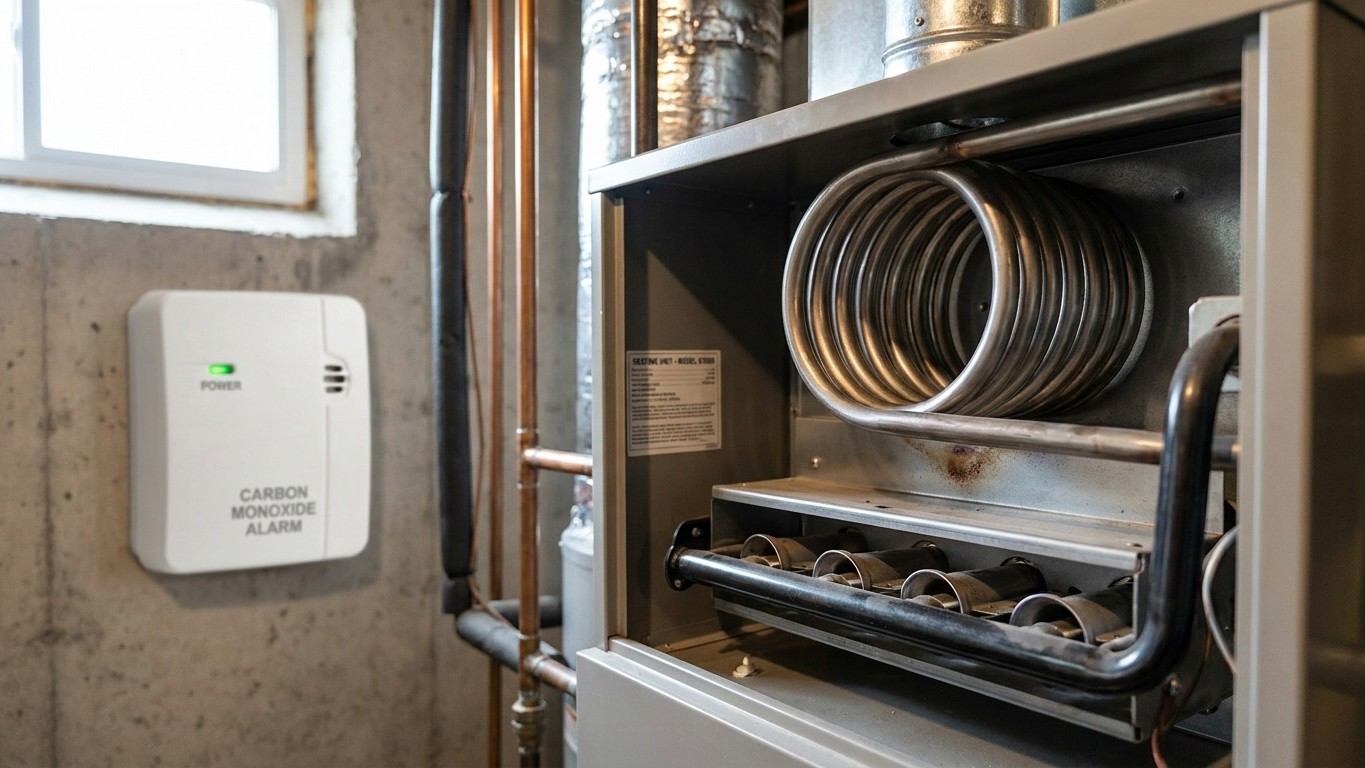

A fuel-burning furnace can produce carbon monoxide when combustion is incomplete or when its venting fails to carry exhaust outside. That’s the mechanism. What’s actually known, from the agencies that track it, is narrower and more specific than most warnings suggest: heating equipment is named as a top contributor to CO deaths, alongside portable generators, and prevention comes down to two dated federal recommendations plus a working alarm. An electric furnace produces none of this at all.
Why you cannot detect it yourself
Carbon monoxide has no color and no smell. That single fact separates it from almost every other furnace problem covered on this site. A rattling blower, a burning-dust odor at startup, a pilot light gone yellow instead of blue — those are things a person notices. Carbon monoxide gives you nothing to notice. There is no version of attentive homeownership that catches it by paying closer attention, which is exactly why the guidance below centers on a device rather than a habit.
The U.S. Consumer Product Safety Commission puts a number on the consequence: “Each year, more than 200 people die from unintentional non-fire related carbon monoxide poisoning associated with consumer products. Heating equipment and portable generators are among the top contributors to CO deaths.”
Read that sentence carefully, because it’s easy to misquote in a way that sounds similar but isn’t. It does not say furnaces kill 200 people a year. It’s a count of deaths associated with consumer products broadly, specifically the ones not related to fire, and it names heating equipment and portable generators together as top contributors, not furnaces alone. Boilers, water heaters, wood stoves and generators all sit inside that same category. Narrowing the figure to one appliance overstates what’s known about that appliance specifically; widening it to all CO deaths overstates the scope of what CPSC is actually counting here.
None of this is a reason to feel alarmed about a functioning furnace. It’s a reason to treat detection as a job for equipment, not instinct. A smoke detector works on the same logic: nobody expects to smell smoke reliably from every room of a house while asleep, so the house gets an alarm instead. Carbon monoxide asks for the same accommodation, except there’s no backup sense to fall back on if the alarm isn’t there. That’s the whole argument for the sections that follow — not fear, just a plain description of where human senses stop being useful.
Which appliances can produce it, and which cannot
Carbon monoxide is a byproduct of burning fuel. Anything in a home that burns gas, oil, propane or wood is a candidate. Anything that runs on electricity alone, with no flame and no combustion, is not. This distinction sounds obvious once it’s stated, but it rarely gets stated plainly, and it’s the one that tells a reader whether the rest of this page applies to their house.
| Appliance | Burns fuel? | Does CO advice on this page apply? |
|---|---|---|
| Gas, oil, or propane furnace | Yes | Yes |
| Gas or oil boiler | Yes | Yes |
| Gas or propane water heater | Yes | Yes |
| Wood stove or fireplace | Yes | Yes |
| Portable generator | Yes | Yes |
| Electric furnace | No | No |
| Electric baseboard heat | No | No |
| Heat pump | No | No |
If your heat comes from the top half of that table, the rest of this page is written for your house. If it comes from the bottom half, the CO risk described here does not apply to your furnace at all. An electric furnace has no flame, no combustion, and nothing to vent, so it cannot produce carbon monoxide by the mechanism described above. That’s worth stating plainly rather than burying in a footnote, because a reader with electric heat who came here worried about their system should be able to stop reading this particular concern and move on. For a full look at how electric systems actually work and what does go wrong with them, see our electric furnace guide.
One appliance deserves a specific callout because it’s so often used indoors during outages: portable generators. CPSC is direct about this one: “Never use portable generators inside homes or garages, even if doors and windows are open. Use generators outside only, at least 20 feet away from homes with exhaust facing away.” The “even if doors and windows are open” clause is the part people skip past, and it’s the part that matters — open windows don’t change the outcome. The 20-foot distance comes from this exact sentence and applies to generator placement specifically, not to furnaces, flues, or anything else on this page.
The alarm, and where it goes
Detection, since it can’t happen by human senses, comes down to the alarm itself. CPSC’s guidance: “Install battery-operated CO alarms or CO alarms with battery backup on every level of the home and outside sleeping areas. Interconnected CO alarms are best; when one sounds, they all sound.” Every level of the home. Outside every sleeping area. Battery-operated, or with battery backup if it’s hardwired. Interconnected if the setup allows for it, so a signal in the basement is heard in the bedroom.
There’s a second CPSC sentence that narrows the picture in a way that surprises a lot of homeowners: “CO alarms should be installed on each level of the home and outside sleeping areas. CO alarms should not be installed in attics or basements unless they include a sleeping area.” The basement is usually where the furnace lives, so it’s the instinctive place to put an alarm. The guidance points elsewhere instead, unless someone actually sleeps down there. That doesn’t mean a basement furnace is unmonitored or safe to ignore. It means the alarm belongs on the levels where people are, since CO produced near the furnace still travels through the house, and the alarm’s job is to reach the people, not to sit next to the source.
Once alarms are in place, they need upkeep on two separate schedules, and CPSC gives both together: “CPSC recommends consumers replace the batteries in their smoke and CO alarms annually and test the alarms monthly.” Battery replacement once a year, testing once a month, for both smoke and CO alarms together. That’s a rhythm, not a one-time task.
Then there’s what to do if an alarm sounds or symptoms appear, and CPSC keeps this as a single instruction: “Know the symptoms of carbon monoxide poisoning: headache, dizziness, weakness, nausea, vomiting, sleepiness, and confusion. If you suspect CO poisoning, get outside to fresh air immediately, and then call 911.” Outside first. Call second. This is the one section of furnace guidance anywhere on this site where the advice is simply to leave, not to check a panel, not to identify a code, not to diagnose anything before acting.
What actually prevents it
Prevention here isn’t a mystery product or a filter rating. It’s a schedule, and two federal sources describe it with slightly different emphasis worth keeping side by side rather than picking one. CPSC: “CPSC urges consumers to schedule a yearly professional inspection of all fuel-burning home heating systems, including furnaces, boilers, fireplaces, wood stoves, water heaters, chimneys, flues and vents.” The list is the useful part. Most homeowners who schedule furnace service have not had the chimney, the flue, or the water heater looked at in the same visit, and CO can originate from any of them.
The EPA, in a 1997 publication (EPA 402-K-97-002), frames the same idea around timing rather than a full list: “EPA does, however, recommend that if you have a fuel burning furnace, stove, or fireplace, they be inspected for proper functioning and serviced before each heating season to protect against carbon monoxide poisoning.” Put the two together rather than choosing one: CPSC says yearly, and names more equipment; EPA says before each heating season, tying the timing to when a furnace actually starts running hard again. Both apply only to fuel-burning equipment. Neither reaches an electric furnace or a heat pump, since neither produces the byproduct these recommendations exist to catch.
What to watch for between inspections
A yearly inspection doesn’t mean the system goes unwatched the other 364 days. A few observable signs are worth reporting to a technician, not diagnosing on your own:
- A burner flame that has changed color, particularly from blue to yellow or orange.
- Soot or dark staining around the furnace, water heater, or fireplace.
- A flue or vent pipe that looks blocked, disconnected, or has come apart at a joint.
- Unusual condensation on windows near where the heat is running.
Each of these is a signal to call a professional, not a set of steps to work through alone. There’s no diagnostic code list here worth publishing, because those differ by manufacturer and by system, and the honest instruction is to read whatever panel or manual came with your specific equipment rather than rely on a generic guide.
Common questions
Can a well-maintained furnace still produce carbon monoxide?
Yes. Maintenance lowers the odds of a venting failure or incomplete combustion, but it doesn’t eliminate the underlying mechanism. That’s why CPSC and EPA both frame inspection as a yearly or seasonal routine rather than a one-time fix, and why an alarm remains the backup regardless of how recently the system was serviced.
Does a carbon monoxide alarm expire?
CPSC’s published guidance covers battery replacement (annually) and testing (monthly) for smoke and CO alarms together. It does not address replacing the alarm unit itself, and no interval for that is given in the sources this page draws from.
If I smell gas near my furnace, should I look for the source first?
No. The instruction from CPSC for suspected CO poisoning is to get outside to fresh air immediately, then call 911. That sequence, outside first, applies before any attempt to identify or fix anything at the appliance.
Does an electric furnace need a carbon monoxide alarm?
The furnace itself doesn’t produce carbon monoxide, since it burns no fuel. Many homes still have other fuel-burning appliances such as a gas water heater or a fireplace, and CPSC’s alarm placement guidance applies to those regardless of what type of furnace is installed.