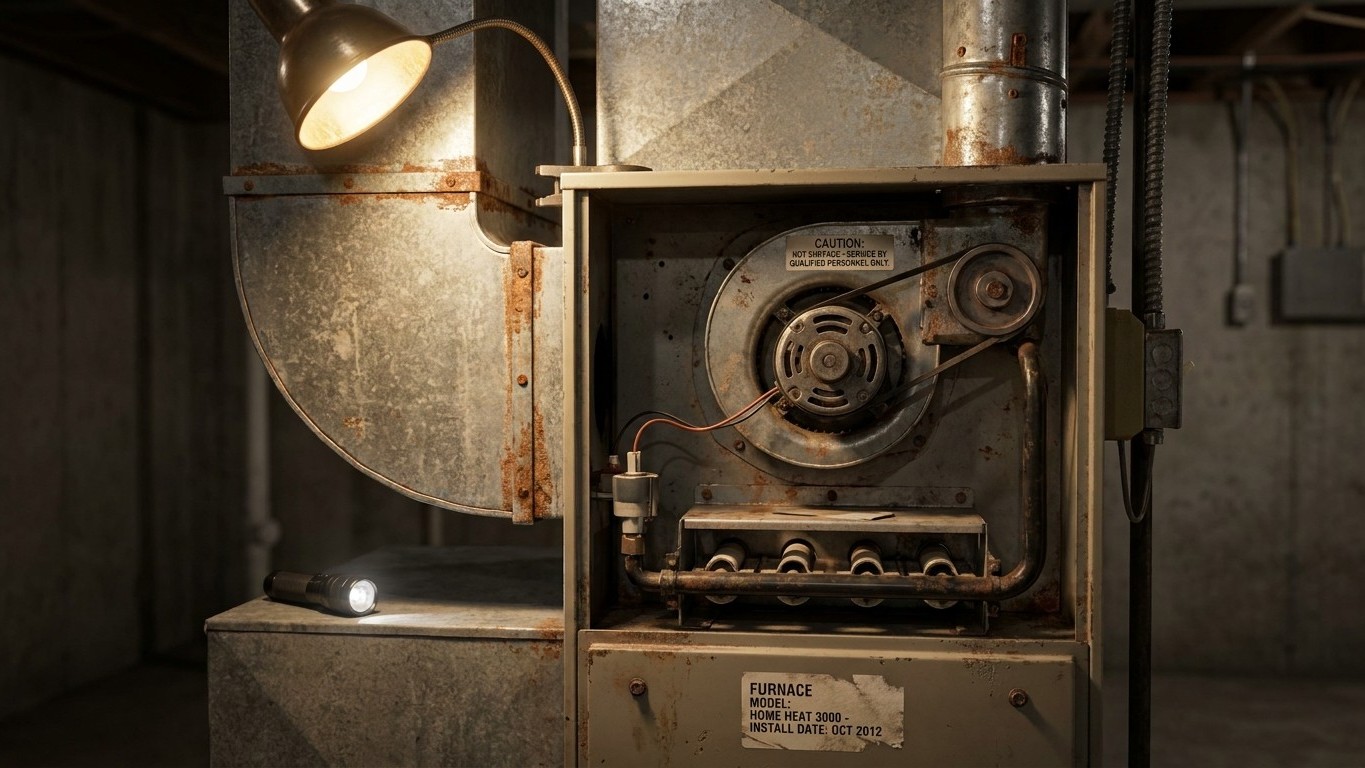

Each furnace noise points to a different part of the system, and the sound itself is often the fastest diagnostic tool you have. A bang usually traces back to ductwork or delayed ignition, a squeal to a belt or motor, and a rumble to the burner assembly or a blower out of balance. Knowing which is which tells you whether to grab a flashlight or call a technician.
Bangs, Squeals and Rumbles
A bang at startup or shutdown is almost always sheet metal doing what sheet metal does: expanding when it heats up, contracting when it cools, and popping as it moves against its screws or brackets. That’s the “oil-canning” sound you hear in ductwork. A different kind of bang, sharper and closer to the furnace cabinet itself, means gas has built up in the combustion chamber for a second or two before igniting, then lights all at once instead of catching smoothly. That’s a small, contained explosion happening exactly where it’s supposed to be contained.
A squeal comes from something spinning against something else that it shouldn’t be touching, or touching too hard. On belt-drive blowers, a worn or slipping belt vibrates against the pulley and produces a high, thin pitch that rises with blower speed. On direct-drive motors, the belt isn’t there, so a squeal usually means a bearing that’s lost its lubrication and is grinding metal on metal. The pitch and the timing are the tell: constant while the blower runs points to the belt or bearing, while a squeal only at the start points to the motor itself struggling to spin up.
A rumble is lower and heavier, and it’s the sound most worth paying attention to. It often means the burners aren’t igniting evenly, so the flame pattern is irregular instead of a clean, uniform blue line. It can also mean the blower wheel has come out of balance, which shakes the whole cabinet at a frequency you feel as much as hear. The mechanism matters here because a rumble from uneven burners isn’t cosmetic; it means combustion isn’t happening the way the system was designed to burn it.
| Sound | Likely source | Where it happens | Urgency |
|---|---|---|---|
| Bang | Ductwork expansion or delayed ignition | Ducts or combustion chamber | Low to moderate |
| Squeal | Belt slip or dry bearing | Blower motor assembly | Moderate |
| Rumble | Uneven burner ignition or unbalanced blower | Burner assembly or blower wheel | High |
How to tell, in your own house
Before touching anything, figure out exactly when the sound happens: at ignition, throughout the running cycle, or at shutdown. That single detail narrows the list of causes more than almost anything else you can check, and it costs nothing but a few minutes standing near the furnace with your phone timer running.
- Note the timing. Write down whether the noise happens at startup, mid-cycle, or shutdown. This alone rules out or points toward ignition versus mechanical wear.
- Pull the air filter and look at it. A filter clogged with dust restricts airflow, which can make the blower work harder and louder, and it’s the cheapest fix in the entire system.
- Check that supply and return vents aren’t blocked. Furniture, rugs, or closed registers force air through a smaller opening, which can turn a quiet system noisy.
- Look at the visible ductwork near the furnace. Loose panel screws or a disconnected duct section will rattle or bang; tightening accessible screws is within reach for most homeowners.
- Listen with the access panel closed versus cracked open (never with power running to exposed components) to judge whether the sound is coming from the blower compartment or from the ducts beyond it.
That’s where homeowner work ends. Opening the burner compartment, adjusting gas pressure, inspecting the heat exchanger, or working on the blower motor’s internal bearings all involve either an open flame, line voltage, or a component that, if cracked or misaligned, can leak combustion byproducts into the house. None of that is a weekend project, and none of it should be. A technician has the tools to check flame pattern, combustion readings, and heat exchanger integrity safely; a flashlight and a screwdriver don’t substitute for that.
What it costs you to ignore it
A bang from ductwork rarely damages anything on its own, but it’s frequently a symptom of restricted airflow, and restricted airflow has a real cost. According to U.S. ENERGY STAR, “airflow problems can reduce your system’s efficiency by up to 15 percent.” That’s a system running exactly as designed mechanically, burning the same fuel, and still losing performance because air isn’t moving through it the way it should. A dirty filter or blocked vent is often the whole story behind that loss.
A squeal left alone doesn’t stay a squeal. A slipping belt eventually snaps, and a dry bearing eventually seizes, and either failure stops the blower entirely, meaning no heat moves through the ducts even if the burners are firing fine. What starts as an annoying sound during dinner turns into a furnace that runs but never delivers warm air anywhere in the house.
A rumble carries the highest stakes because it’s tied to combustion, not just airflow. Uneven burner ignition can spread soot and corrosion inside the heat exchanger over time, and a heat exchanger that cracks under that stress can allow combustion gases to mix with the air your blower distributes through the house. That’s not a comfort issue or an efficiency issue anymore; it’s a safety one, and it’s exactly why the rumble is the sound that should move a homeowner from “I’ll check the filter” to “I’m calling someone” the fastest.