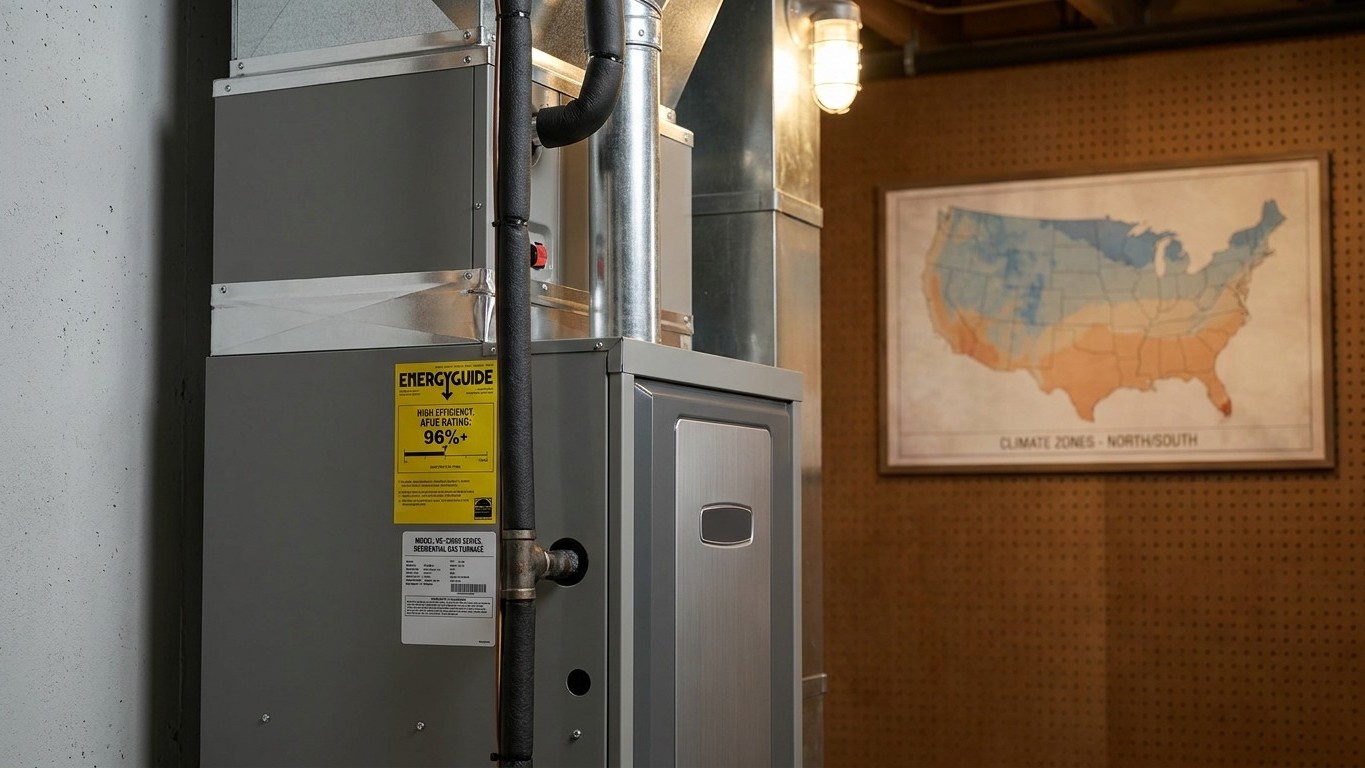

AFUE stands for Annual Fuel Utilization Efficiency, a percentage that tells you how much of the fuel your furnace burns actually turns into heat for your home rather than escaping up the flue. The “threshold” isn’t one number nationwide; ENERGY STAR sets a higher bar for colder regions because those furnaces run so many more hours per year.
What AFUE Means, and the Threshold Where You Live
The AFUE percentage comes from a standardized lab test that measures fuel input against usable heat output over a full year, factoring in start-up losses, cool-down losses, and the heat that simply vents outside with the exhaust. A furnace rated at 80% AFUE turns 80 cents of every fuel dollar into heat inside your ducts; the other 20 cents leaves through the flue pipe. That number is fixed by the equipment itself, not by your thermostat settings or your insulation.
Where the “threshold” question gets interesting is regional. ENERGY STAR splits the country into geographic zones and sets a different minimum AFUE for each, because a furnace in a place with long, cold winters logs far more run hours than the same model in a mild climate, so the payback on a more efficient unit arrives faster. In New York State, which falls into ENERGY STAR’s U.S. North region, a gas furnace has to hit a rating of 97% AFUE or greater to earn the ENERGY STAR label, according to the agency’s own product criteria.
That 97% figure is specific to the North zone. Other parts of the country sit in different ENERGY STAR regions with their own criteria, so a furnace that qualifies as efficient in a milder climate zone won’t automatically match the North’s threshold, and you should check the criteria for your own zone rather than assume New York’s number travels with you. If you’re in Canada, this entire framework doesn’t apply at all; ENERGY STAR’s furnace specification is a U.S. program, and Canadian provinces and territories run under separate national efficiency regulations, so borrowing the American threshold would be the wrong comparison entirely.
| Location | ENERGY STAR region | Gas furnace AFUE threshold |
|---|---|---|
| New York State (example) | U.S. North | 97% AFUE or greater |
| Other U.S. states | Depends on zone | Set separately by region; check your local criteria |
| Canadian provinces/territories | Not covered | Governed by separate national regulations |
The mechanism behind the regional split is simple: a furnace that runs 2,000 hours a season loses far more total energy through inefficiency than one running 600 hours, even at the identical AFUE rating. So the North region’s stricter 97% threshold isn’t an arbitrary number; it reflects how much more fuel a Northern household burns over a winter, and how much more there is to save by pushing efficiency higher.
How to tell, in your own house
You don’t need a technician on-site to answer the first few questions. Work through these in order, because each step either answers the question outright or tells you exactly what to check next.
- Find the rating plate. It’s a metal or foil sticker on the furnace cabinet, usually near the access panel, listing the model and serial number. This costs nothing and takes two minutes with a flashlight.
- Look up the AFUE rating using that model number. The manufacturer’s spec sheet or the owner’s manual (often searchable online by model number) will state the exact AFUE percentage the unit was tested at.
- Check for an ENERGY STAR label on the unit itself. If it’s there, the furnace already met the regional threshold that applied when it was certified.
- Compare that number against your region’s current ENERGY STAR criteria. A furnace installed years ago may have met the bar at the time but fall short of today’s requirement for your zone, particularly if you’re in the North region.
- Bring in a licensed HVAC technician for a combustion efficiency test. This is where homeowner work stops. Verifying real-world efficiency accurately requires a combustion analyzer inserted into the flue to measure flue gas temperature, oxygen content, and carbon monoxide levels, plus access to the burner assembly and gas valve. Opening that side of the furnace without training risks a gas leak or a carbon monoxide exposure, and it’s the point where this becomes a licensed technician’s job, not a weekend project.
Steps one through four cost nothing but time and answer the paperwork question: what was this furnace built to do. Step five answers a different question entirely, which is what the furnace is actually doing right now, today, in your ductwork. A unit can carry a high AFUE rating on paper and still underperform it if the burner is dirty, the heat exchanger has scaling, or the venting was installed incorrectly. That gap only shows up with a combustion test, and that’s a boundary worth respecting rather than working around.
What it costs you to ignore it
Skip the check, and the furnace doesn’t fail dramatically. It just quietly loses ground. Comfort goes first: rooms farther from the furnace run cooler, the system cycles more often trying to catch up, and the thermostat setting stops matching what you actually feel in the house.
The equipment absorbs the next hit. A furnace running below its rated efficiency, whether from a below-threshold model or from a properly rated unit that’s drifted out of tune, works harder for the same heat output. That means more burner cycles per day, more wear on the ignition system and blower motor, and a shorter path to a major repair or early replacement. Furnaces don’t usually announce inefficiency with a warning light; they announce it with a bigger repair bill down the line.
Then there’s the fuel itself, and this is the part that’s easiest to feel without ever running a test. Every percentage point of AFUE that a furnace fails to deliver is fuel that goes straight up the flue instead of into your ductwork. Over a full heating season, especially in a North-region climate where the furnace runs for months on end, that lost heat adds up to real fuel burned for no benefit. It doesn’t show up as a single dramatic event. It shows up as a furnace that seems to run constantly without ever quite catching up, which is usually the first sign worth checking before winter gets deep.