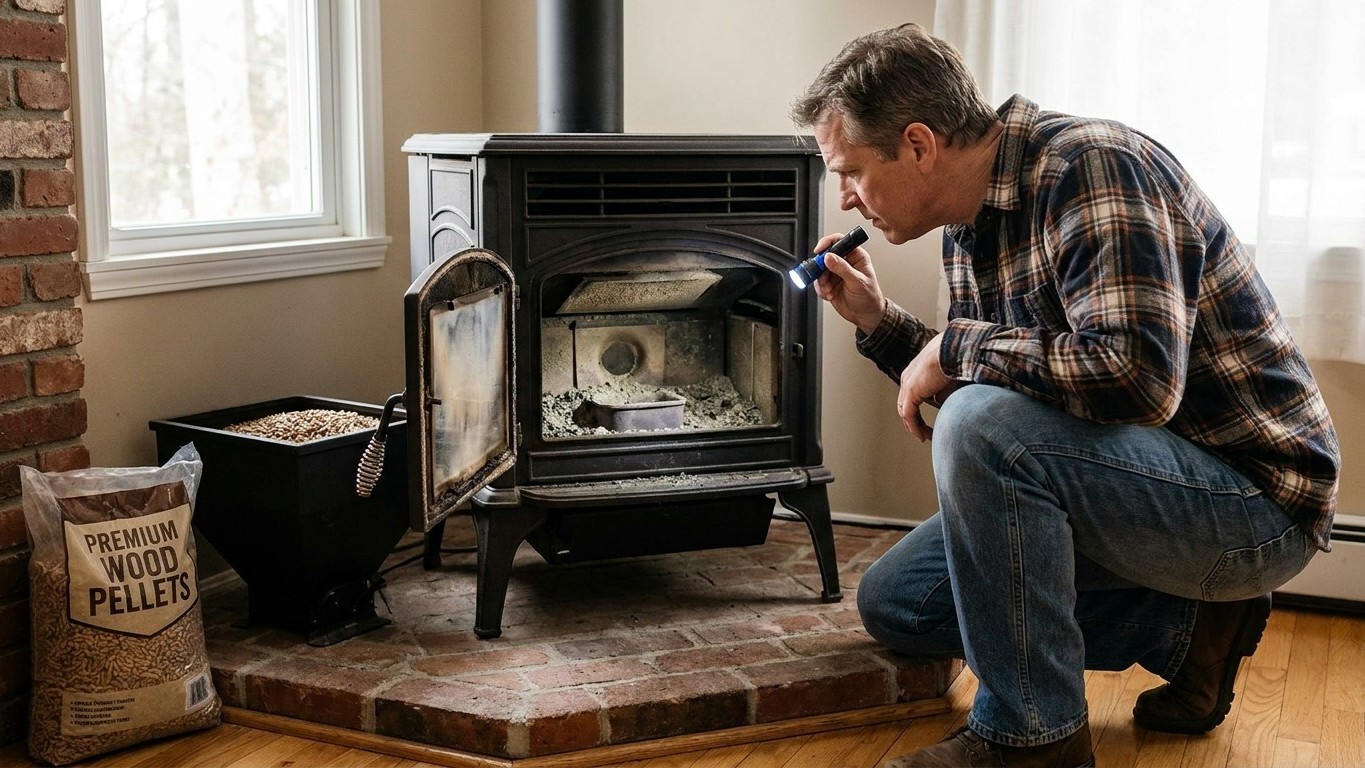

Nine times out of ten, a pellet stove that won’t light isn’t fighting an electrical or mechanical failure at all. It’s starved: fuel isn’t reaching the burn pot in a quantity the igniter can catch. The fix is usually a five-minute check, not a service call. Below is the order to work through before you assume the worst.
Check in this order

Troubleshooting a stove that refuses to light works best as a process of elimination, starting with what costs nothing to check and ending with what actually requires tools and training. Go through these in sequence:
- Fuel in the hopper, and fuel in the burn pot. A full hopper doesn’t guarantee the burn pot is getting pellets. Open the door and look. If the pot is empty or has only a few pellets scattered in it, the problem is upstream, not at the igniter.
- A clear burn pot. Ash buildup or a hardened clinker (a fused, glassy chunk of residue) blocks air from reaching the pellets and can smother the igniter’s heat before it ever catches. Scrape it clean before doing anything else.
- The door and ash pan fully closed and latched. This one gets skipped constantly. A door that looks shut but isn’t fully latched, or an ash pan sitting a quarter-inch out of its slot, is enough to stop ignition.
- Power at the outlet. Not just “is the light on somewhere,” but confirmed power at the wall receptacle the stove is plugged into. A tripped breaker or a dead outlet produces exactly the same symptom as a failed igniter.
- The igniter itself, last. Only after the first four checks come back clean does the igniter become the suspect.
Where owner checks end
Everything on that list is observation: looking, listening, confirming a switch is where it should be. None of it requires opening the stove’s electrical housing, testing voltage with a meter, or disassembling the auger assembly. The moment troubleshooting moves to “test the igniter’s resistance” or “check the control board’s output,” that’s a technician’s job, not a Saturday-afternoon project. Pellet stoves route several safety interlocks through the control board, and probing the wrong wire can turn a $40 igniter repair into a $300 board replacement.
As the U.S. EPA notes, “Pellet stoves need an electrical supply to work because they use motorized components to feed the fire and blow out hot air.” That single sentence explains why a pellet stove and a wood stove fail so differently: no power means no auger turning, no igniter heating, and no fan pulling combustion air, regardless of how much fuel sits in the hopper.
When the fuel is not arriving
If the burn pot came up empty in your first check, the feed path is where to look next, and it’s responsible for the largest share of no-light calls by a wide margin. The EPA describes the basic design plainly: “The pellets are poured into a hopper, which automatically feeds into the stove.” That automation is convenient until something interrupts it, and three things commonly do.
The usual culprits
A bridged hopper happens when pellets arch over the auger opening and stop falling, even though the hopper still looks full from above. Tap the sides of the hopper and stir the top layer with a gloved hand; if pellets suddenly drop, that was the problem. Fines (the sawdust-like debris that accumulates at the bottom of a pellet bag) pack around the auger intake and jam it in a way that looks like an empty hopper even when it isn’t. And pellets that have absorbed moisture, whether from a damp storage shed or a torn bag left outdoors, swell up and jam solid in the feed tube instead of dropping freely.
That last point connects directly to fuel quality, and it’s worth being blunt about: no amount of igniter replacement fixes a feed problem caused by bad pellets. The EPA is direct on this: “Pellets can differ significantly in how well they’re made and how well they burn. Lower quality pellets may provide less heat and create a fine dust. Higher quality pellets tend to burn cleaner and produce less ash.” A bag of pellets that’s absorbed humidity or was poorly manufactured to begin with will jam feed tubes and choke burn pots no matter how new the igniter is. If you’re troubleshooting a feed problem, it pays to look at what you’re feeding the stove before you look at the stove itself; our guide on choosing and storing quality pellets covers the moisture and density issues that cause exactly this kind of jam.
The stove has to see a closed box
Here’s the failure almost nobody expects walking in: a pellet stove is a forced-air appliance, and it constantly monitors its own draught (the airflow moving through the firebox and out the vent). If that airflow reading doesn’t match what the control board expects for a sealed firebox, the stove either refuses to ignite in the first place or shuts itself down a few minutes after lighting, before you’ve even had time to walk away.
What breaks the seal
Three things commonly break that seal without being obvious to the eye. A door that’s closed but not fully latched leaves a gap too small to see but large enough to throw off the draught reading. An ash pan that’s been removed for cleaning and set back in slightly crooked does the same thing; it can look “in” while still leaving a sliver of an opening at the seam. And a gasket, the rope or tape seal that runs around the door and pan openings, degrades over time from heat cycling and simply stops sealing even when everything is latched correctly.
That third point matters because a gasket is a wear part, not a permanent fixture. Owners who’ve run a stove for several heating seasons without replacing the door gasket are often surprised to learn that’s the reason ignition has become unreliable, especially if the stove used to light fine and now hesitates or shuts down shortly after starting. Check gaskets for flattening, fraying, or gaps you can see daylight through; if the gasket compresses easily under a finger instead of showing gentle resistance, it’s likely no longer sealing.
Checking these three points, door latch, ash pan seating, and gasket condition, takes under two minutes and rules out an entire category of ignition failures. It’s also the step most likely to be skipped, because a door that swings shut and appears closed doesn’t look like a problem.
What is not an owner repair
Once fuel delivery, burn pot condition, and firebox sealing have all checked out clean, what’s left belongs to a qualified technician. Four components in particular require diagnostic tools and training the average owner doesn’t have on hand, and attempting to test or replace them without that background risks doing more damage than the original fault.
- The igniter element itself, since testing its resistance and confirming it’s drawing correct voltage requires a meter and knowledge of the specific model’s specs.
- The control board, which manages every interlock in the stove and can be damaged by incorrect probing or a wiring mistake made while chasing an unrelated fault.
- The vacuum or pressure switch, the sensor responsible for the draught reading discussed above, which fails in ways that mimic both feed problems and gasket problems.
- The auger motor, since a motor that’s seized or drawing incorrect current looks identical from the outside to a simple feed jam, and misdiagnosing one for the other wastes both time and parts.
Beyond fixing the failure in front of you, there’s a compliance angle worth knowing. Since 2020, new room heaters have had to meet an emission limit of 2.0 grams per hour tested with crib wood, or 2.5 grams per hour with cord wood, under EPA’s New Source Performance Standards; stoves certified under the older 2015 standard met a looser 4.5 grams per hour. Pellet stoves are held to those same limits as wood stoves, and a technician working on the control board or auger system on a newer unit needs to keep that certification intact rather than swap in parts that push the appliance out of compliance.
The best defense against ending up at this stage in the first place is routine maintenance, and the EPA is specific about what that means: “Pellet stoves need to be regularly cleaned to ensure that the stove runs efficiently and safely. Additionally, you should have your stove professionally cleaned at least once a year.” The owner’s side is the ash removal and burn pot scraping covered above. The professional side, the annual inspection of exactly the components listed here, is what catches a worn gasket or a struggling auger motor before it becomes a stove that won’t light on the coldest morning of the year.
Common questions
Why does my pellet stove start the auger but still not light?
That pattern usually points to the igniter itself rather than the feed path, since pellets are clearly reaching the burn pot but nothing is catching them. Confirm the burn pot isn’t ash-clogged or holding a clinker first, since both can smother an igniter that’s actually working fine.
Can a dirty burn pot really stop ignition completely, not just reduce heat?
Yes. A burn pot packed with ash or a fused clinker blocks the airflow the igniter needs to get pellets burning, and can prevent a flame from establishing even though everything else in the stove is functioning normally.
Is it normal for a pellet stove to need a new gasket every year?
No, but gaskets are wear parts, not permanent fixtures, and they degrade faster with heavy seasonal use or frequent door opening. Most last multiple heating seasons before flattening enough to affect the draught reading; a technician’s annual visit is the right time to check gasket condition.
Does a power surge or outage explain a stove that suddenly won’t light?
It can. Since pellet stoves rely on motorized components (the auger, the igniter, the combustion fan) for every part of ignition, a brief outage or a tripped breaker produces the exact same symptom as a genuine electrical fault. Confirming power at the outlet is step four for a reason.