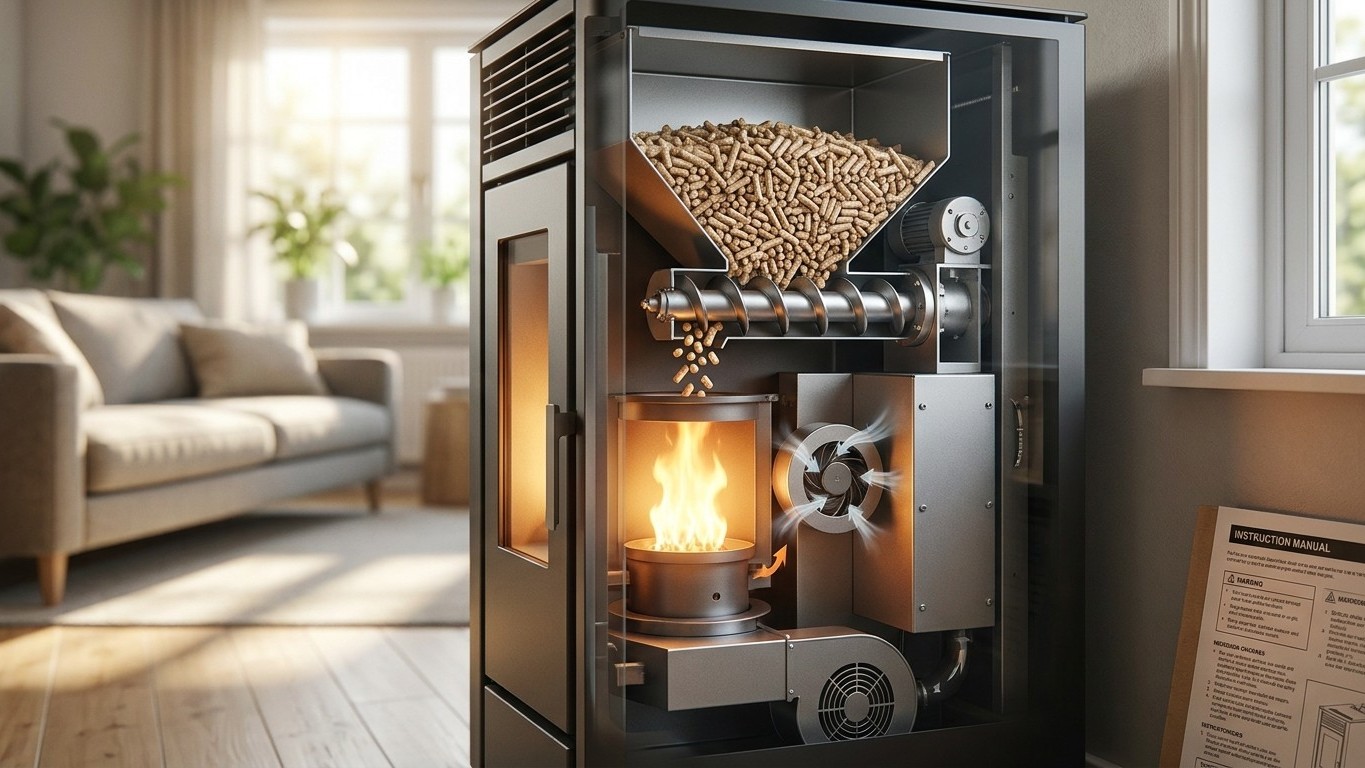

A pellet stove works by dropping small amounts of compressed wood fuel into a fire, on a schedule, rather than letting you pile in logs and walk away. That metering is the whole story: it’s why the flame stays even, why the Thermostat can hold a set temperature, and why the appliance needs a power cord in the first place. Everything else, the labor it saves you and the limits it hands back, follows from that one design choice.
Hopper, auger, fan

Start with what the EPA says plainly: “The pellets are poured into a hopper, which automatically feeds into the stove.” That single sentence is the difference between a pellet stove and a wood stove. You’re not building a fire, you’re loading a magazine, and the machine decides how much fuel it needs and when.
Here’s how that plays out mechanically. Pellets sit in the hopper, a storage bin usually mounted on top of or beside the firebox, holding anywhere from a day’s worth of fuel to several days depending on the model and the size of the space you’re heating. A motorized auger, essentially a slow-turning screw, pulls pellets out of the hopper in small measured batches and drops them into the burn pot, the small metal basin where combustion actually happens. An igniter starts the first batch, and once the fire catches, the auger just keeps feeding it at whatever rate the control board has set based on your temperature dial or Thermostat.
Two fans do the rest of the work. The combustion blower pushes air into the burn pot to keep the fire burning hot and clean, and vents exhaust out through the flue. The convection blower is the one you actually feel: it pulls room air across the hot firebox and pushes warmed air back out into the house. Neither fan is optional. Without the combustion blower the fire smolders and smokes; without the convection blower the heat just sits inside the stove.
Below the burn pot sits the ash pan, which catches the fine residue left over from burned pellets. Because pellet fuel burns so completely, the ash volume is small compared to cordwood, but it still needs attention. The EPA is specific about this, stating that “pellet stoves need to be regularly cleaned to ensure that the stove runs efficiently and safely. Additionally, you should have your stove professionally cleaned at least once a year.” That’s two separate jobs, not one: emptying the ash pan and wiping the glass is on you, on whatever schedule the manual recommends, while a full inspection of the venting and internal components is a once-a-year appointment with a technician.
No electricity, no heat
Every part described above, the auger, the igniter, both fans, runs on household current. The EPA states it without qualification: “Pellet stoves need an electrical supply to work because they use motorized components to feed the fire and blow out hot air.” There’s no workaround built into the appliance itself. A wood stove will keep radiating heat during a blackout as long as you keep feeding it logs by hand. A pellet stove, unplugged, is just a metal box with unburned fuel sitting in it.
This matters most exactly when you’d want the heat the most. Winter storms that knock out power are often the same storms that drop temperatures hardest, and a household that chose a pellet stove specifically to cut its dependence on the grid can find itself with a cold, dark house and a hopper full of pellets it has no way to burn. Some owners address this with a battery backup or a small generator sized to the stove’s draw, which is typically modest, but that’s a separate purchase and a separate plan, not something the stove provides on its own.
It’s worth being honest about what this means for anyone shopping for backup heat rather than supplemental heat. If the goal is a heat source that works no matter what the utility is doing, a pellet stove by itself doesn’t check that box the way a wood stove or a propane heater without electronic ignition might. If the goal is efficient, low-labor heat for a house that keeps the lights on, it’s a strong fit. We’ve covered the specifics of running one through an outage, including what a backup power setup actually needs to handle, on our dedicated pellet stove power outage guide, since that’s a big enough question to deserve its own answer rather than a paragraph here.
What it asks of you, and what it does not
The EPA frames the trade-off in one line, describing pellet stoves as “cleaner and more efficient, with less hauling and no cutting, splitting, stacking or waiting for wood to dry.” That’s a fair summary of the labor side. You’re not swinging an axe, you’re not stacking a cord in the yard, and you’re not waiting a year or two for green wood to season before it’ll burn clean. Bagged pellets show up ready to burn the day you buy them.
The other side of that ledger is real too. Pellets come in bags, usually 40 pounds each, and a season’s supply for a moderate climate can mean storing a ton or more somewhere dry. You’re buying fuel rather than harvesting it, which means a trip to the hardware store or a delivery, not a walk to the woodpile. And a pellet stove is a machine with sensors, a circuit board, and moving parts, which is more to maintain and more that can eventually need repair than a steel box that just holds a fire.
Wood stove vs pellet stove, side by side
| Factor | Wood stove | Pellet stove |
|---|---|---|
| Fuel | Split logs, seasoned 6-12+ months | Bagged pellets, ready to burn |
| Labor | Cutting, splitting, stacking, hauling | Carrying bags, filling hopper |
| Control | Manual, by air vents and log placement | Automatic, thermostat or dial |
| Power dependence | None, works during an outage | Total, stops without electricity |
Neither column is objectively better. It comes down to whether you’d rather spend a weekend a year splitting wood or spend a monthly trip loading bags into a garage, and whether losing power for a few days is a minor inconvenience or a genuine safety concern in your climate.
Certified, and what the number means
The EPA publishes a range for certified units: “EPA-certified pellet stoves usually fall into the 70-83% efficiency range, while heating capacities range from 8,000-90,000 Btu per hour.” Those two figures have to be read together. A stove rated near the top of the efficiency range but sized at the low end of the Btu span still won’t heat a large open floor plan, and a high-Btu unit at the lower end of the efficiency range will burn through more fuel to deliver that output. Neither number alone tells you whether a specific stove suits a specific room.
The agency also notes the scale of the market it’s reviewing: “EPA currently certifies over 90 different pellet stoves.” That’s a wide field, and certification itself is narrower than shoppers sometimes assume. It’s an emissions test, checking how many grams of fine particulate matter a stove releases per hour of operation, not a comfort rating and not a guarantee of how a unit will feel in your living room. Since 2020, new room heaters have had to meet a limit of 2.0 grams per hour when tested with crib wood, or 2.5 grams per hour with cord wood, tighter than the 4.5 grams per hour standard that applied to stoves certified under the older 2015 rule. Pellet stoves are held to those same limits as wood stoves, so a pellet stove built before 2020 was certified to a looser standard than one built after.
What certification doesn’t cover is fuel quality, and that gap matters more than it sounds. The EPA is direct about it: “Pellets can differ significantly in how well they’re made and how well they burn. Lower quality pellets may provide less heat and create a fine dust. Higher quality pellets tend to burn cleaner and produce less ash.” A stove certified at 83% efficiency won’t hit that number burning a bag of poorly made pellets full of fillers and moisture. The stove’s certification tells you what the appliance is capable of under test conditions; the pellets you feed it decide how close you get to that number in practice.
Common questions
Do pellet stoves need a chimney?
No traditional masonry chimney is required. Most pellet stoves vent through a smaller, horizontal pipe that can run directly through an exterior wall, since the combustion blower pushes exhaust out rather than relying on natural draft the way a wood stove does.
How often do you need to refill the hopper?
It depends on hopper size and how hard the stove is running, but many households refill once a day during cold stretches, and less often during milder weather when the auger is feeding pellets at a lower rate.
Can a pellet stove run on a small generator?
Many can, since the combined draw of the auger, igniter, and fans is modest compared to a furnace blower, but the exact wattage needed varies by model and should be checked against the stove’s manual before you size a generator to it.
Is a pellet stove worth it if the power goes out often?
If outages are frequent and long in your area, a pellet stove alone won’t solve that problem, since it stops working without electricity. It can still make sense paired with a battery backup or generator, but that’s an added cost and setup, not something the stove handles on its own.