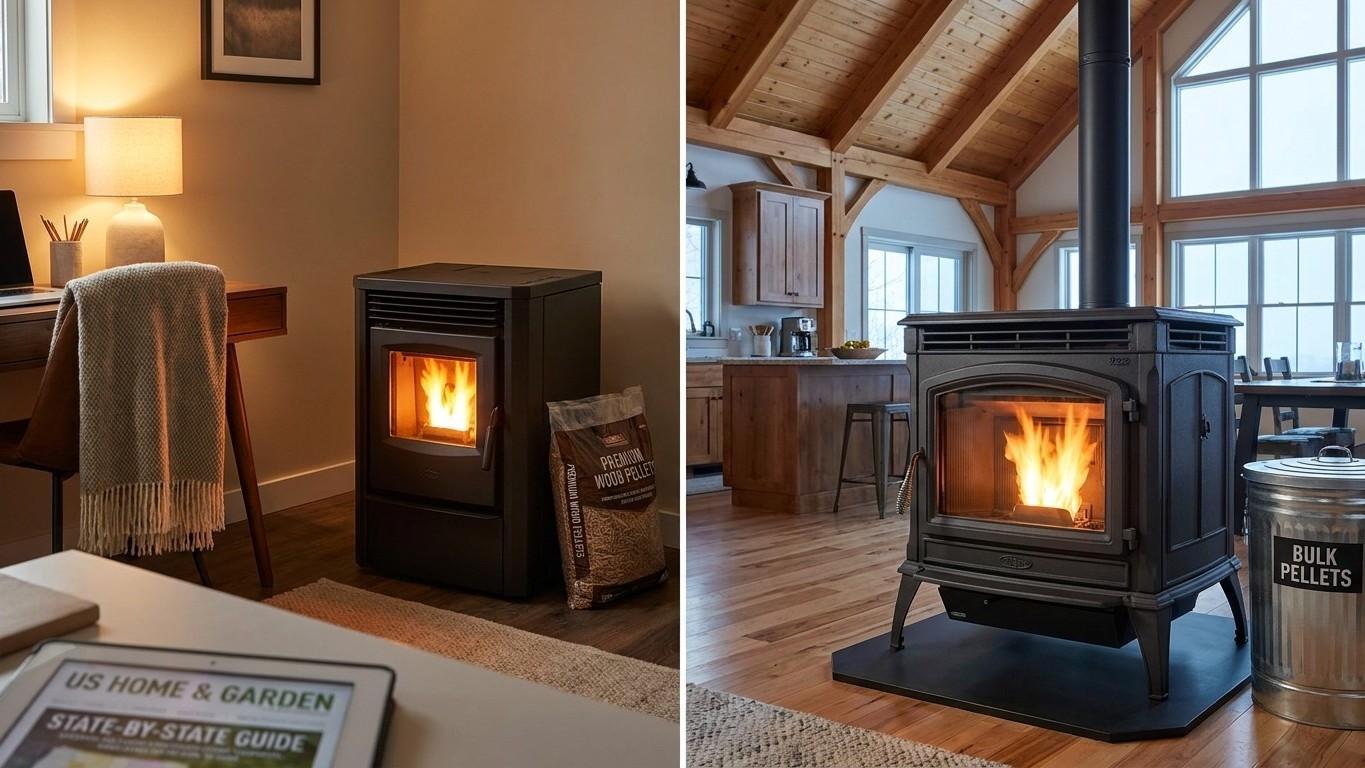

The right pellet stove size depends on the room’s square footage, ceiling height, insulation quality, and how cold your winters run, not a single number that works everywhere. A small, well-sealed bedroom might need one of the smallest EPA-certified models, while an open great room in a drafty older home could require something near the top of the range. Matching capacity to the space, rather than picking the biggest unit “to be safe,” is what actually keeps the stove running well and heating efficiently.
The span is enormous, and that is the point

According to the U.S. EPA, “EPA-certified pellet stoves usually fall into the 70-83% efficiency range, while heating capacities range from 8,000-90,000 Btu per hour.” Read that second number again. A factor of more than ten separates the smallest certified stove from the largest. That is not a rounding error or a marketing quirk. It means the phrase “a pellet stove” describes a category as broad as the range between a window air conditioner and a whole-house central unit.
At the low end, an 8,000 Btu stove is built for a single room. Think a home office, a small bedroom, or a den that gets closed off from the rest of the house in winter. It is not designed to fight the temperature swings of an open floor plan, and asking it to do so will leave you cold no matter how long it runs.
Move up the range and you get into stoves meant for open living areas: a kitchen that flows into a living room, a finished basement with a low ceiling but a wide footprint, or a cabin with one main living space. These mid-range units, often somewhere in the 40,000 to 60,000 Btu territory depending on the model, are built to circulate heat across a bigger, less contained volume of air.
At the top, near that 90,000 Btu ceiling, you are looking at appliances meant to function almost like a central heating source for a small, efficient house, or to carry the main heating load in a colder climate where the stove runs for months without much of a break. That is a different job than warming one room, and the equipment reflects it: larger hopper capacity, bigger blowers, and a firebox built to sustain higher output for longer stretches.
The efficiency figure the EPA gives, 70 to 83 percent, applies across this whole range. It is not a guarantee tied to any single stove, and it does not tell you whether a given model is the right size for your room. Efficiency and capacity are two separate specs, and conflating them is one of the more common sizing mistakes.
Sizing from the space, not the catalogue
The instinct to look up a model number and copy its rated capacity skips the step that actually matters: what the room itself demands. Several factors push that requirement up or down, sometimes by a wide margin, and none of them show up on a spec sheet.
- Floor area and ceiling height — a taller room holds more air volume even if the footprint looks modest on paper, and that air has to be heated too.
- Insulation quality — a well-insulated newer build holds heat far longer than an older home with thin walls or an unfinished attic above, so two rooms of identical size can need very different output.
- Window area — large or older single-pane windows bleed heat fast, and a room with a wall of glass loses more than one with a couple of small openings.
- How open the space is to the rest of the house — a stove trying to heat one room that is also feeding warmth into an open staircase or an adjoining hallway is effectively heating a bigger volume than its footprint suggests.
- The local winter — a stove sized for a mild coastal climate will fall short in a region where subzero stretches are normal, even in an identical room.
Notice what is missing here: a Btu-per-square-foot formula. That is deliberate. The climate difference alone between a home in Florida and one in Manitoba is wide enough that any single rule of thumb would mislead one of them, if not both. A figure that comfortably heats a sealed, well-insulated room in a mild climate could leave an equivalent room in a harsher climate underheated all winter, and the reverse produces an oversized stove that never runs the way it should.
There is also a practical wrinkle that catalogue browsing tends to skip over entirely: pellet stoves need electricity to operate at all. As the EPA puts it, “Pellet stoves need an electrical supply to work because they use motorized components to feed the fire and blow out hot air.” That means sizing decisions cannot ignore the reality of a power outage. A stove sized perfectly for the room does nothing during a blackout unless there’s a backup power plan, which is a separate consideration from Btu output but one worth factoring into the overall heating strategy for the space.
Fuel quality plays into the practical side of sizing too, even though it is not a capacity number. The EPA notes that “pellets can differ significantly in how well they’re made and how well they burn. Lower quality pellets may provide less heat and create a fine dust. Higher quality pellets tend to burn cleaner and produce less ash.” A correctly sized stove running on poor pellets can still underperform, so the sizing conversation and the fuel conversation are connected rather than separate decisions.
The oversized stove problem
The common assumption is that a bigger stove is a safer bet, a cushion against guessing wrong. With a pellet stove, that logic runs backward, and it is worth stating plainly because it contradicts what feels intuitive.
A stove rated well beyond what a room actually needs spends nearly all its life at the lowest end of its output range, since running it any higher would overheat the space almost immediately. That sounds harmless. It is not. A pellet stove burning at minimum output is operating at its least efficient and least clean setting. The fire is smaller, the burn is cooler, and combustion is less complete than at a stove’s designed operating range. The mechanics behind this are straightforward: the pellets are poured into a hopper, which automatically feeds into the stove, and that feed rate along with the airflow is calibrated to work best somewhere in the middle of the appliance’s range, not pinned at the floor.
The practical consequence shows up fastest in maintenance. Because the EPA states that “pellet stoves need to be regularly cleaned to ensure that the stove runs efficiently and safely,” and separately that owners “should have your stove professionally cleaner at least once a year” (professional cleaning is a yearly baseline, on top of routine owner cleaning, not a substitute for it), an oversized stove running at minimum output tends to demand attention more often than that baseline suggests. Lower, cooler burns leave behind more unburned residue and ash buildup, which means more frequent cleaning of the burn pot, glass, and venting than a correctly sized stove running in its efficient middle range.
There’s a regulatory dimension worth knowing too. Since 2020, new room heaters, pellet stoves included, have had to meet tighter federal emission limits: 2.0 grams per hour when tested with crib wood, or 2.5 grams per hour with cord wood, compared with the 4.5 grams per hour standard that governed appliances certified under the older 2015 rule. Pellet stoves are held to these same limits as wood stoves. A stove operating constantly at minimum output, regardless of which standard it was certified under, is working against the conditions that let it burn cleanest, since low-fire operation tends to produce more particulate matter than a unit running in its intended range.
An undersized stove is at least an obvious problem. The room stays cold, and the shortfall is easy to notice and correct. An oversized stove is a quieter failure: the room feels fine, the thermostat reads comfortable, but the appliance itself is working outside its efficient zone every single day, racking up dirtier burns and more frequent cleanings without anyone realizing the stove was ever the wrong size to begin with.
Common questions
Can one pellet stove heat an entire house?
It depends on the house. A well-insulated, compact home can sometimes be heated primarily by a single stove near the top of the EPA’s 8,000 to 90,000 Btu per hour range, especially if the floor plan is open enough for heat to circulate. A larger or more compartmentalized house, or one with several closed-off rooms, usually needs supplemental heating even with a high-capacity stove installed.
What happens to a pellet stove during a power outage?
It stops producing heat. The EPA is direct on this point: pellet stoves “need an electrical supply to work because they use motorized components to feed the fire and blow out hot air.” Without power, the hopper feed and the blower both stop, regardless of how the stove is sized for the room.
Does pellet quality affect what size stove I need?
Not directly, but it affects performance at any size. The EPA notes that lower quality pellets “may provide less heat and create a fine dust,” while higher quality pellets “tend to burn cleaner and produce less ash.” A correctly sized stove fed with poor fuel can still underheat a room or produce more mess than expected.
How many pellet stove models are actually EPA-certified?
The EPA currently certifies over 90 different pellet stoves, spanning that full 8,000 to 90,000 Btu per hour capacity range. That number gives homeowners a reasonably wide field to match a certified model to a specific room’s actual heating needs rather than settling for whatever capacity happens to be on the showroom floor.