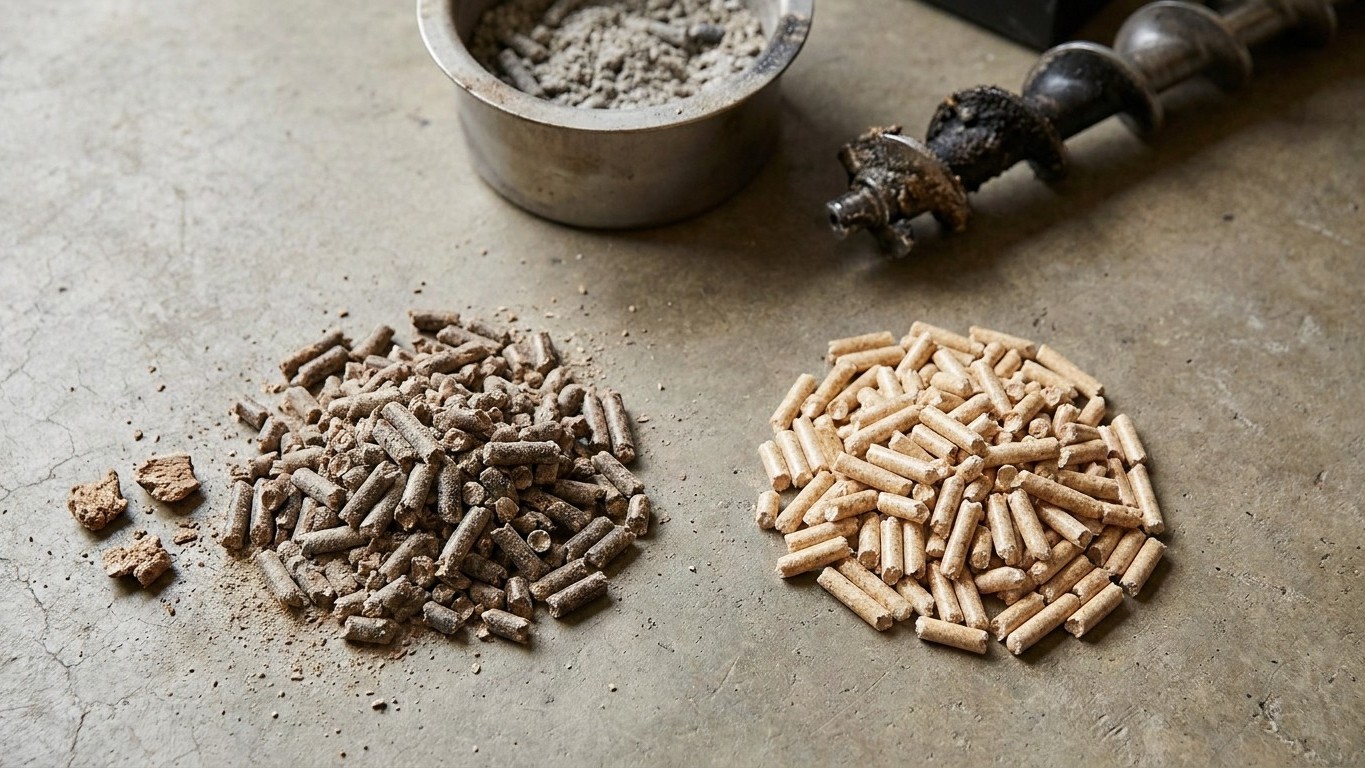

Cheap pellets cost more because they burn dirtier, leave more ash, and force the stove to work harder to produce the same heat. That extra ash and unburned dust end up clogging the burn pot and auger, which means more frequent cleaning, more service calls, and a stove that never quite reaches the efficiency it was built for. The savings at checkout get eaten up in maintenance.
The fuel is not standardised
The U.S. Environmental Protection Agency puts it plainly: “Pellets can differ significantly in how well they’re made and how well they burn. Lower quality pellets may provide less heat and create a fine dust. Higher quality pellets tend to burn cleaner and produce less ash.” That single sentence explains why two bags sitting side by side on a hardware store shelf, both labeled “premium,” can behave completely differently once they hit the burn pot.
Here’s what’s easy to miss: the stove gets certified. The fuel doesn’t. EPA “currently certifies over 90 different pellet stoves,” and since 2020 new room heaters have had to meet strict emission limits, tested at 2.0 grams per hour with crib wood or 2.5 grams per hour with cord wood, down from the 4.5 grams per hour allowed under the older 2015 standard. Pellet stoves are held to those same limits as wood stoves. But none of that testing touches what’s inside a bag of fuel bought at a feed store or big-box retailer. The appliance is regulated. The raw material is not.
That gap matters because EPA notes that “EPA-certified pellet stoves usually fall into the 70-83% efficiency range, while heating capacities range from 8,000-90,000 Btu per hour.” That range is a property of the machine under ideal conditions. Feed it fuel packed with bark, dirt, or high moisture, and a stove built for the top of that range settles closer to the bottom. The efficiency number on the spec sheet assumes fuel that burns the way it’s supposed to.
What drives the variation is mostly the raw material and how tightly it’s compressed. Pellets made from clean, dry sawdust with no bark hold together under heat and pressure. Pellets made from a mixed batch, some green wood, some bark, some recycled material, come out looking similar in the bag but fall apart differently once the auger feeds them into the fire. There’s no bag-side certification standard cited by EPA for retail pellet fuel, so the burden of judging quality lands on the buyer, standing in the aisle with a 40-pound sack in hand.
What you can judge in the bag
Nobody’s running a lab test in their garage before loading the hopper. But a few visual and physical cues, checked before buying a pallet, tell you a fair amount about how a batch is likely to burn. None of these is a formal grade. They’re indications, the kind of thing that tips the decision between one supplier and another.
- Dust and broken pieces at the bottom of the bag. Tip a bag on its side, or look at one that’s already been opened. A heavy layer of sawdust and shattered fragments at the bottom usually means the pellets took a beating in transport, or weren’t well bound to begin with. That dust is exactly the fine material EPA describes as a byproduct of lower quality fuel.
- Uniform length. Pellets that are consistently sized suggest a mill running clean, well-calibrated equipment. A mix of long, short, and crumbled pieces points to inconsistent processing, and inconsistent processing tends to track with inconsistent burning.
- A hard, shiny surface rather than a crumbly one. Pick up a single pellet. It should feel dense and hold its shape under light pressure, with a slightly glossy surface from the heat and pressure of the compression process. A pellet that crumbles between two fingers is telling you something about the moisture or fiber content that went into it.
- How much ash the last batch left. This one requires memory rather than inspection. If the previous bag from a given brand or supplier left a noticeably thick layer of ash after a burn cycle, that’s a real data point for the next purchase, more useful than anything printed on the bag.
None of these observations replace a lab analysis, and none of them guarantee a flawless burn. But together they give a buyer a reasonable read on what’s inside, without needing any special equipment beyond a hand and a bit of attention.
What poor fuel does to the machine
This is where the cost of a cheap bag actually shows up, not at the register, but in the stove itself. EPA explains the basic mechanics simply: “The pellets are poured into a hopper, which automatically feeds into the stove.” That feeding process depends on pellets moving smoothly through an auger, a motorized part that pushes fuel from the hopper into the burn pot at a metered rate. Fine dust and broken fragments don’t move the same way whole pellets do. They pack into corners, bind up the auger’s rotation, and build up in the burn pot faster than intact pellets would.
That buildup has consequences beyond a messy burn pot. EPA notes that “Pellet stoves need an electrical supply to work because they use motorized components to feed the fire and blow out hot air.” Those motorized components, the auger motor and the combustion blower among them, are working against extra resistance when the fuel path is clogged with fines. A motor straining against packed debris wears faster than one moving clean fuel through a clear channel.
Ash and the cleaning cycle
Higher ash output from lower quality pellets means the burn pot fills up sooner, which chokes airflow and drags combustion efficiency down even further. It’s a compounding problem: dirtier fuel produces more ash, more ash reduces airflow, and reduced airflow makes the burn even less complete. EPA is direct about the response required: “Pellet stoves need to be regularly cleaned to ensure that the stove runs efficiently and safely. Additionally, you should have your stove professionally cleaned at least once a year.” With low quality fuel, that first half of the instruction, the routine owner cleaning, stops being a suggestion and becomes something that has to happen far more often than the manual assumes, sometimes weekly instead of monthly during heavy use. The annual professional service still matters regardless of fuel quality, but it’s not a substitute for the more frequent attention that a poor pellet supply demands.
Storing them dry
A good pellet ruined by damp storage behaves exactly like a bad one. Wood pellets are compressed sawdust, held together by the natural lignin in the wood under heat and pressure, with no glue or binder added. That construction is efficient and clean when the pellets stay dry, but it also means they have almost no resistance to moisture. A pellet left in a damp environment absorbs water, swells, and starts to crumble back toward the loose sawdust it came from.
Storage location decides most of this outcome before the fuel ever reaches the hopper. Pellets keep best off the floor, where ground moisture and condensation collect, under cover so rain and snow never reach the bags directly, and ideally sealed in their original packaging or a container that blocks humidity. A garage corner on a wood pallet, with a tarp overhead, does more for pellet quality than any brand choice at the store.
A swollen or partially crumbled bag doesn’t just burn poorly, it recreates the exact mechanical problem described above. Softened, broken pellets feed into the auger as fine debris rather than solid fuel, packing the same corners and choking the same burn pot that a low quality bag would. The stove can’t tell the difference between fines caused by bad manufacturing and fines caused by bad storage. Either way, the auger jams more easily, the burn pot fills faster, and the cleaning schedule tightens up. Buying a well-made pellet is only half the job. Keeping it dry until it reaches the fire is the other half.
Common questions
Does a higher price always mean better pellets?
Not automatically. Price reflects sourcing, wood species, and regional supply as much as manufacturing quality. The physical checks, dust at the bottom of the bag, uniform length, a hard shiny surface, tell you more than the price tag does.
Can I mix pellets from different suppliers in the same hopper?
Mechanically there’s no barrier to it, but mixing batches with different moisture or ash characteristics makes it harder to judge what’s causing a change in burn performance. Running one supplier’s fuel at a time makes it easier to spot which pellets are leaving more ash or clogging the burn pot.
How often should I clean the burn pot if I use lower quality pellets?
There’s no fixed schedule that applies to every stove, but expect to check it more often than the manual’s baseline recommendation. EPA’s guidance that stoves need regular cleaning “to ensure that the stove runs efficiently and safely” applies with more urgency when the fuel is leaving heavier ash.
Does bag storage really make that much difference?
Yes. Since pellets are held together only by the wood’s own lignin, with no added binder, moisture is the single fastest way to undo a well-manufactured pellet. A dry, covered, off-the-floor storage spot protects the fuel quality you already paid for.