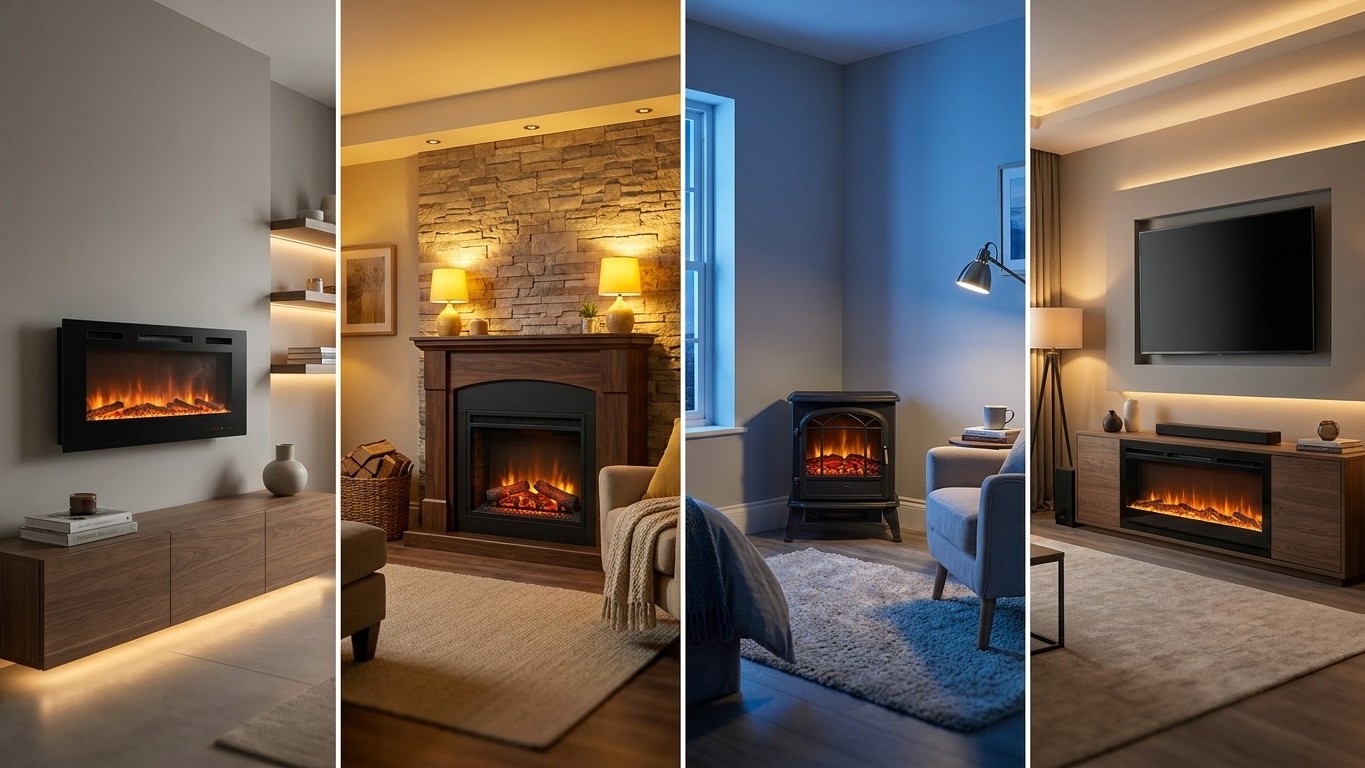

All electric fireplaces run on the same core: a resistive heating element, a fan, and an LED or mist-based flame display, wired to a standard household outlet. What separates one from another is the shell around that machine. An insert, a wall-mounted panel, a mantel package, a media console and a Freestanding stove all install differently and suit different rooms, but none of them burns anything or produces more heat than roughly 1,500 watts allows.
Five shapes, one machine

Strip away the cabinetry and every electric fireplace on the market is doing the same job: heating a small volume of air with resistance coils and a blower, while a separate light effect (LED panels, sometimes a rotating drum, occasionally an ultrasonic mist system) simulates flame and sometimes glowing embers. The heat output and the flame effect are two unrelated systems running side by side in the same box. That matters because it means the decision between shapes is really a decision about furniture and wall space, not about how warm the room will get.
An insert is built to slide into an existing rectangular opening, most often a masonry fireplace that no longer burns wood or gas. A wall-mounted panel hangs flat against drywall like a large flat-screen television, with a narrow depth of a few inches. A mantel package pairs a firebox with a surrounding wood or MDF frame, sold as a single furniture piece that sits against a wall without any mounting into it. A media console tucks the firebox into the lower section of a TV stand, so the flame effect sits below the screen. A freestanding stove mimics a wood-burning stove’s silhouette, standing on short legs and needing nothing more than floor space and a nearby outlet.
| Type | What it is | How it mounts | Best room fit | What it needs |
|---|---|---|---|---|
| Insert | Firebox sized to slide into an opening | Sits inside masonry or a pre-built surround | Living rooms with an existing but unused fireplace | An outlet reachable from inside the opening |
| Wall-mounted panel | Slim flame display with heater | Bracketed flat to a wall, like a TV | Bedrooms, condos, small living rooms | A wall rated to hold the unit’s weight |
| Mantel package | Firebox with a full furniture surround | Freestanding, placed against any wall | Rooms without a fireplace opening at all | Floor space and a nearby outlet |
| Media console | Firebox built into a TV stand | Freestanding furniture piece | Family rooms centered on a television | Clearance behind the unit for airflow |
| Freestanding stove | Stove-shaped shell with firebox inside | Stands on short legs, no fixing required | Cabins, offices, rooms wanting a stove look | A dedicated outlet nearby |
Putting one in a disused fireplace
This is the project most homeowners actually search for: a masonry or prefab fireplace that stopped being used for wood or gas years ago, now sitting as a cold, empty rectangle in the middle of the living room wall. An electric insert solves the two problems that opening causes at once. It stops being a source of drafts and heat loss, and it stops being a chimney that needs periodic inspection or repair just to sit unused. Homeowners who’ve priced out chimney repointing or a new liner often find that closing the loop with an electric insert costs a fraction of keeping the flue in service for a fireplace nobody lights anymore.
What changes and what doesn’t
The install itself is almost anticlimactic. Because the unit burns nothing, it needs no combustion air, no flue connection and no venting whatsoever. What it needs is an electrical outlet within reach of the opening, either an existing one behind the firebox or a new one added by an electrician. Some inserts are built shallow enough to sit forward of an old damper without any modification; others need the opening’s dimensions checked against the unit’s spec sheet before buying, since fireplace openings vary widely in width and height even within the same era of home construction.
One question the insert itself doesn’t answer is what happens to the chimney above it. A flue that’s no longer venting anything still connects the house to outdoor air and outdoor weather, and many homeowners choose to cap or seal it once an electric insert goes in, both to stop drafts and to stop water and debris from working their way down. That decision depends on what the chimney is built from and its current condition, which is a separate question from the insert itself. For a breakdown of flue materials and what capping or lining involves, see the chimney material section of this site.
What doesn’t change is the ceiling on heat output. Whether the insert sits in a two-story stone fireplace or a small 1960s brick opening, it’s still built around the same roughly 1,500-watt limit that governs any plug-in heater on a standard 120-volt circuit. A large opening won’t make the unit heat a larger area; it just gives the flame effect a bigger stage.
Choosing by the wall, not the picture
Showroom photos sell the flame effect. The wall behind the eventual installation sells whether that particular unit actually works in that particular room, and that’s the harder, less glamorous set of questions to answer before buying.
Power, weight and sightline
Start with the outlet. A wall-mounted panel or insert needs power within reach, and if the nearest outlet is on the wrong side of the room, that’s an added electrical job, not a fireplace job. Next comes the wall itself: a mantel package or media console rests its own weight on the floor, but a wall-mounted unit hangs its weight on drywall and studs, so the bracket has to land on framing capable of carrying it, especially for larger panel sizes. Mounting height matters just as much as weight. A flame effect mounted too high above a seating area reads as a decorative screen rather than a fireplace, while one mounted at a natural eye-level height from a sofa or bed reads convincingly, which is really the whole point of buying one for ambiance.
Then there’s the heat question, which gets skipped more often than it should. Because the unit tops out around 1,500 watts, or roughly 5,000 Btu per hour, it’s sized for one room, not for supplementing a furnace across an open floor plan. A bedroom or a den benefits from that; a great room with vaulted ceilings won’t feel it. If the room is already warm enough and the goal is purely the flame effect, that’s a legitimate reason to buy one and simply turn the heater function off, since the light show and the heating element operate independently.
Clearance is the last piece, and it’s the one people forget because there’s no visible fire to be wary of. The U.S. Fire Administration’s guidance doesn’t carve out an exception for electric units: “Keep anything that can burn at least 3 feet from all heat sources including fireplaces, wood stoves, radiators, space heaters or candles.” Curtains, upholstered furniture, and holiday decorations pushed up against a mantel package or freestanding stove violate that distance just as easily as they would next to a space heater, because that’s functionally what’s inside the cabinet.
Common questions
Does the flame effect use much electricity on its own?
The LED or mist-based flame display draws very little power compared to the heating element. Most units let the flame run with the heater switched off, which is why people run them purely for ambiance in warm weather without meaningfully affecting an electric bill.
Can an electric insert replace a wood-burning fireplace’s heat output?
Not in the way a wood fire does. An electric unit is capped around 1,500 watts, about 5,000 Btu per hour, enough to take the edge off a single room. A working wood or gas fireplace can produce far more radiant heat, so the electric insert is a comfort and convenience swap, not a heating-capacity upgrade.
Do I need a special outlet or breaker for an electric fireplace?
Most plug-in units are designed to run on a standard 120-volt household outlet, the same one used for other heaters and appliances. Whether that circuit can comfortably carry the fireplace along with anything else already plugged into it is worth checking against the unit’s rated wattage before installation.
Is a wall-mounted electric fireplace safe over a TV or near curtains?
The unit itself doesn’t produce flame or combustion byproducts, but it still gets warm at the vents where air is blown out. Following the same 3-foot clearance guidance used for any heat source, including fireplaces, keeps curtains, media equipment and furniture at a safe distance from that airflow.